
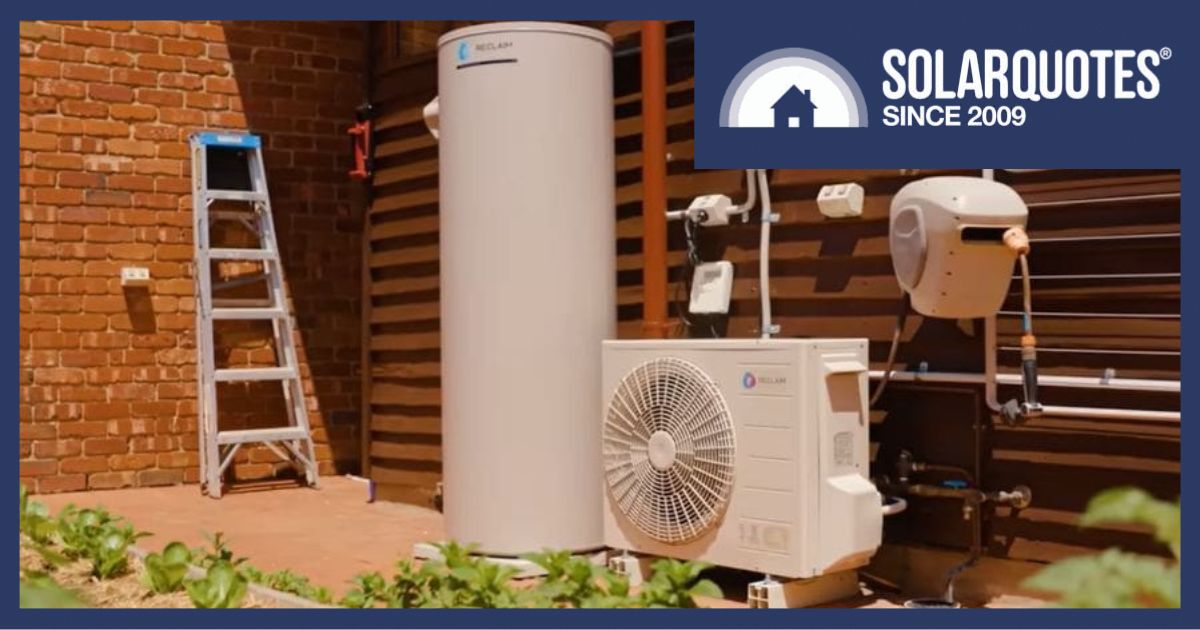
In the colder months of the year, your heat pump hot water system may need adjusting.
Heat pump hot water systems are highly efficient because they don’t generate heat in the same way as traditional electric hot water systems. Instead, they draw heat from the surrounding air and transfer it into the water.
Give The Heat Pump More Time to Run
We can think of the heat in the air as the heat pump’s fuel. When the air is warmer, there is more available heat, and the heat pump can produce hot water easily. As the temperature drops, less heat is available, and the system has to work harder and longer. This is why the settings that work well during warmer months may not be ideal during the colder ones.
One of the first things to consider is the operating timer.
A common setting for the heat pump to operate is between 11 am and 3 pm. We set up heat pumps to run during the middle of the day to leverage more heat in the air, as well as cheaper and greener electricity.
During warmer months, this may provide plenty of time for the unit to heat the water.
In winter, however, the water may take longer to heat. A four-hour window may not always be long enough for the heat pump to complete its heating cycle, particularly after heavy hot water use.
A simple first step is to lengthen the operating window. A few weeks back, I noticed my heat pump was still working at around 4 pm, just before it was supposed to turn off. I checked it and noticed the temperature hadn’t quite hit the target of 60 degrees. I lengthened the timer to come on 1 hour earlier, 10 am instead of 11 am.
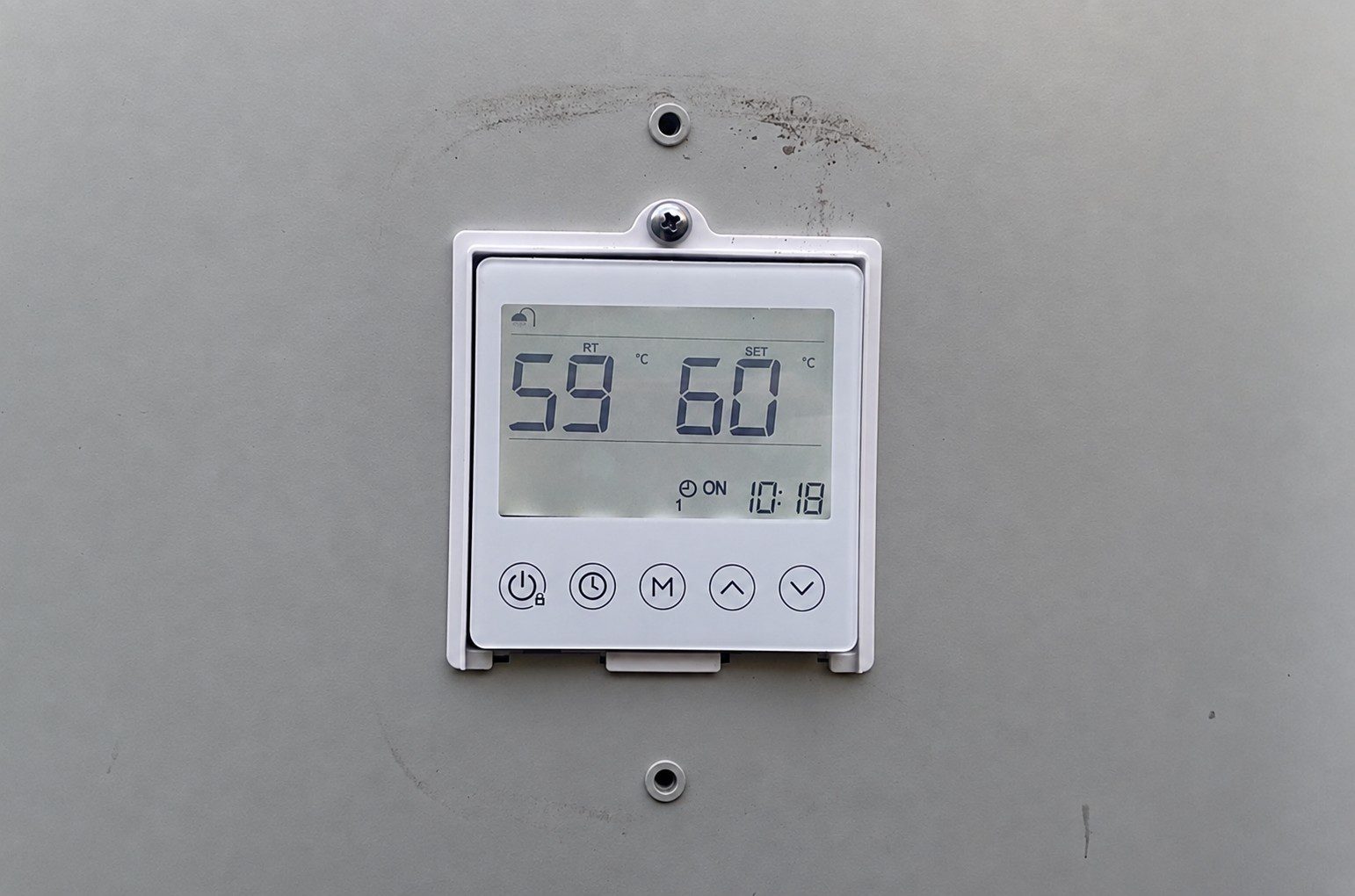
This doesn’t necessarily mean the heat pump will run continuously for six hours. It simply gives the system a larger window to hit the target temperature (usually 60 degrees). Whether it works for one hour or six hours will mostly depend on how much hot water I used the day before.
Cold Winter Nights
Heat pumps generally don’t perform as well when outdoor temperatures are very low. In places such as Melbourne, Canberra and Hobart, overnight temperatures can fall into the low single digits during the cold season.
At these temperatures, some heat pump hot water systems can run for a very long time without producing hot water as effectively as they would during warmer parts of the day.
This can create a problem if the system is restricted to a short daytime timer. If we use a short timer and too much water is used outside of the timer hours, the unit will run out of hot water. It will only kick in when the timer is set to restart the next day.
The most logical solution here is to extend the timer again, let’s say from 8 am to 8 pm.
Again, this doesn’t mean the unit will necessarily run for 12 hours. It means it has access to the warmer parts of the day and has plenty of time to replenish the hot water supply.
But there’s still a risk that too much water is used outside these hours, leaving someone with a cold shower in the morning.
The Backup Heating Element
Some heat pump hot water systems also have a traditional electric heating element for backup or to raise the temperature of the stored water.
If you heat the stored water to a higher temperature, you effectively have more usable hot water stored in the tank. This hotter water in the tank can then be mixed with colder water from the tap. This increases the volume of usable hot water in your tank because you’re using less hot water to wash your hands.
This can be particularly useful when you want to make sure there is enough hot water available outside the heat pump’s operating hours.
For example, the system could use the heat pump in the middle of the day and, where appropriate, use the electric element to further heat the tank during periods of excess solar generation or other low-cost/free electricity.
This can be a sensible way of storing energy as hot water.
The goal is to have plenty of hot water available when the heat pump isn’t operating, such as early in the morning or later at night, all without unnecessarily relying on expensive electricity.
Of course, the exact settings and whether to use the backup element will depend on the specific system and your electricity tariff.
Think About The Seasons
Many homeowners want to set their hot water system once and forget about it. That’s understandable.
However, for those of us who are more focused on efficiency, there is a good argument for having two basic settings:
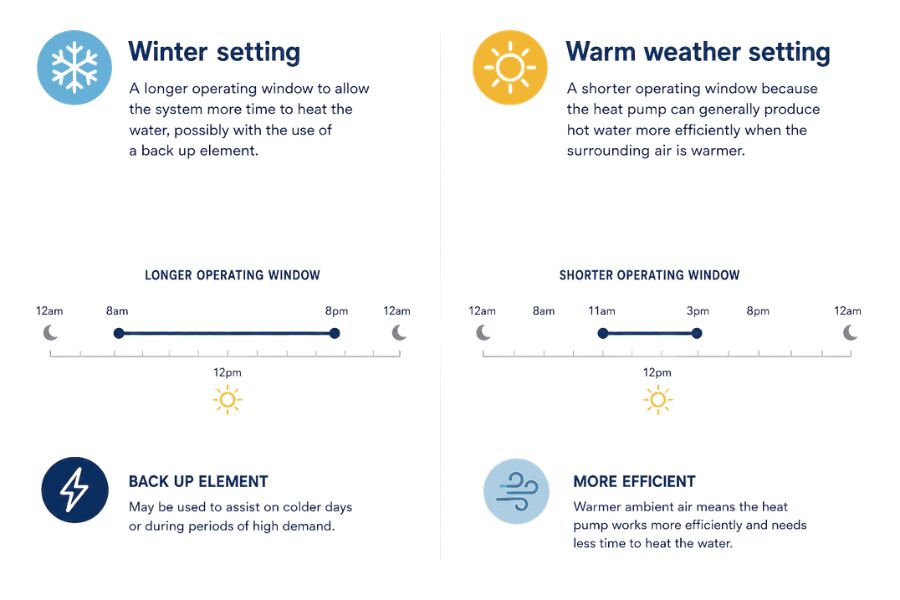
Heat pump settings for the colder months vs. the warmer ones.
When spring arrives, and the weather starts to warm up, it’s worth resetting the timer rather than leaving the winter setting in place all year round.
The Simple Winter Adjustment
If you have a heat pump hot water system, the most important thing to remember as winter arrives is this: cold weather usually means your heat pump takes longer to heat your water.
Before you assume there is something wrong with the system, please check the operating timer.
If you currently have a short window, such as 11 am – 3 pm, consider extending it to 10 am – 4 pm. If you’re in a particularly cold climate or the system struggles to recover after overnight use, a much longer window, such as 8 am – 8 pm, may be appropriate.
Then, when the weather warms up again, review the settings and return to a shorter operating window.
For more, read our detailed guide to hot water heat pumps.
 About Tim Johnston
 RSS - Posts





What works for us is a 10am-4pm timer all year round, heating to 65 degrees. But in winter, pairing this with a morning timer from 630-730am.
Otherwise in winter we can run out of hot water in the mornings if there is lots of evening usage and the other factor to consider is the system loses more heat overnight in winter.
The extra morning timer costs around 10c a day and barely uses 0.5kw.
We have an Aquatech X8. Highly recommend a heat pump HWS with a back up heating element for the higher temperature settings.
Hi Paul, I’d question whether you need to heat to 65 degrees in summer. The Dynamic X8 uses the backup element to heat from 60 to 65 degrees, so it’d be worth changing this to standard mode during the warmer months, see whether that gives you enough hot water and save a few extra kWs.
In this time of large solar arrays and home batteries this almost seems like another argument against heat pump hot water heaters in some circumstances. I am building and need two water heaters. As mentioned in the recent awards post for heat pumps that would cost me $6000 or more installed after any rebates. Probably more as I am not sure if rebates apply as I am building.
Two resistive hot water systems would cost only about $2,500 installed. Bear in mind I will have a plumber onsite anyway. I have good solar already and will add more plus a battery when the house is complete. Although I live in a warmer area than down south I still get plenty of single digit temps overnight in winter. While most it is just me at times I will have a full house.
The economic argument just doesn’t stand up in my situation and I definitely don’t want to run out of hot water or have to manage its use carefully.
Yes, Patrick, I agree. Heat pumps made good sense when you were importing energy from the grid to heat the water. But now it is more debatable (and maybe not economic).
I have a small solar array and a Catch Green unit that diverts excess solar to my resistive hot water tank. So the tank is basically acting as a battery. It will also top up at night with off-peak if necessary but I probably only need to do this a month or two in winter, and I mostly have that feature turned off.
It’s nice to be using my excess solar to heat my water, rather than getting a meagre FIT.
Same here but because I’ve got more solar than you my green catch is set on solar only and always still got heaps of hot water !!
I hope you have considered your long term running costs especially with 2 units at a possible (2×3.3kW) combined load.
My 1kW Istore heatpump is easily covered by solar on 99% of days, I know for damn sure the old electric was often pulling from grid in winter.
I have mine monitored, and even with some days of -1 degree mornings and 15 degree max its never peaked over 3.5kWh. Using in the order of 160L water 2.5kWh would be average for this winter.
Hey Darren,
How do you monitor your iStore? Mine doesn’t have WiFi.
Why wouldn’t I just run it 24hrs a day and let the device decide when it needs to heat the water?
How many kWh per day do these units used in Winter? And what would be the effect/difference if it ran all day rather than a window
It’s all about optimisation Andrew. If you can run the unit during the hotter part of the day, I’d argue your unit won’t have to work as hard and it might last longer. You can of course run it all day though if you want to set and forget.
Andrew,
Heating 250 L of water from 20°C to 60°C required 11.6 kWh of heat energy.
Given a heat pump, you can divide that by its COP, perhaps 3.5 in warm weather, less when it’s cold.
Here, I only enable the HWS when there’s some sun, to avoid draining the battery for hot water – that’s too entropic a process for my liking, and not a great idea if the battery is modest.
Andrew B: – “Why wouldn’t I just run it 24hrs a day and let the device decide when it needs to heat the water?”
My Sanden Heat Pump + 250 L tank unit requires electrical power 24/7 but spends most of the time on standby. The unit is programmed to run daily from 10am (standard time) through to 3pm, but usually stops running sooner because the tank is fully charged. Observed run times are typically:
1½ – 2¼ hours in summer
3½ – 4½ hours in winter
~20 minutes when water inlet temperature at heat pump unit drops below ~3 °C (anti-freeze cycle)
Heat pump efficiencies:
https://www.solarquotes.com.au/blog/heat-pumps-win-the-hot-water-efficiency-war/#comment-1727052
There’s a backup for the system clock & blockout timer settings (for 48+ hours) should power blackouts occur. Never had blackouts that long so far.
The nominal water temperature setting delivered directly from the Sanden Eco Plus Heat Pump unit is 63 °C.
https://www.sanden-hot-water.com.au/specifications/
If you have a decent sized battery, that is exactly what you do – just let it heat when it wants to. I already do that with my resistive system, and will continue to do that when i get around to installing a heat pump in the next year or two.
Hi Andrew,
I know plenty of people like to keep it simple but we have to remember that batteries have a warranted life. I’m always a little hesitant to wear them out “charging” a big dumb thermal battery when the warranted cost per kWh might be 50c. Batteries are cheap at the moment because of incentives, but right now they also cost $7/kilo to dispose of. Heat pumps are a winner.
yeah, a heat pump will be going in when i get the pennies together.
Nice when you have enough battery. I am in Canberrrra. Up till August I wasn’t fully charging the (20kWh) battery daily. So I would be drawing from the grid if the HWS decided to switch on (250litre resistive). So I have a wifi timer that I usually set to switch the heater on around 10:30AM. Even with a low battery, any solar energy (think cloudy day) goes into the HWS as a priority. Even with only about 1 – 2 kW off the panels, that offsets the power the HWS needs.
But from August onwards there’s enough solar for both, depending on cloud cover. I do adjust the wifi HWS timer if the weatherman says it’s going to be sunny later in the day. No point in drawing grid power in the morning then have good solar later on.
I’m in southern Qld, so both the benefit of a bit better angle, as well as winter being our dry season, so little cloud. Most days i still manage to export 5 kWh or better of power during winter.
doesnt the start time make the difference in efficiencies? i’d probably just let the unit run for many hours after, because if it needs it well,,. it needs it. otherwise it’ll just turn off anyway.
having a heat cycle kick in during the dead of night doesnt make a lot of sense (for the humans, or the efficiencies)
Starting the timer earlier, outside the 3-free-hrs, ensures that you’re always paying for energy, even when the water could have been heated later for free. Isn’t it more economical to extend timing after the 3-free-hrs, as that draws energy only if the free heating did not suffice. (As the thermostat has otherwise cut out.)
Better still, what about a timer on the HWS heater element? Whack that on as well during the 3-free-hrs, then utilisation of grid surplus is also optimised. And you have the hot water faster.
Granted, ample rooftop solar changes the equation, but only on a sunny day, when free self-generation is available. (At 8:30 a.m. here, there’s 100% rooftop solar going into the HWS, aircon, and heatlamps in the bathroom, heating the floor. The HWS, with a 2.4 kW element, is plugged into a GPO, so I can perform the sunny-day override on the way to the kitchen. (Yes, it’s indoors, so lost heat warms the room, not lost at all.)
Thanks Erik. If the unit heats after the 3 hour window and keeps going, it might start creeping into peak load times (eg 5pm). It depends on how much water the unit needs to reheat, but for any system heating a meaningful amount of water it’ll almost always take longer than 3 hours.
The hot water element can work – yes I agree with that approach. Many units don’t work with the heat pump and element at the same time, so they need to be sequentially. Timing will be require a bit of finesse so the element is working during the 3-hour free period.
From what I’ve seen most of the solar sharer deals are pretty shoddy so I imagine most people would be better off on a more balanced plan. Given how long most HPHWS need to run I think many users will struggle to get it all heated in the free time anyway, especially over winter. There’s 4 in our house and it’s not unheard of on a cool day with some long showers for it to take most of the day to completely heat up again. I’d rather the heating start a bit early and it be hot and finished before the pm peak rates hit than start later and still be running in the expensive time of day
I merely set the start time of my system. No end time. This allows the full cycle to complete each day and I don’t have to guess whether its done a full cycle to reduce risks of Legionella. Having said that I have never seen it run past 2pm. But I don’t always check or need to.
The problem with this approach Richard is if you have a shower at 4pm, 6pm or 10pm, the unit will most probably kick in and start reheating to replenish that hot water. Not having an end time is the same as having no timer at all.
I recommend an end time so that the bulk of the reheating is done during the 10am to 4pm sweet spot.
I have one single air to water heat pump as boost to solar hot water tanks of 640 lt storage. Yes I know you get no rebate but that is the system I choose. The system is located in the Victorian high country and supplies hot water for up to 10 persons. In summer the heat pump sits idle for most of the time. The solar tubes do all the work. In winter the heat pump does all the work on the cloudy rainy days. The first timer is set from 11am for three hours to cut out at 59c. If it is a sunny winter day it gives the solar time to do some work. I allow another couple of hours for some more possible sunshine and a second timed schedule runs from 4pm to 8pm to cut in if the temperature is below 45c and to cut out at 55c. This is a big shower window for the property and makes sure there is plenty of hot water for all occupants. The second time schedule only comes on in winter and then only in days without much sunshine.
I was recently inspired by a YouTube video by Matt Ferrell discussing the concept of using a hot water system as a thermal battery. He featured an intelligent heat-pump hot water system developed by Cala Systems in the US, which can optimise water heating and storage based on energy prices, solar generation and predicted hot water demand.
This made me wonder whether it would be possible to use my hot water system in a similar way by storing water at a higher temperature, perhaps around 70–75°C, to increase its thermal storage capacity. However, my Reclaim unit appears to have a maximum temperature limit of around 60°C.
Do you know whether there is a legal maximum storage temperature for residential hot water systems in Australia? Also, if I were to increase the storage temperature beyond the manufacturer’s specified limit, would this create any safety, compliance or warranty issues?
I don’t believe there is any limit to how high you can heat the water. Many heat pumps though will only heat to 60 degrees. Many will then use a back up element to heat beyond 60 degrees, they heat pump can’t heat beyond that limit. I wouldn’t recommend trying to force the issue. While you might get more thermal storage from your hot water unit, it’s just as likely to cause more problems down the track (eg: wearing your heat pump out more quickly).
The in-flue heat exchaner on my woodheater can boil the water in the HWS, though I have never heard it bubbling, perhaps because good room insulation means minimal stoking. A HWS with an “uncontrolled heat source” must be vented to atmosphere, to avoid a boiler explosion. (In the past, such events hurled multi-tonne boilers a kilometer, smashing through the factory roof, and killing people in the process.)
Venting is not optional, so the temperature limit is 100°C. Heating 250 L of water from 20°C to 60°C stores:
250 kg * 4.1813 kJ/(kg K) * 40 K = 11.6 kWh
Taking it to 100°C would double that, but also double the initial heat loss rate, unless some insulation is added, either a wrapping of batts or foam sheet lining of an enclosure, perhaps.
The set and forget works well for me as I have timers on a couple of freezers,…the best option is to have a start time of when you expect your solar (or free hours) to provide all the energy, and then to have it switch off after you expect it has done its job in your worst case scenario. The unit (hot water or freezer) will not draw power then. If you’ve just filled up the freezer or have guest using lots more water then perhaps a manual boost is all that is required to economise your system.
Sounds like a lot of mucking around to me I’ve got solar and a green catch diverter and get real hot water everyday for free and don’t have to do anything !!
Only if you want to overcomplicate things. Personally I just run a simple timer and relay on the meter box. Comes on at about 8:30am and goes off at 4pm. By 8:30 there’s usually enough solar to cover usage and we are all at school/work so the house load is down. Itsusually hot and done by early afternoon ( or earlier) and in the worst case it might run into the first hour of peak rates (3-4pm) but that will still generally be covered by solar. It’s long enough that people will have hot showers ( and I’m generally the last to shower so I’m invested in their being enough for me!) but will only rarely draw on power during peak times. If I really need to ( eg blackout, guests, teenage girls/long showers…)I can just flip the timer off. I find that less complicated that trying to have a sunmer/ winter setting based on a minuscule optimisation oppurtunity. Mental load =0.
When we got our heat pump for our retirement unit we got a bigger storage tank.
The tank and unit is exposed to the sun from noon to sunset.
As a consequence although we set our heat pump to run for 4 hours every afternoon we have never run out of hot water in 4 years
Thanks, I recently figured this out the hard way after I had the system setup in summer running just 11am to 2pm. Turns out this isn’t enough – even for the relatively moderate Brisbane winter – especially if one of us runs the bath.
I now run it 10am to 3pm and that sees it get to 60 (or very close) most days. The is an OmniX 340L I think, decent for the price from what i can tell.
not sure where this guy lives but even at 5C 4 hours is plenty of time for a 1100W input power R290 heart pump to heat 200L from scratch (10C water from the mains). Given that the temperature of ‘cold’ water when taking a shower is ABOVE body temperature you require far less energy than the 200L from scratch example needs…
If I change from gas to a heat pump, the unit will be in the shade all day even though install would be on an outside wall.
What difference would this likely make to the water heating process?
Hi Dave,
A heat pump hot water unit uses refrigeration to pick up heat from the air and transfer it into the tank. It’s the same principle your air conditioning uses.
Imagine a split AC system sucking heat out of your house by blowing indoor air over a coil, that heat is pumped outside (using refrigerant) and another fan & radiator coil blows the heat off into the atmosphere.
For a hot water service, it’s pulling heat from the air, so there’s no need for direct sunshine, just good airflow and some daytime temperature helps.
Get a heat pump with a decent sized motor and it’ll recover quickly without taking hours and hours.