

Western Australia’s government-owned Synergy has an unusual position in the electricity market: it owns some of the state’s biggest batteries, as well as generators selling electricity into the same market.
New analysis has found its batteries sometimes charging at surprisingly high wholesale prices in the middle of the night, helping push those prices even higher. On the one hand, Synergy is paying more to charge its batteries. On the other hand, its generators could benefit from higher wholesale prices.
The prices discussed in this article are wholesale electricity prices. Individual price spikes don’t flow directly through to the regulated tariffs that most WA households and small businesses pay. But persistently higher wholesale costs can ultimately affect the cost of supplying electricity in WA.
When Does Battery Trading Become A Problem?
Normally, batteries make money through a simple strategy: charge when electricity is cheap and discharge when it’s expensive. It’s called energy arbitrage.
Home battery owners can do much the same, particularly with electricity plans that vary in price. The important difference is that your home battery takes the electricity price as given.
Synergy’s batteries are now big enough to help determine that price. WA’s Economic Regulation Authority (ERA) says batteries set the state’s real-time wholesale electricity price during 86% of dispatch intervals in the first half of 2026. This happens more often while charging than discharging.
So Synergy isn’t simply responding to wholesale prices when deciding when to charge. Its batteries can influence the very prices at which its generators sell.
And that’s exactly what a new analysis of Synergy’s alleged battery trading has put under the spotlight.
The Evidence Behind The Concern
Modo Energy analyst Marcus Freese examined an extraordinary period between 1 AM and 2 AM on July 12, when Synergy ramped up its battery charging from 229 MW to 640 MW.
The extra load added roughly a third to electricity demand at the overnight trough, while wholesale prices climbed from around $120/MWh to more than $350/MWh.
Freese found this wasn’t an isolated event.
Across 71 high-price charging days, Synergy’s batteries paid $7.3 million for electricity while Synergy-owned generation earned $18.4 million during those events.
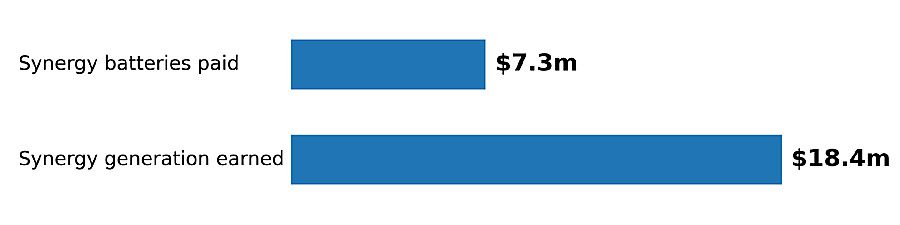
Synergy battery charging costs and generation revenue across 71 high-price charging days. Source: Modo Energy analysis.
Those figures don’t mean Synergy pocketed the $11.1 million difference, nor do they prove the batteries caused all that generation revenue.
They do illustrate the potential portfolio incentive.
“A high charging offer increases the price paid by the battery, but it can also increase the price earned by generation in the same portfolio,” Freese says.
Freese also modelled what would have happened on July 12 if Synergy had charged its batteries differently. He found they could have bought the same amount of electricity while charging more when prices were cheaper, and the peak wholesale price would have been lower.
The Regulator Is Already Looking At The Problem
Interestingly, WA’s electricity market regulator, the ERA, had already identified precisely this potential problem.
Its August 6 discussion paper on the battery market offers says that an operator owning both batteries and generators could have an incentive to submit high-priced charging offers that increase market prices. This could happen even when those prices aren’t justified by the battery’s own costs, opportunity costs, or operating requirements.
It’s not the first time Synergy’s market behaviour has come under scrutiny. In 2022, the Electricity Review Board found Synergy had breached market rules by making generation offers linked to its market power.
The ERA says: “Charging offers should reflect the efficient operation of the individual BESS Facility, not the Market Participant’s portfolio.”
It also warns that portfolio-based behaviour may raise concerns under electricity market rules covering conduct that distorts or manipulates wholesale prices.
None of this establishes that Synergy’s current battery trading has broken any rules.
Freese says market data alone can’t prove why a battery charges at high prices. Batteries may need stored energy to meet future grid obligations, while rapidly changing price forecasts can make apparently strange charging decisions seem perfectly reasonable.
Synergy’s Response
Synergy has not publicly provided a specific explanation for why its batteries were charging during the high-price periods identified in the analysis.
In a statement reported by the ABC, the government-owned retailer instead pointed to batteries being relatively new technology whose capabilities would continue to be monitored and refined, and said they allowed more renewable energy into the system:
“while enhancing system reliability through rapid response to changing system conditions”.
WA Energy Minister Amber-Jade Sanderson also declined to address the specific trading behaviour, instead defending the state’s broader energy strategy:
“We’ve always said that the most reliable and affordable energy mix for the future is renewables backed by batteries and gas.”
She also stressed that regulated households and small businesses are shielded from wholesale price movements.
Batteries Aren’t The Villain Here
Big batteries are already helping WA absorb increasing amounts of renewable energy and smooth out wholesale prices. The issue is what happens when batteries become powerful enough not merely to respond to electricity prices, but to influence them.
That’s particularly uncomfortable when the batteries are government-owned, and their owner also has generators, potentially benefiting from higher wholesale prices.
There may be a perfectly reasonable explanation for Synergy’s charging behaviour. But without one, it’s a lousy look for batteries, which are relied upon to help deliver a cheaper, cleaner electricity system, and it risks undermining confidence in the renewable energy transition.
For more on Australia’s changing energy market, minus the industry jargon, sign up for the free SolarQuotes newsletter.
 About Kim Wainwright
 RSS - Posts






Aren’t they also able to elect to only buy from specific sources?
If so then they’re ultimately only paying themselves to increase the price everyone else pays them.
Nathan, Synergy can have exposure on both sides of the market, but it’s not quite as simple as buying electricity from itself. Other generators and market participants are involved too.
• A-Star Electricity
• Alinta Energy
• Amanda Energy
• Change Energy
• EV Energy
• Kleenheat
• Ocean Reef Renewable Energy (ORRE)
• Peel Renewable Energy
• Perdaman Energy
• Perth Energy
These are all commercial electricity retailers in WA. So, by manipulating the wholesale electricity price higher, Synergy would have made more money from those retailers, right?
Mark – Maybe. Individual retailers’ exposure depends on their contracts and market positions. Other generators can benefit from the higher wholesale price too. The waters are pretty murky.
The WA government needs to maintain public confidence in the new energy system.
Market manipulation leaves the government vulnerable to allegations of corruption which could destroy the social licence for renewables.
This is particularly dangerous territory in WA because of the history of WA inc and because of the isolation of our grid. The next 3 or 4 years are absolutely critical in the transition from fossil fuels and corruption of the energy market is exactly the opposite of what we need.
Maybe the government should run the electricity generation and distribution. Have the system run by engineers rather than lawyers.
There may be other factors to consider here, looking back through my own records the 11 July was one of the few days where my home battery in Perth didn’t fully charge. On the 10th July it reached 100% at 12:55pm and on the 12th it reached 100% at 11:30am, however on the 11th it only got to 96% at 4:50pm. This would have meant less excess solar flowed into the system. Did the miserable weather on the 11th trip the charging algorithm over?