

More battery owners can now take a ride on Amber Electric’s wholesale pricing rollercoaster, with leading battery brand GoodWe integrating with the retailer’s SmartShift technology. It is the second big reveal from Amber in a matter of weeks, after the company announced BYD’s Sealion 7 can now join its vehicle-to-grid (V2G) trial.
Will GoodWe Batteries Work With Amber?
Eligible GoodWe ESA systems are now integrated with Amber’s SmartShift technology, giving households access to the sharp peaks and troughs of wholesale electricity prices, feed-in tariffs and automated battery optimisation.
Homes in NSW, Victoria, SA and South East Queensland with eligible GoodWe ESA battery systems can get involved.
The inclusion applies both to eligible systems that are yet to be installed and to systems that are already up and running, however GoodWe owners should make sure their specific model is eligible.
It comes after a beta testing phase involving more than 350 GoodWe sites.
GoodWe’s latest ESA all-in-one batteries launched last year, with the brand one of the few budget battery offerings to make the grade as a SolarQuotes Recommended Brand.
Dean Williamson, Country Manager for GoodWe Australia and New Zealand, said customers had been pushing for Amber integration for some time.
“Australians have made a significant investment in home energy storage, and they increasingly expect their battery to do more than simply store excess solar. This integration gives eligible GoodWe customers another way to use their system intelligently, respond to real energy market conditions, and potentially unlock greater value from the energy they generate and store,” he said.
BYD Sealion Added To Amber V2G Trial
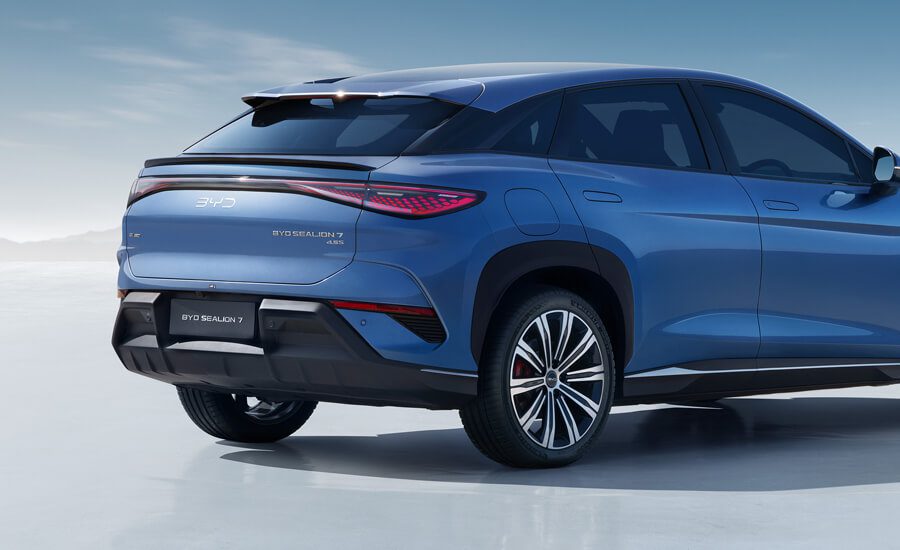
The BYD Sealion 7
It comes as Amber adds BYD’s Sealion 7 to its V2G electric vehicle charging trial, which was previously only open to Atto 3 drivers.
BYD says the Sealion 7 is its top-selling model in Australia, with more than 30,000 sold since its February 2025 launch.
Both Sealion 7 variants have an 82 kWh lithium iron phosphate (LFP) battery, which BYD says leaves “plenty of headroom” for V2G. For a sense of scale, exporting 20 kWh in an evening would use about a quarter of the battery.
The car can already power appliances straight from its battery, a feature called vehicle-to-load (V2L). V2G goes a step further by sending power back to the grid. Our guide to V2G and bidirectional charging explains the difference.
V2G trial members will also get 6% off the base recommended retail price, including GST, on four BYD variants. Here’s what that’s worth:
| Variant | Recommended retail price | 6% discount |
|---|---|---|
| Atto 3 Evo Dynamic | $41,990 | about $2,520 |
| Atto 3 Evo Premium | $46,990 | about $2,820 |
| Sealion 7 Premium | $54,990 | about $3,300 |
| Sealion 7 Performance | $63,990 | about $3,840 |
The offer is listed on Amber’s V2G hub, with no end date given.
There’s a catch though – the discount roughly equates to about the cost of the bidirectional charger you’ll need to participate. Amber says trial members with a BYD can get a subsidised StarCharge charger for $2,990, including a standard single-phase installation. Everyone in the program buys a new charger, even if they already own an eligible BYD.
That holds up on the Sealion 7, with a few hundred dollars to spare. On the Atto 3 Evo, the discount falls about $170-470 short.
Many Australian homes run on single-phase power. If yours runs on three-phase, the installation costs a bit more. To check which you have, SolarQuotes in-house installer Anthony Bennett, a licensed electrician, explains how to tell if you have single, two or three-phase power.
Joining also means becoming an Amber customer on its wholesale plan for at least 12 months. Amber’s subscription costs $25 a month, or $300 a year, on top of what you pay for electricity.
Before you commit, ask Amber and BYD:
- Can the 6% be combined with other BYD offers?
- Do you need a confirmed spot in the trial before you buy?
Offers like this can change, so check the eligibility rules and terms first.
Can You Join The Trial?
Maybe not straight away. Amber is aiming for more than 1,000 V2G homes over the next 18 months, and it says more than 8,000 people are already on the waitlist for its V2G program. Amber has also said spots aren’t handed out on a first-come, first-served basis. It picks participants based on whether their car is compatible and where they live.
The Australian Renewable Energy Agency (ARENA) added $13.6 million to fund the expansion, which we covered when it was announced.
Where you live matters because your local electricity network has to approve any device that exports power to the grid, and some networks move faster than others. Most of the trial’s homes are in New South Wales and South Australia. Amber says Ausgrid, which covers Sydney, the Central Coast, and the Hunter Valley, is the most progressive.
Approval can also take longer if your home already has solar or a battery, because the network has to sign off on another device exporting power alongside it.
Why Other Manufacturers Are Wary
In an interview with SolarQuotes, Amber Electric Head of Business Development Clare Rainbow says vehicle warranties are one of the biggest barriers to V2G in Australia today. Exporting power means extra charging and discharging, and most carmakers don’t yet cover that use under their battery warranties. Without that cover, V2G is a risky bet with an expensive battery.
Asked where the hold-up sits, Rainbow points to carmakers. “It’s with the EV manufacturers,” she says.
So why was BYD first to back Amber’s trial? Rainbow has a theory, and she frames it as one.
“I think they’ve been more progressive because they’re completely vertically integrated. They make their own batteries,” she says.
Many other carmakers buy their batteries from suppliers, which Rainbow says makes them more hesitant.
To be fair to carmakers, their caution isn’t unreasonable. There’s still little long-term data on how EV batteries cope with regular V2G, which is why ARENA says one goal of this trial is to test batteries in real-world conditions.
BYD gets something out of it too. It says the trial gives it real-world data for its development. And a 6% discount gives buyers a reason to pick a BYD over a rival.
Rainbow says Amber is talking to several other carmakers about adding V2G-warrantied models, though some are further off than others.
How Much Can V2G Earn?
Most retailers charge set rates for the electricity you use, sometimes varying by time of day. Amber instead passes on the wholesale market price, which changes every 5 minutes, plus network charges. Power you send back to the grid earns the wholesale price at that moment, too.
Amber’s app tracks those prices. When they spike, it exports power from your car. When they drop, it recharges the car. The car can also run your home in the evening, so you avoid buying power when it costs the most.
Wholesale pricing cuts both ways, though. If you’re drawing power from the grid when prices spike, you pay the spike too, unless your car or home battery covers you. And when prices go negative, as they can on sunny afternoons, exporting solar can cost you money.
On the right day, the results can be impressive. Rainbow says one customer earned hundreds of dollars in a couple of hours during a South Australian heatwave. Most of that came from their BYD, and the rest from their home battery.
That was one customer on a very unusual day. Don’t expect it every week.
Rainbow admits big price spikes are getting rarer. She says the rush of new home batteries is flattening wholesale prices.
“Our current battery customers are very aware of it. They’re like, ‘Hey, I used to get more price spikes,'” Rainbow says. She expects some volatility to return as coal plants retire.
Over a full year, Rainbow says Amber expects customers to save about $2,500 on average. That’s Amber’s estimate, not an audited result, and Amber didn’t say what the saving is measured against.
Our 12-month Amber review covers the pros and cons of wholesale pricing. To compare other ways to earn from your exports, see our guide to virtual power plants.
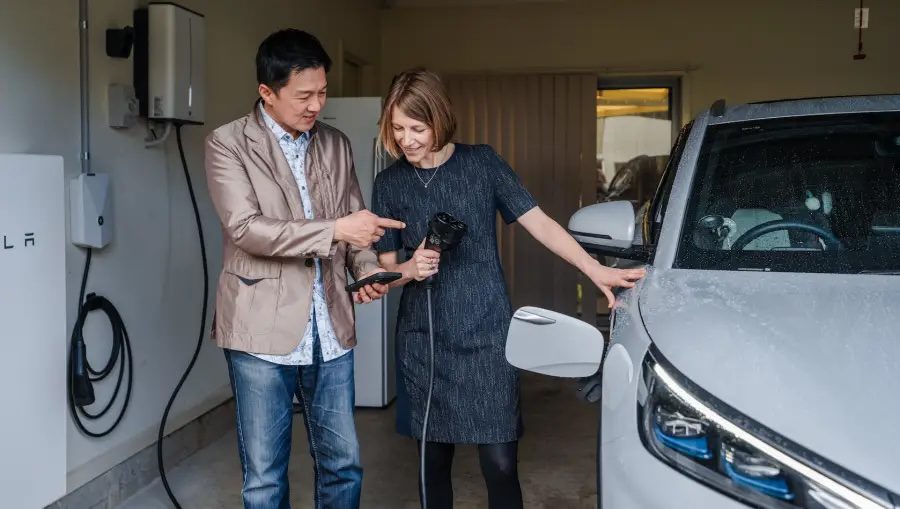
V2G trial participant Ken Chung with Amber Electric Head of Business Development Clare Rainbow.
What If Your Car Isn’t Home?
It’s the obvious question. Evening price spikes often hit while cars are still in a car park at work, or just back home with a low battery.
The short answer: if your car isn’t plugged in when prices spike, it can’t export, and you miss out. That’s why, in Amber’s own figures, the cars that earned the most were the ones plugged in for most of the day.
“Everybody’s scenario is going to be different,” Rainbow says.
To learn how people really use their cars, Amber runs a research program with motoring organisation NRMA and the Institute for Sustainable Futures at the University of Technology Sydney. Trial members keep diaries of when they drive, when they plug in and how they use their solar and batteries.
Rainbow gave two examples of how participants make it work. Some charge for free at work, then use that power at home in the evening. Others let Amber recharge the car cheaply overnight, so it’s ready by morning.
SolarQuotes founder Finn Peacock sees this as a core weakness of V2G.
“A home battery is most useful when it’s always at home. Putting it in the car breaks that,” he writes.
Read his case against V2G before you decide.
Will V2G Wear Out Your Battery?
Batteries wear a little with use. Engineers count that use in charge cycles: one cycle is a full battery’s worth of charging and discharging. V2G adds cycles, so it adds some wear to your car’s most valuable part. The real question is how much.
Nobody knows exactly yet. That uncertainty is part of what this trial is testing.
BYD’s battery warranty still applies to trial members, so using V2G won’t void it. BYD’s standard battery warranty runs for 8 years or 160,000 km, whichever comes first, and guarantees the battery keeps at least 70% of its capacity.
A warranty doesn’t stop wear, though. It only pays out if the battery drops below that 70% within the warranty period. V2G adds charge cycles without adding kilometres, so ask BYD whether trial members’ cover comes with any extra conditions, such as a limit on how much energy you can export.
Finally, there’s the everyday risk of hopping in the car to find less range than you expected. Amber co-CEO Dan Adams says he never wants his own car’s charge to drop below 40%.
If you need a full battery for a morning commute, you want to know it’ll be there.
For more, read our detailed explainer on V2G.
 About Jacob Boyd
 RSS - Posts





Speak Your Mind