
Last week two flaws in PHP went public. PHP is the programming language behind SolarQuotes and a big slice of the web, and these bugs had been sitting in its code for about 14 years. AI models found them. Within 45 minutes of the announcement, Cloudflare was seeing tens of thousands of attempts to exploit them. By that evening it was millions.
PHP doesn’t run the grid. But AI has made finding and weaponising software bugs faster and cheaper, and almost everything between the power station and your toaster now runs on software: the network operator, your retailer, the market operator, and the cloud platform your inverter uses.
Then there’s the weather. The Bureau declared an El Niño in June, and its models have it potentially the strongest on record. Heat, fire and the storms that follow are what take out power to homes for days.
Put the two together, and I reckon the chance of a serious, multi-day disruption to Australian electricity has gone from fairly unlikely to reasonably likely. And it won’t get better as AI improves and CO2 keeps climbing.
The Poms Have Been Told To Stock Up
Last Thursday, the UK government published guidance asking every household to buy bottled water, non-perishable food, a torch and batteries, a radio, blankets, copies of important documents, and cash.
I think that’s smart, and you don’t need to panic buy. Every time you go shopping, drop a few extra non-perishables into the trolley, get $50 cash out and put it under the mattress.
None of that makes you a prepper.
When Did Backup Get Uncool?
Now think about your electricity supply. Somewhere in Australia’s battery boom, worrying about backup became almost uncool. The conversation moved to bill savings, VPP payments and tariff tricks, and blackout protection got treated as an optional extra for nervous types.
So plenty of people have ended up with a cheap and cheerful system that has no backup at all, or backup that was badly designed. And with the el-cheapo installers, it’s rarely tested before the van leaves the driveway.
We hear too many stories where the backup’s first test is the first real blackout, and it fails. Some owners discover their “backup” needs someone to flick a manual switch in the switchboard, in the dark. Others discover the battery won’t run the aircon after dark. Either way, they find out at the worst possible moment.
In this threat-heavy environment, I think you’re nuts to invest in solar and batteries and not have backup that’s robust, tested and well understood.
“But I Never Get Blackouts”
I can hear the comments already. “It’s not worth the extra cash. I never get blackouts.”
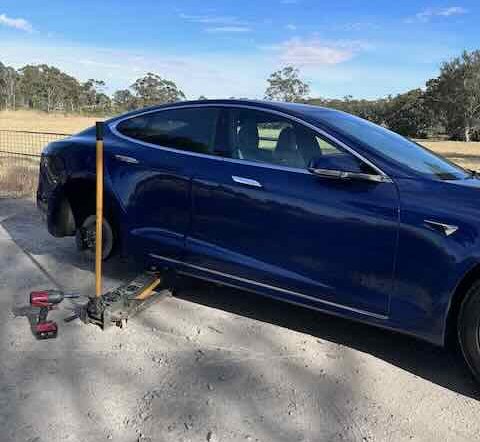
Which reminds me of an idiot with a Tesla who’d never had a flat, so never bothered buying a spare tyre. You can guess what happened next. A flat in the Clare Valley, a night in a cheap motel, and a long wait for the local tyre place to open. Luckily, I had my bike in the car, so I could cycle to the nearest accomodation.
Tesla’s so-called roadside assist was useless. “It’s a Sunday!” “You’re a long way from Adelaide!” Serves me right for waiting until I needed the backup to test it, I suppose.
Years without a flat told me nothing about that particular trip. A decade of reliable grid supply tells you about the last decade’s weather and the last decade’s hackers, and this summer is shaping up with a nastier set of both.
What To Do About It
Yet to buy a battery? Go with an installer who is competent enough to design and install backup properly, tests it before they leave, and can tell you what it will run and for how long.
Already have a battery but never tested the backup? Now’s the time.
Did your retailer talk you out of backup? I think that was terrible advice. They’re using a history of good luck as evidence that bad luck won’t happen. Get a quote to add backup.
Partial Backup? Have A Plan For Dead Circuits
Partial backup is common and perfectly fine, as long as you know which circuits go dark and have a cheap alternative for each one.
- Induction cooktop not backed up? Keep a portable induction unit in the cupboard. IKEA’s TILLREDA is about $50.
- Oven not backed up? An air fryer on a backed-up power point will handle most of what the oven does.
- EV charger not on the backup circuit? Make sure you’ve got a portable trickle charger that plugs into a normal power point.
Whole-Home Backup? Know Your kW From Your kWh
Whole-home backup means everything can run. How long it can run is another matter.
Two numbers matter. kW is how hard your appliances pull at any moment, and your inverter has a ceiling. kWh is a measure of how much energy the battery holds. Big loads hit both: they can trip the inverter, and they empty the tank fast.
So when the grid drops, switch off the pool pump. Keep a close eye on big aircons. Switch the EV charger off, unless it’s set to charge on solar only.
That leaves the battery to do its real job in an outage: keeping the fridge cold, the lights on, and the internet up until the sun comes back.
One more catch for three-phase homes. Some three-phase inverters can only put a third of their output on each phase, so one big single-phase load can trip the backup even when the total looks fine. I covered that here.
Make It A Conscious Choice
I’m not a doomsday prepper. I’m fairly optimistic about the future.
But if you’ve invested in solar and a battery and you choose to forgo backup insurance because “long outages never happen”, that’s your call. Just make sure it’s a conscious one.
And make sure you’re happy explaining it to your family when they’re sitting in a hot, dark house for hours or days, with a big shiny battery on the wall and a load of solar panels on the roof.
Phase Shift is a weekly opinion column by SolarQuotes founder Finn Peacock. Subscribe to SolarQuotes’ free newsletter to get it emailed to your inbox each week along with our other home electrification coverage.
 About Finn Peacock
 RSS - Posts





We are currently living in a rental house while we build our new house in regional NSW. We experienced our first blackout (90min) since 2018 last month caused by a thunderstorm.
Prior to moving we had 10kW of solar with 10kWh of battery with UPS auto switch (65ms) and EV charger. Our new house is having a similar system installed with 25kWh of battery installed. Having blackout protection is really useful in any solar/battery system.
A few years ago, our street in the Dandenongs was without power for 5 weeks, I missed out on the generators shipped in from NSW after a Victorian sell-out. It was cold, but a wood heater, and a camping stove for fried eggs & hot coffee saved our bacon. And a couple of decades ago, 1 km of power lines were down in (and on) that street, again due to storms. Three SEC trucks were there for days.
Here, off-grid, an ample battery runs a couple of small split-system aircons all night when it’s hot. Half a BEV charge works too, when home late. Even when it takes time to build up, self-sufficiency is a resilience which will pay off, this decade or next.
My brother, on-grid, made throwing the grid isolator a system commissioning requirement. Avoid a modern inverter generator as backup for a Victron system. It may not sync up, due to harmonics. A simple low tech alternator works better. (No, an AC line filter didn’t help.)
Chocolate keeps well in the fridge … if out of sight.
The Daily Niño 3.4 (OISSTv2.1) was at +3.47 °C, & the 30-day mean was at +3.31 °C, as of 24 Oct 2026. A “super” El Niño is ongoing, forecast to peak near +4.0 °C in Dec 2026.
https://dashboard.theclimatebrink.com/#enso
The 2026 super El Niño is now the strongest El Niño on the instrumental record, having already surpassed previous historical benchmarks, exceeding the prior +3.08 °C record set in Nov 2015.
Berkeley Earth’s September 2026 Temperature Update, published 22 Oct 2026, included:
https://berkeleyearth.org/september-2026-temperature-update/
Finn, as you have a Powerwall 2 do you know if the actual Powerwall 2 battery charges during sunny periods if the grid is down? I noticed that our Powerwall 2 was not charging during g and all day outage for local grid maintenance. I asked Tesla about this and got no satisfactory answers although along the way I did numerous observations and “tests” at their direction.
In the end I found a local company experienced with Powerwall 2 installations and was told that what I had observed was in fact normal.
Can you add anything to my observations and is this really “normal’.
We live in regional NSW. When we moved here we asked the previous owners about blackouts. They insisted they were rare: definitely incorrect. When we had solar installed (no batteries), we also had a changeover switch installed and bought a large inverter generator. Some of the best $$$ spent since we moved here. Suffice to say, our power backup system has been well used. In a blackout, we can have the whole house powered in about 5 minutes.
My partner works for a state-owned electricity infrastructure company and regularly speaks to customers who have life-supporting medical equipment, but no power backup whatsoever. It astounds me that these people can be so short sighted. Even the simplest, crappiest inverter/generator will give them some form of backup power if they need to, for example, run oxygen therapy devices. Crying foul and trying to make the problem someone else’s seems to be their option of choice. Boggles my mind.