
Are Australian switchboards suitable for home electrification? Yes. Are some of them going to blow up as loads increase? Also yes.
Read on as we spell out a cautionary tale and some solid advice to minimise the risk of your lights going out.
What Happens To Overloaded Cables?
Generally speaking, power supplied to the average house from the grid comes via an underground conduit or overhead cable. At some point in the circuit there must be a fuse or circuit breaker to protect the wiring from any potential overload.
Whether you’ve gone for a spectacular result by driving a garden fork through the main supply cable, or tried the slow burn approach of charging two EVs and a roast meal, overloading a cable is dangerous. Excess current creates excess heat, which either melts cables quickly or fries them to a crisp.
If it goes on long enough, then insulation fails and things go exponentially pear shaped. Think of it like fireworks as a precursor to burning down your house.
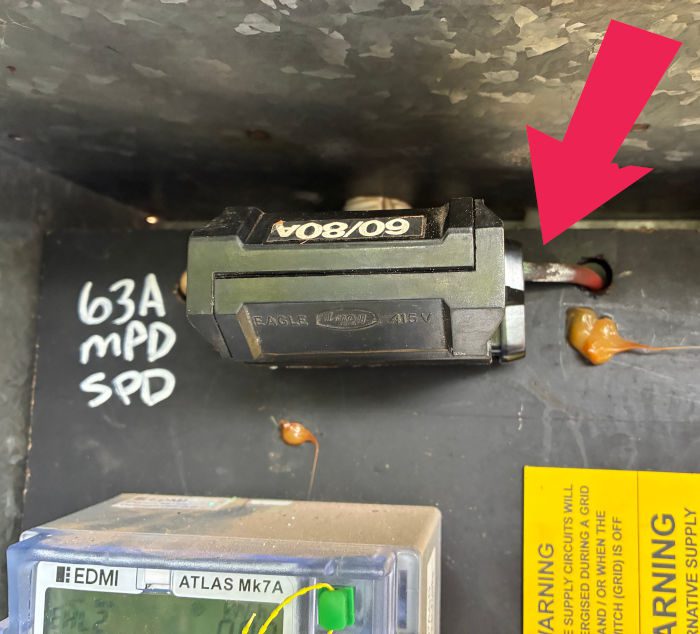
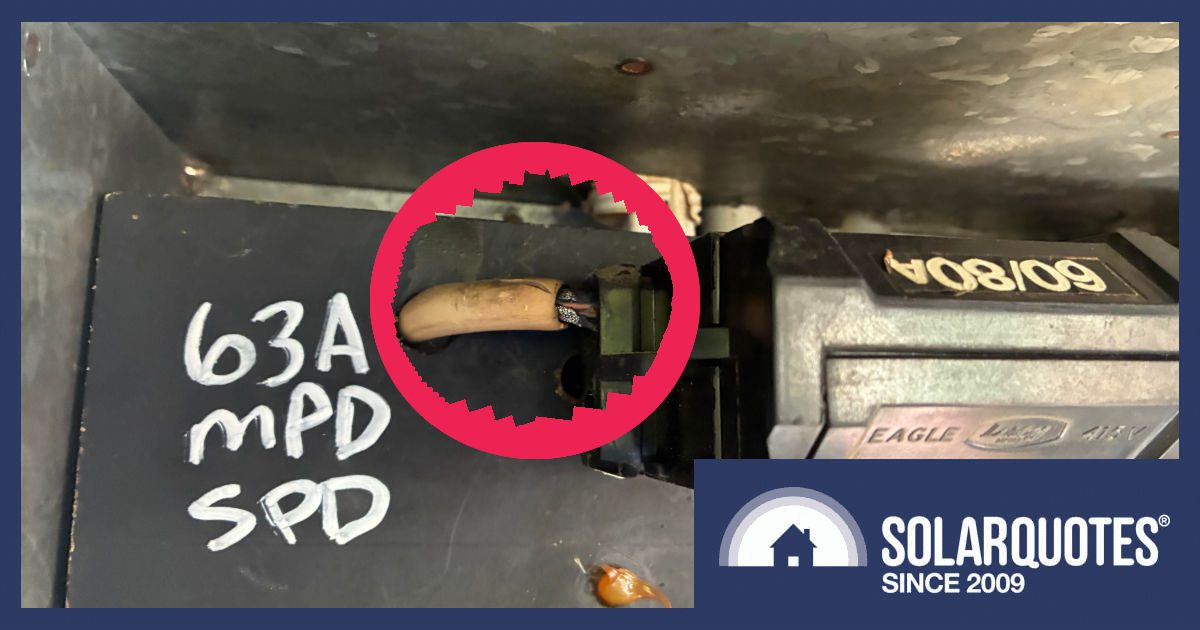
Telltale discolouration and crumbling of the main supply cable shows the poor connection inside the service fuse holder has been overheating for some time.
Service Fuses Protect You And The Grid
I’ve seen firsthand when an overhead mains cable has been overloaded because the neighbour once rang me to ask if the lights in my house were flickering.
When I came out the front I witnessed two things: my petrified neighbour tearing off in his car, while the cable hanging from the power pole to the house was dripping plastic and throwing off increasingly large sparks.
The low voltage mains have an incredible capacity to deliver, and without a fuse in line, they’ll maintain an amazing show. Once you’ve melted or burnt off the insulation, the sparks melt the copper or aluminium conductor, like welding in reverse, and eventually it falls to the ground, throwing more sparks at it lands on and electrifies the chain mesh fence.
Once the exciting part had died down, I rang the network people and got them around to make things safe and fix everything up.
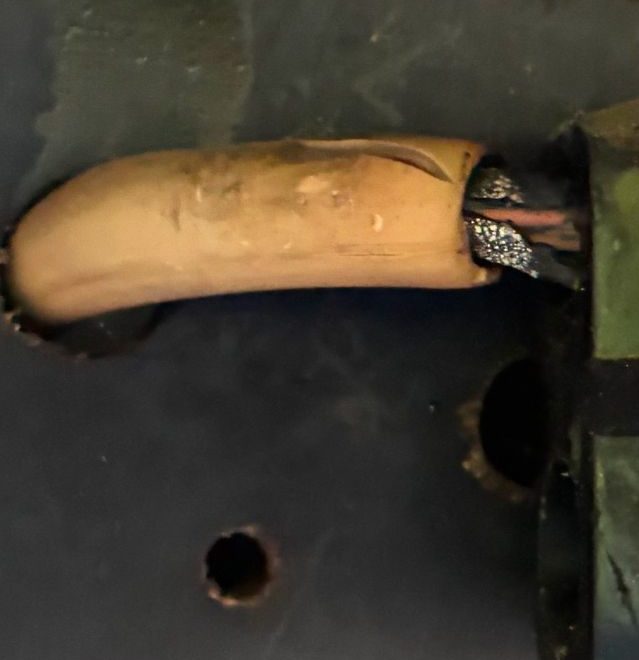
The white sheath has pulled back while the primary insulation is cooked, crumbling and exposing the wires. Corrosion on the copper conductor tells us this has been ongoing for some time, but either way this is EXPOSED LIVE PARTS ready to electrocute the unwary.
This Wouldn’t Happen Everywhere
There’s 17+ Distribution Network Service Providers (DNSPs) in Australia and they all have slightly differing rules about their connection to you the consumer.
Generally speaking the national electricity rules administered by the Australian Energy Regulator tell us that the service fuse is the demarcation between us and them.
Poles and wires upstream of the service fuse are owned and maintained by the DNSP.
Most things downstream of the service fuse are customer owned.
Where it gets tricky is that the retailers own the meter, however that piece of wire downstream of the service fuse, but upstream of the meter, it’s customer owned but also the responsibility of the DNSP.
I know this because I’ve asked the AER about whether I’m allowed to cut that wire and install a Fronius solar smart meter. Clutching their rosaries, the DNSP people exclaimed NO! but the AER said it would be easiest to bribe the retailer metering technician to install the meter I wanted, despite the DNSP objections.
What’s it got to do with you? Well in some instances, the service fuse is on the power pole or screwed to the fascia of your house.
For underground supplies, it might be hiding under a green pit cover in your front yard.
In these images, the service fuse is mounted inside the switchboard, typical of an older underground supply.
In any case, it might be worth keeping an eye out if you have an increasingly electric home.
The Story Goes
Thanks for this story must go to a regular contributor to our comments section on the blog. The images and the background explaining them lobbed in my inbox recently and I figured it’s well worth reporting:
Hi Anthony
We had a bit of an ‘oops’ solar-related thing happen yesterday which I’m told isn’t that uncommon (which in itself is also scary). I was charging the home batteries and EV in the middle of the day using a combination of grid and solar. Probably around the maximum load the single phase/63A house would normally allow (it was pretty cloudy).Then suddenly I could smell smoke. We found the source, the main service fuse to the property was smoking. You can see the charred cables going into and out of it.
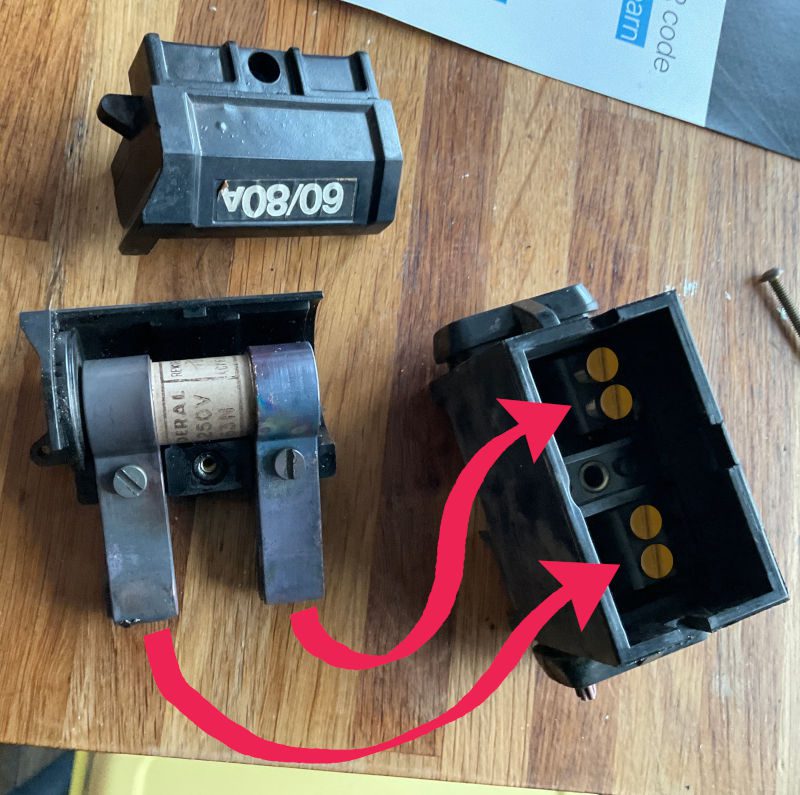
We quickly switched off all grid load and then miraculously managed to find a Level 2 sparky to come and look and replace the fuse, on a Sunday afternoon. The fuse hadn’t blown, the problem apparently was those metal clips holding the fuse in place, with the screws, which had become loose and the current had likely been arcing due to that loose connection. The sparky said the fuse would have blown if it had been a load issue, the problem was the loose connection.Ours is an old house and this was an old fuse unit. The rest of the switchboard is all new switches/gear. But it made me wonder how often that main fuse is checked by installers, our installers are one of the best in the country, so I wouldn’t fault them. But this was potentially dangerous.CheersThe pins arrowed plug into the fuse holder, but they should be a clean nickel silver, not burnt blue. The screws we’ve shaded yellow for clarity are the ones which should be tightened as a matter of course.
Don’t Panic
Charging an EV at a full 7kW, plus topping up your house battery and running the air conditioning could run a standard 63A single phase supply flat out. It’s rated for the job and will work reliably, provided all the connections are in good order.
What we’re seeing in these pictures isn’t ideal, but it’s more or less the system working as intended. Fuses and circuit breakers are basically the weak link, designed to fail when things go wrong. Obviously this particular mode of failure isn’t ideal but it’s not burning down houses every week.
After decades of service and thousands of heat cycles, a screwed connection can relax. Once it gets a little loose, and a little corrosion creeps in, things can go from good to bad to worse in pretty short order.
As EVs proliferate then this problem will become more common, mainly because charging an EV has little diversity. It’s full load, full time, so there’s no throttling like an air conditioner or cycling on and off like the simmerstat on a stove.
When you have a switchboard upgrade, or more importantly when the retailer gives you a new smart meter, it’s worth asking about the service fuse. When they change meters, the metering technician should at least tighten the screws on the service fuse.
 About Anthony Bennett
 RSS - Posts





Re your comment about whose issue it is re wiring before the service fuse. Here in nsw, when one of the two phase lines fell down from the street pole to our scout hall, ausgrid said it was our problem to fix. We had to get a level 2 to fix ar a cost of. $1100
Anthony, regarding your comment about installing a Fronius Energy meter, I feel this is a good reason why consumers should have an easily accessible means of directly reading their energy meter in real time. Why is this not available until 2028 (& then if you upgrade your meter!)
There should be a way that consumers can access real time data from their energy meter that can then be used by inverters & other control equipment inc humans to know exactly what is being consumed/supplied at any time. This interface should be non-contact, so Zigbee (Vic & SA), or via the optical port for other states. The Optical port can be read by a cheap reader but requires the meter to be configured for access by the meter owner. nb: The DNSP can easily remove this reader so the Optical port can be used, then the reader re-installed after.
I feel as an interested group, there could be pressure applied to the relevant authorities to enable this real time meter access earlier than 2028.
If its like here with Ergon it may also be them trying to avoid their responsibilities.
We had to pay for a new overhead line despite having warned them multiple times that it was far too tight (they cut corners on crossing the road to power a council property over the road so the pole moves and cant be anchored too well where it is).
It shocked the tech when ergon decided to just say they weren’t paying and there’s not really any practical way to dispute it.
You were very lucky finding the electrician. Last November the storms blew down trees which ripped the powerline down between the street and my pole on my land.
Here in SE Qld Energex own the system to the top of your private pole.
It took Energex 6 days to come and put the powerline back up, then they hit me with a notice requiring me to have the line and fixings on the pole inspected, but at least they did turn the power back on in the interim.
I couldn’t find a level 2 electrician to come and do the work on my pole until mid February. Then he was here for all of 2 hours, replaced the conduit and the power cable fixing on top of the pole and left, my wallet $800 lighter.
A few years ago, my sister-in-law suffered a burnt out 200m long underground supply cable, where the supply fuse was on the pole out on the road. Expensive – digging and all. I advised her to claim it as “fire” (for which she was covered) on her insurance, as the insulation had burnt. Much expense shifted off her shoulders. (Electrical insurance is often limited to “burnt out motors” or similar.)
Even a new installation can cook due to the higher resistance of loose connections. My installer forgot to tighten one lug screw on the battery isolator. High current not only melted cable insulation, but discoloured the plating on the screw and terminal. We replaced the isolator, as internal damage was unknown. It was the moderate “burning plastic” odour of the cooking cable insulation which raised the alarm. (So listen to your nose, around electricals, rather than wait for smoke and flames.)
Double the current = 4 times the resistive heating, triple => 9 times, so it can be sudden.
I think ausgrid took advantage of you surely? You must be missing some information here.
So that would mean anyone on the street (in NSW) who interferes / damages the wire from the street pole to your building you are responsible for?
Yep. They are actively shirking as much responsibility as they can- I recently had to install a private pole despite there being a public pole which I was currently connected to when getting a switchboard upgrade. So so dumb.
Here in NZ, when I got batteries added to my. Solar the installers without asking put a 64 kVA RCBO after my meter. To avoid the issue of ever blowing the pole fuse.
It’s tripped twice both times when the batteries and car were charging at same time (software glitch – as normally the two are kept separate in time so are never both charging at once).
In theory battery detects the car charging current and adjusts it’s draw accordingly – but the two times it tripped it didn’t do that – but I’ve watched seen it do so other times.
That little device has saved the local lines company replacing the pole fuse which is across the road at the top of a wooden pole.
Mind you I had reported low voltage (out of tolerance voltage) to them in the early days and they checked and did replace the pole fuse as they said it had some corrosion. That reduced the voltage sag under full load which is good as it’s less wasted power – mind you it’s losses before my meter. So not something I’m charged for.
Fuses when operated near their rated current get hot. So the fuseholder needs to dissipate that heat, and the wiring also helps to get the heat away. I had to increase the fuse rating, to reduce the temperature rise during summer conditions. And yes fuses wear out over time. I recently replaced the old fuseholder for the new NH00 type, as required in the new regulations in Spain.
Not according to AusGrid. The property owner’s responsibility begins at the first cable connection point on the owner’s property. If the supply cable from the street pole is aerial, then the property owner’s responsibility begins at the point where the supply cable connects to either the first private pole on the owner’s property, or directly from the street to the first connection point to a building on the owner’s property.
https://www.ausgrid.com.au/In-your-community/Bushfire-prevention/Private-poles-and-powerlines
AusNet is similar: https://www.ausnetservices.com.au/-/media/project/ausnet/corporate-website/files/safety/private-electric-lines/private-electric-lines—your-responsibilties.pdf?rev=492d17d0b8894e7796ba197be72c69c9&hash=F53011DD05B886F48BE9DF83EAE20530
Yep , you are correct . I had a problem with my incoming aerials being snagged by neighbours trees . The old rules were that aerials could bisect neighbours property , however new rules require a pole or point of attachment on property involved at or near the boundary to avoid this situation . Ausgrid initially refused to trim said trees due to them being on private property . Being a retired electrician I pushed Ausgrid to overcome this situation , which they eventually agreed to via a “Flying Fox “ aerial connection . If I didn’t know my rights a dangerous situation of possibly live broken aerials on the ground was resolved . Ausgrid try to get out of their responsibilities until they realise the implications .
Yep the service blew the first time the new battery was charging. Despite the breaker at 63A, the service fuse was the original and found to be 45A! I have a CES that mentions 80A from nearly a decade ago after an upgrade and rewire, so lots of finger pointing now.
An old house is likely to have old parts and while a switchboard upgrade is pretty much needed every time the access panel is opened, somehow the service fuse question or main supply in, isn’t always looked at.