
Rooftop solar panels just got another power bump. Several new high-output modules from Chinese manufacturer Aiko have appeared on Australia’s Clean Energy Council approved list, with residential panels ranging from 535 W to 550 W — potentially allowing homeowners to install larger systems on the same roof without adding more panels.
Up to now, the standard for most Australian rooftops has typically been around 400–450 W, but the new approvals give installers the option to offer significantly more powerful panels in a similar footprint.
What Panels Were Actually Approved?
The new listings come from Zhejiang Aiko Solar Technology Co Ltd, the manufacturer behind the Aiko brand. They appeared on the CEC list in mid-March 2026, with approval dates of the 10th and 13th of March.
Several models were approved, but the residential ones most relevant to homeowners fall into Aiko’s MCE60 series. The MCE60 designation refers to a 60-cell module format commonly used in residential rooftops. Key models include:
- AIKO-A535-MCE60Mw
- AIKO-A540-MCE60Db (dual-glass, full black)
- AIKO-A545-MCE60Mw
- AIKO-A545-MCE60Db (dual-glass, full black)
- AIKO-A550-MCE60Mw
Variants with slightly different suffixes indicate frame, glass, or aesthetic differences rather than major electrical changes. These panels correspond to Aiko’s Gen 3 Neostar ABC 60-cell line, which the company says delivers world-leading efficiency for its class.
Key Features Of These Panels
The key difference is higher power output from a standard residential panel footprint. According to Aiko’s Gen 3 ABC 60-cell information, the key specs are:
- Power range: 535 W – 550 W
- Module efficiency: up to 25%
- Dimensions: 1954 × 1134 × 30 mm
This footprint is typical for modern high-power panels, meaning the extra power comes from higher-efficiency N-type ABC (All Back Contact) cells, rather than dramatically larger modules.
ABC technology includes Zero-Gap cell layout, Invisi-Ribbon interconnection, and a grid-free front surface, boosting output while reducing electrical losses. Copper interconnections replace silver, improving mechanical strength and reducing the risk of microcracks.
Aiko claims the new modules can deliver up to 30 W more power per panel and around 15% higher lifetime energy yield per square metre compared to similar-sized TOPCon panels. With a temperature coefficient of around -0.26%/°C, they are also designed to perform well in hot Australian conditions.
Why Higher Wattage Matters
Higher-wattage panels are especially useful for homes with limited roof space. More output per panel allows you to install a larger system using fewer panels. For example:
10 kW system:
- 370 W (typical older panel): 27 panels
- 450 W: (typical current panel): 22 panels
- 550 W (new Aiko): about 18 panels
6 .6kW system:
- 370 W: 18 panels
- 450 W: 15 panels
- 550 W: 12 panels
Fewer panels simplify installation, reduce costs, and can improve roof aesthetics, while also reducing roof penetrations and giving installers more flexibility on complex layouts. For homeowners thinking about future electrification — EV charging, heat pumps, or home batteries — being able to install a bigger solar system is particularly valuable.
Aiko Has Been Gaining Traction In Australia
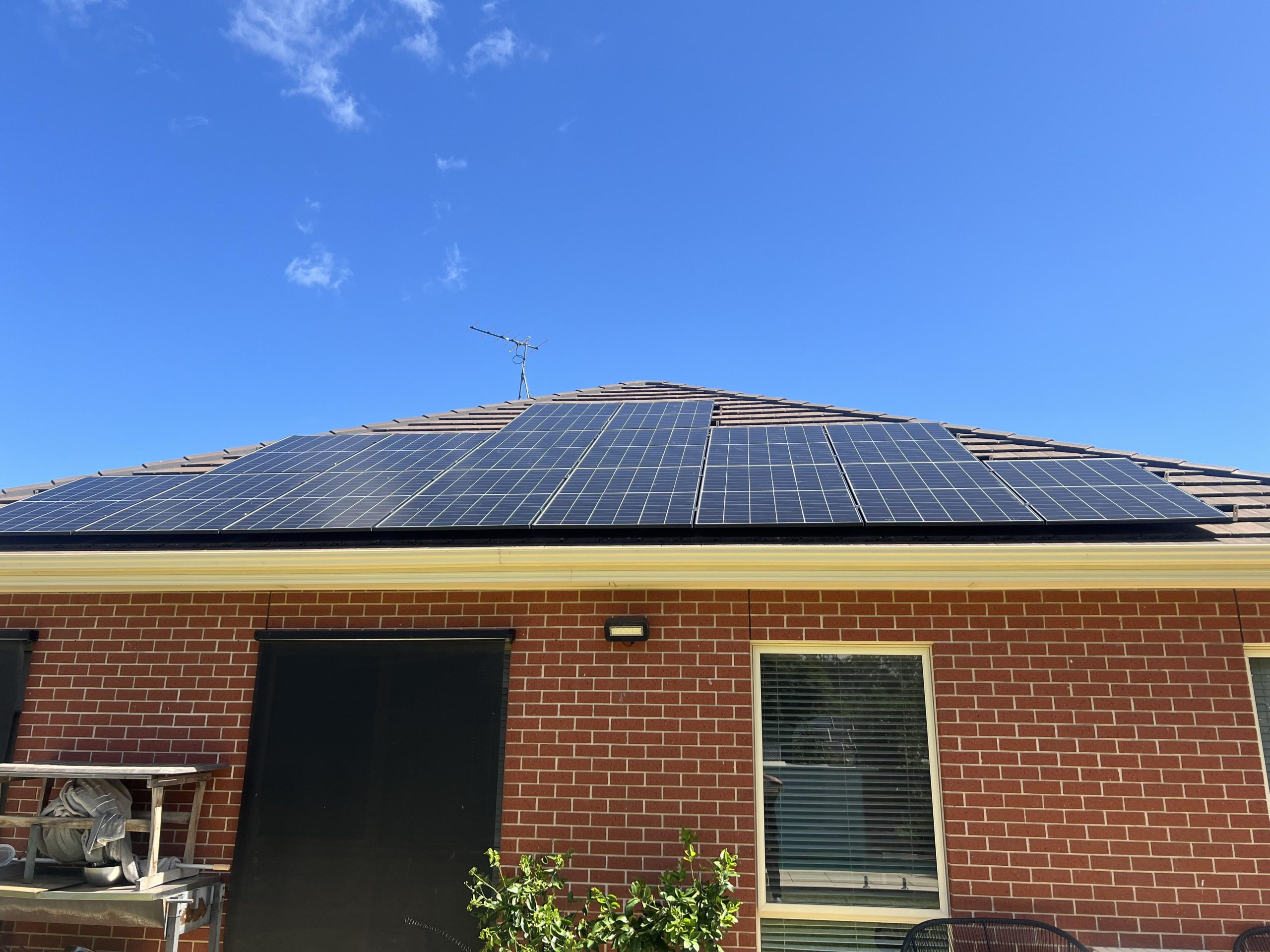
Aiko solar panels installed by MDB Solar SA.
Although Aiko only launched in the Australian market in 2024, the brand has already caught installer attention. In the 2025 SolarQuotes Installers’ Choice Awards, Aiko was voted best solar panel brand by participating installers. Popularity is partly due to the back-contact cell design, high efficiency and competitive pricing.
Some industry observers have previously raised questions about shading performance in certain installations, and the company is involved in patent disputes with other back-contact manufacturers such as Maxeon. Despite these issues, installer feedback so far has been positive.
Next Steps For These Panels
CEC approval doesn’t necessarily mean the panels are available yet, but it is a key step for eligibility under the Small-scale Renewable Energy Scheme (SRES). Initial Australian supply will begin late April 2026 for 535–540 W models, including a limited-run 545 W mono-glass panel. Additional variants, including 545 W dual-glass and 550 W panels, will roll out later in 2026.
If these claims hold up in real-world conditions, they could mark another step forward in squeezing more solar capacity out of limited Australian roof space.
For a deeper look at how Aiko panels have been performing, installer feedback, efficiency and real-world reviews, see our full Aiko solar panels review.
 About Kim Wainwright
 RSS - Posts






How much should I pay to have a battery added to my 7:5 kw system and what size should I get
My monthly bills are around $60 to $100 after feed in tariffs so I am not sure if I would recoup the price of the battery
Considering how mature the technology is, they are still advancing capacity at quite a rate.
A tip for people with old systems upgrading – Bloke down the road from me upgraded his panels a couple of months ago, looks like he stayed with the same capacity, which meant about 5 or 6 less panels on his Colourbond roof.
If looks bl@@dy ugly where the old panels used to be, as the roof is a totally different colour, the rest of the roof having faded over the years leaving a nice big bright spot in the gap where the old panels used to be.
So, the tip is – If you can’t replace with the same number of panels, try and leave the gap where it is not highly visible from the street!
Except we also need a smaller form factor update to their 490W panel at 25% percent efficiency which would be a cool 500W. That is because domestic roofs more often than not do not lend themselves to longer panels with an extra row of panels on the bottom which is is what the 540 / 550W panels are about.
Hi Matthew,
It drives me batty but the form factor for solar is all about the internal size of a shipping container…
That is simply not correct. From day one the size of Chinese pv modules has never ever been predicated on the space available in a container.
Hi Bruce,
You’re right, panel sizes were initially more about the size of wafers, which in turn were dictated by the diameter of silicon ingots, from which wafers were sawn.
However panels are bulky and shipping containers are a fixed size.
What’s happened is that panels have grown to efficiently fill a container.
What people want to handle, or what will fit on the roof comes a very distant 5th place after size, cheapness, power rating & durability.
Wow. Any chance the other panel manufacturers will be coming out with similar ratings in the same form factor? Trina, CS, Jinko, Suntech?
Or are Aiko truly ahead in terms of the underlying tech?
Copper contacts and all-back connections are fresh out of the R&D lab. Id say Aiko is leading the way with this one – well done to them.
Would be good if the CSIRO was still testing panels but I think they shut that down. Always need to see I dependant verified claims rather than just relying on manufacture claims.
It is good to see the evolution in panel efficiency.
However, – what is not immediately apparent is that these panels are slightly oversize, so the increased power ouput is not quite as impressive as at first glance.
A “standard” 2m^2 panel: 1762×1134 (typ. ~450W, 22.5% efficiency)
Aiko panels 1954×1134 (typ. ~540W, up to 25% efficiency)
So – they are 200mm (20cm) longer. Which means they may not be a ‘drop in’ replacement for someone looking to upgrade old panels, e.g. with limited roof space looking to upgrade some older panels.
Case in point – I could not fit those new Aiko panels on one of the strings on my roof. Whether they would bolt onto the existing bracket locations on the other string would also be an interesting question.
Hi Graeme,
Ross from Aiko here, thanks for your comment.
It sounds like you already have a system installed, and you’re absolutely right, our 60-cell modules are longer than the traditional 54-cell format, which can make retrofits more challenging in some cases.
That said, we do offer 54-cell panels with dimensions of 1762×1134 mm, which are much closer to standard residential sizes. In Australia, these are currently available as a 490 watt module, with efficiencies of 24.5%.
These smaller-format modules are often a better fit for upgrade scenarios where roof space or existing mounting layouts are a constraint.
If helpful, I’d be more than happy to run through options or layouts that may work for your setup.
Thanks again for sharing your perspective, it’s a really important consideration for many homeowners and for them to understand the different panel sizes that are available.
The article states “with residential panels ranging from 535 W to 550 W” and this “This footprint is typical for modern high-power panels”.
Definition of Typical: something that is usual, normal, or representative of a particular group, acting as a standard example.
This is misleading, deceptive and I go so far as to say false.
Here I was hoping to see 550Watss from the “typical” rooftop solar panel which measures 1760mm x 1134mm x various thickness.
Why the clickbait?