
 Virtual Power Plants (VPPs) are often marketed as “easy money” for battery owners: let your battery support the grid during peak periods and receive a small payment. Sounds simple, right?
Are VPPs worth joining?
Before you rush to join, it’s worth stepping back. Much of the financial benefit of a battery comes from having it properly installed, correctly sized for your household, and integrated with your solar system. That reduces grid consumption, maximizes self-consumption, and provides backup reliability. VPP payments are usually a small addition compared to this core value.
Read on for a rundown on VPP participation and what it means for different types of users.
How Batteries Age
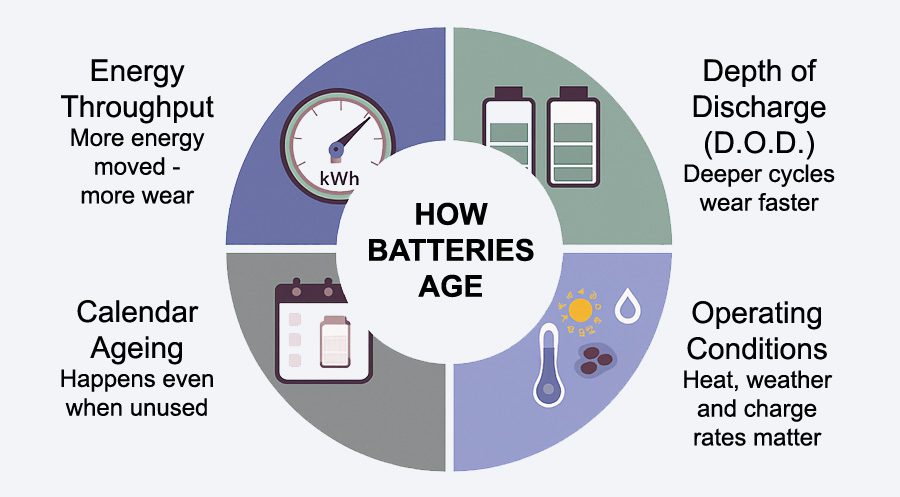
Batteries wear over time due to a combination of energy throughput, cycle depth, calendar ageing, and operating conditions:
- Energy throughput: Total kWh moved through the battery. More energy moved generally increases wear.
- Cycle depth (Depth of Discharge, DoD): How much of the battery’s capacity is used in each cycle. Deeper cycles cause more wear per kWh than shallow cycles.
- Calendar ageing: Batteries naturally lose capacity over time, even if they aren’t used.
- Operating conditions: Where and how a battery is installed — including temperature, exposure to the elements, and charging or discharging rates — can significantly affect wear.
Having a general understanding of these factors can guide your decisions — there’s no need to calculate exactly how each one contributes to battery wear or try to predict its exact end of life, which is essentially impossible.
What VPPs Change
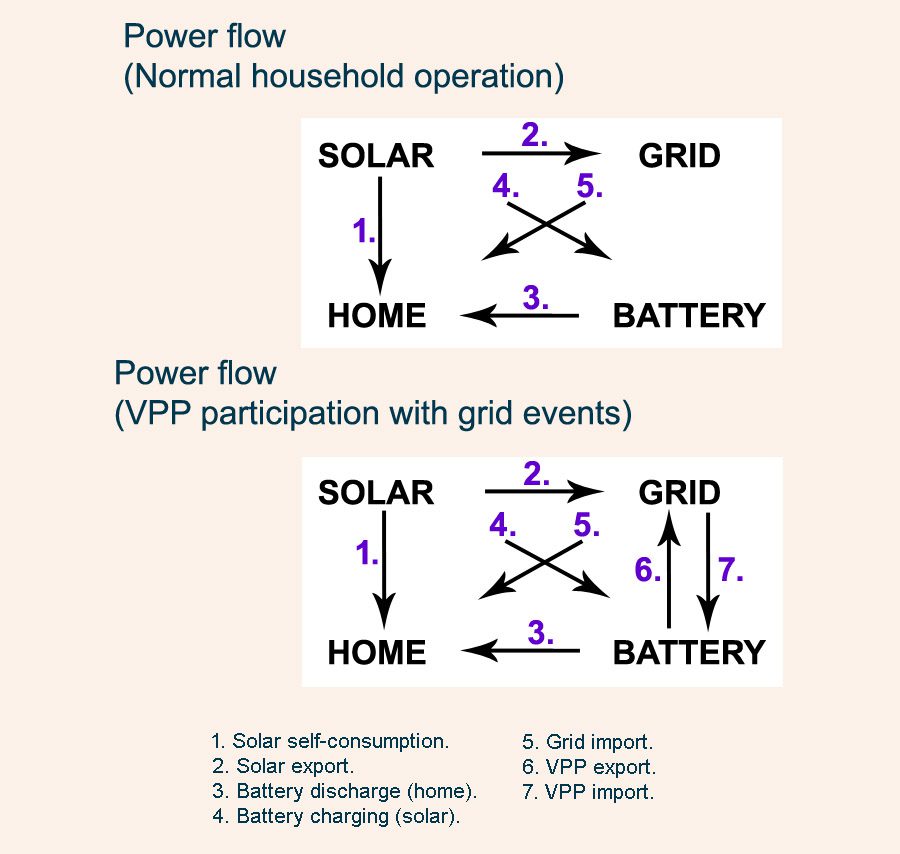
Joining a VPP can alter the way your battery behaves, but the exact effect depends on how the program dispatches energy and how often your battery is already cycling. To make it easier to see what’s happening under the hood, here’s a breakdown of the main changes you can expect when participating in a VPP:
- Extra cycling: VPP events push additional energy through your battery that wouldn’t otherwise be used.
- Dispatch timing: Events often occur during peak grid demand — hot afternoons or evenings — which can increase stress.
- Power levels: Batteries may discharge faster than normal, generating heat and wear.
- Control: Reserve settings or self-consumption priorities may be temporarily overridden.
These changes are real, but whether they matter depends on how you use your battery and whether the extra cycling and payments make sense for your household.
Household Categories
Everyone uses their battery differently, so VPP participation doesn’t impact every household in the same way. Factors like how you use solar energy and why you installed your battery will influence the effect.
VPP events typically occur during peak demand periods, when the grid most needs extra capacity. How these events align with your normal battery use affects whether the impact is mostly extra wear, extra income, or both.
To make it more relatable, we can roughly group households into three types — just a guide to help you see where you might fit:
- The high self-consumption household: Most of the solar energy is used on-site, so the battery already cycles daily. Extra cycling from a VPP adds wear with limited financial gain.
- The low daytime usage household: The battery often sits idle. VPP participation can generate extra income with minimal downside.
- The rebate-driven or short-term household: Installed primarily for incentives; short-term payments matter more than long-term wear.
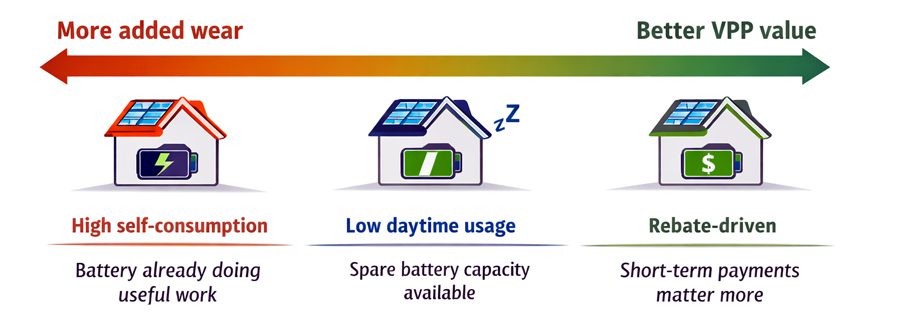
These categories are simplified guides, not hard rules. Real outcomes depend on your household, battery setup, and the details of the VPP contract.
VPP Financial Trade-Offs
The key question: Does the VPP payment compensate for the value your battery loses?
If you’re hoping VPP payments will make or break your battery’s economics, you’re probably worrying about the wrong thing.
Because batteries wear gradually over time, extra cycling uses up a little of their useful life. The exact impact is impossible to pin down — grid events, timing, household usage and battery behaviour all vary too much for precise calculations.
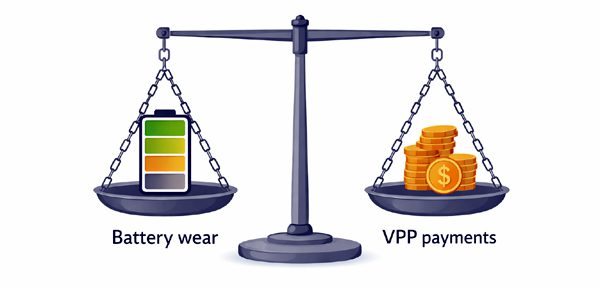
For most households, VPP payments are a small fraction of total battery value. They’re rarely a deciding factor in whether a battery makes financial sense. Think of them as optional add-ons, helping you see roughly where you sit rather than making the decision for you.
VPP Decision Checklist
Before joining a VPP, consider:
✅ How often will my battery cycle without a VPP?
✅ How much am I paid per extra kWh moved?
✅ Does the VPP limit my control or reserve settings?
✅ Which household category do I fit into?
Answering these questions helps balance payments against value lost and ensures you make a decision that fits your system and usage.
Final Thoughts
VPPs aren’t inherently good or bad. They’re a trade-off: some battery wear and control in exchange for payment.
The vast majority of a battery’s financial benefit comes from proper installation, correct sizing, and system integration. VPPs are a secondary consideration — useful for some households, negligible for others. Understanding how your household fits into the categories above is key to making an informed choice.
If you’re still unsure whether to join a VPP, it’s generally a low-stakes decision — particularly if your battery has spare capacity for much of the day. At the very least, participation lets your battery quietly help stabilise the grid and support the broader renewable energy transition.
For more, watch our new video explainer on VPPs.
 About Kim Wainwright
 RSS - Posts






The ielectricity ndustry is by nature predatory and parasitic I refuse to play a one sided game. Others are entitled to make their own mistakes by trusting these bottom-feeders
The energy sharks / electricity industry, has some work to do in gaining trust. Myriads of electricity plan offers that confuse people with the different combos of DSC and Consumption Tariffs, FiT’s shrinking in value and the ‘sun tax’. Now with VPP’s, households are to give over some control of their batteries to the energy sharks. The thought of joining a VPP doesn’t fill me with any excitement whatsoever.
A case of putting the foxes in charge of the chicken house methinks.
Not a particularly smart move IMO
FY25- The Origin Energy Ltd (ASX: ORG) share price is in focus today after the company delivered a statutory profit of $1,481 million for FY25, up from $1,397 million last year, with underlying profit also rising to $1,490 million.
https://www.fool.com.au/2025/08/14/origin-energy-fy25-result-profit-rises-dividend-up-as-renewables-and-customer-base-grow/
If I was to go the VPP route and my battery failed within the warranty period, would I still be covered by the warranty? My thought’s would suggest a denial if they know about my VPP usage, because data would be available to prove their case. i have some reservations as to the longevity of the system due to high temperatures of the inverter/charger and the battery packs on days of over 30 degrees ambient. I would suggest the equipment is not suitable for our climate, and not fit for purpose. The system is configured for self consumption, and so far has reduced the power bill to $25, which is what I set out to achieve. The thought of making money is tempting but this wasn’t my reason for installing the system. I initially had a 3KW system installed in 2012 but it failed due to hot spots with bypassed panels and then a total failure of a smashed panel finishing off the system.
Most VPP I have seen are either not worth it, or smoke and mirrors benefits.
The only ones I’d consider are where you can dump into the grid when YOU want to, AND they get the most benefit, during that evening peak, usually between 6pm and 9pm or so.
If you can drop 10kwh or so for 25c or 30c, and still cover all your needs overnight and for early morning peak, then you are probably going to break even and possibly have a small ongoing credit.
On most of these plans you usually get zero for FIT for the whole solar soak.
Winter, get onto charging from free or cheap grid tariffs, and then have enough to do the same, but you might be just breaking even then.
From what I’ve seen Amber is a good option, but only if you are willing to take the risk, it’s fraught with problems of incompatible equipment issues, micro managing is often needed to override terrible smartshift decisions.
I will never do business with Amber since that mob clearly won’t communicate with anyone they think has a clue about what they are doing. Quite likely I asked too many questions.
Dont know what is risky about manually discharging energy after sundown for a higher FiT on Amber. Even though Amber is referred to as a Virtual Power Plant (VPP) architecturally it is not – unless you include the suboptimal SmartShift algorithm. Just a label to get you a subsidy in SA (REPS) .
If you want to be a Prosumer rather than a Consumer, an appropriate analogy might be you cannot complain about a Holden Commodore without Full Self Driving (FSD) because you have seen a Tesla Model 3 video on youtube.
My VPP only activates in price spike events s since January it has only taken 3kwh and it gave me the nsw VPP rebate so definitely worth it.
In another note, if cycle depth affects degradation why did solar quotes articles often promote not oversizing batteries even though you can get oversized batteries for not much more than small ones (with certain brands).
It would be good to have some data in this article. For example, lifetime duty cycles 0-100% or 20-80% or whatever, then extraoploate from there. Some stats for my Sig battery:
– 8kWh battery 60% capacity warranty after 10 years, assuming energy level not more than a little under 7.5 per day (total charge/discharge).
So after 10 years I am guaranteed, from my 24 system, 15kWh minimum. The tech is similar to EV batteries which are still going very strong after 10 years, way above 60%, so I suspect it’ll be more like 80-90%.
You also need to discuss potential recycling/resale/reuse for a complete asset lifecycle ROI. Some guesses, not being an expert:
Scenario A: VPP, revenue gained over 10 years – battery goes to say 80%
Scenario B: no VVP revenue but battery is at 90% after 10 years.
Could be either way you’re replacing or upgrading, so is a 10% delta important? Perhaps an expert can provide a view on likely replacement costs in 10 years?
I have been on an AGL/ACTEW VPP for just over 2 years now, with Tesla powerwall 2 and 6.6 kwh panels.
We are a low consumption household and 2/3rds of our solar goes to the grid.
Our hot water is still electric boosted however (it is one of those older solar tube HWS) and that is the only time when we need grid power, ie. after 3-4 cloudy days the battery is drained.
The surprising thing about the VPP however is that they have only used our battery 3 times over the two and a bit years. And on only one of those times did they drain it to 20%. The other two times they only used it for an hour or so.
So for us the extra feed in tariff is well worth being on the VPP.
so your local wealth is a bigger disadvantage that the commercial incentives for the VPP. Come to South Australia where there is no baseload.
https://explore.openelectricity.org.au/energy/sa1/?range=7d&interval=30m&view=discrete-time&group=Detailed
Hi David,
“Baseload” is industry jargon which used to describe how little load you could justify running a large thermal plant.
Now the coal industry has highjacked the term it roughly translates to “please remember when we were kings”
Things like off peak water heaters were introduced so that large thermal plants could be kept ticking along at a base rate. Stoking them up and down every day shortens the life of a boiler, so artificially cheap tariffs were introduced to -create- demand where it would otherwise never be.
Instead of shaping demand with limited availability tariffs designed to suit lumbering inefficient thermal generators, we now have real time pricing to incentivise use when energy is cheap… so SAPN already offers a “solar sponge” tariff at 25% normal rates compared to 125% for peak use.
I am similar to you, but with EnergyAustralia’s BatteryEase VPP. I get 12 cents per kWh for the first 15kWh, and then 7 cents per kWh uncapped for the rest. There are various other incentives, with the only downside being the cost of importing on those cloudy days, especially if the EV needs charging. With an electric HWS on a timer, I am an all electric household, with no bills (so far). My goal was to have zero usage costs each 12 month period. Despite some poor weather, the amount of kWh they have taken is very very tiny.
So… in a theoretical high self-consumption case where the user is already depleting their battery charge on a daily basis, would the VPP really be adding much extra wear? Surely it just depletes the charge faster so that it’s empty by (say) 9pm on a hot summer night rather than by 6am the morning after. That same time shift then applies for the entire life of the battery so ultimately it ends up accelerating the final demise of the user’s battery by that same 9 hours. Nothing to fret about. The battery gets used to displace fossil fuels whether it runs the user’s AC or the neighbours’ AC, and in fact does a better job by doing so at peak demand times where it displaces on-demand generation rather than baseload generation (which will run anyway whether we use it or not).
Can you opt in and opt out of a VPP in different seasons ie opt in during Summer where my battery is fully charged by 10am and I am currently getting paid a pittance by electricity company for excess solar generated, and opt out during winter (or consecutive rainy days) where I need every kw of power to go back in my battery?
Ross, you obviously mean you need every KW of power to stay in your battery once your solar puts it there.
They don’t stop your battery from charging off all your solar before sending to the grid, they don’t touch your solar at all (apart from that excess to grid), but they can take whatever is agreed in the VPP terms from your battery as and when they wish . . . usually this is in the evening peak after solar soak though.
You can certainly change plans with a retailer, quite quickly too.
A lot of solar / battery owners even change retailers (wholesalers) to the seasons, eg those that can benefit with Amber in summer stay with them for 6 months (summer and 6 weeks either side shoulder), then switch to globird or such for other shoulders and winter, where they can charge their batter for free during the day.
I am not interested in joining a VPP – the offers available are pretty poor, but the reason i got my big battery is not to sell power, it is two fold
– Firstly, after years of being bent over by power companies, I dont intend to pay the scum sucking pigs for one kWh of power ever again if i can avoid it. Conversely i have intent of letting them make money out of my battery either!
– Secondly, the weather patterns here are not a day of rain then nice sunshine the next day, typically when it sets in we get somewhere between 3 days to a week of wet heavily clouded days, and that probably happens up to a dozen times a year. We also get extended power outages due to poor weather, last year I had one period of no power for 3 days with cyclone damage to the network, then in November no power for 6 days with storm taking down my powerline to the street.. I want my battery to see me through these sorts of periods without having to micromanage my power usage.
I absolutely love the comment by Andrew 🙂 🙂 🙂 Scum sucking pigs indeed !!!!
My thinking is similar, the battery is for my use exclusively, IMO anyone who shares their battery with retail bloodsuckers / scum sucking pigs is deluded. These bottom feeding parasites have demonstrated numerous times that they never stop dreaming up ways to gouge customers so why would anyone trust them with ten of thousands worth of batteries ?? I am restraining myself … the moderators would not like what I really think about perpetuators of the electricity racket.
In WA, I see Plico offers 97c/kwh used from you battery. Given the most expensive cost of electricity on the peak surcharge is 53c/kwh (29c/kwh flat rate), is this worth it long term? Only about $200 a year but they do offer $3000 of system install incentives.
Is this a lock in contract with Plico for 10 years?
We’ve been on Amber here in SEQ for almost 4 weeks now, and I’m getting ready to leave. We can’t even make enough to cover the monthly subscription fee.
We have 15kW of solar and a 40kWh battery. We are 100% self-sufficient except for maybe 1 day a month during the worst of the rainy season. All I want is to use maybe 10kWh of my battery to push into the grid at peak times and earn enough to cover my network charges. I don’t care about these mythical spikes they talk about. I haven’t seen a single one since we joined.
Their “smart” algorithm is awful. I’ve seen it start charging the battery that’s 75% full at 45c/kWh, then sell that back to the grid at 8c/kWh. Most of the time it sells nothing back to the grid at all.
If someone had a small battery, maybe just enough to cover them during the evening peak, and could shift their usage to offpeak times, then I could see a real benefit. They could drop their average rate by 2/3rds. But for us, worse than it’s useless.
Amber was brilliant when there was some price volatility in SEQ and you could get a few jackpot nights in Summer or Winter. For months now, electricity has been pretty cheap in the evening – hard to make the subscription fee back.
We left.
A couple of points.
1. SmatShift is a Machine Learning algorithm that takes time to learn you production and consumption profiles over time. Maybe ask the chatbot on Ambers website -under FAQ- what is a typical time for the algorithm to adjust to you – since they struggle to answer customer requests despite taking on more support staff.
2. If you want to ‘set and forget’, Amber is not for you. There is a manual over ride button in the app where you can discharge into the network any time you like. Eg typically prior to sun rise and after sun down the actual price spikes and/or increases in FiT materialise which you can discharge into for fun and profit.
Consumer v Prosumer.
For a SolarEdge inverter it manages heat by reducing its o/p current known as derating preventing internal “hot spots” from exceeding safe.
Below 50°C (122°F): The inverter will generally maintain its maximum 6 kW output, provided it has the required DC input from the solar panel voltage optimizers.
Above 50°C (122°F): The inverter begins to “throttle” or derate. You will see a linear decline in the maximum possible kW output as the temperature climbs toward 60°C.
At 60°C (140°F): The inverter reaches its upper limit. If internal temperatures cannot be stabilized through derating, the unit may shut down entirely to prevent damage.
The equivalent battery spec is as follows:
Metric………………………..Specification
Operating Range………..-10°C to +50°C (14°F to 122°F)
Full Power (5 kW)………..Generally maintained between 15°C and 40°C
Ideal Storage Temp…….-10°C to +30°C (for longevity)
Cooling Method………….Natural Convection (No fans)
For those thinking of joining a VPP, have a look at flowpower. They offer 45c/kwh between 5.30pm-7.30pm for NSW, SA, and QLD and 35c/kWh for VIC.
I am in Victoria and this plan is fantastic for me. I have been exporting between 20-26kwh/day since January this year (have a credit of $242 for Jan 15-feb 14). I was with Amber from 9th Oct last year to 15th January this year and only got a $55 credit. Amber is not suitable in Victoria for low consumption households with spare capacity to export as our grid is quite stable compared to other states. Also, this plan is not a VPP so I have total control of my battery. If there is a day I don’t want to export I simply don’t and there is no need for micro managing the battery. Most of the time it is a set and forget proposition. Program your battery to export X amount of power from 17.30-19.30 and that’s it.
…we are also new to Flow Power, after getting fed up with Amber…we are a low energy consumption house & have been exporting on average 15kwh daily, during their happy hour …should be able to do 20kwh in summer …what we were initially hoping get ROI with Amber, we are certainly doing that now with FP!
I am currently in forecast mode, budgeting my household expenses over the next five years based on market pricing trends. Based on my research:
General On Demand 24 Hr Tariff 5.00% decrease year on year
Feed in Tariff 18.00% decrease year on year; and
Daily Fixed Fees 4.00% increase year on year.
I have made no allowance for those who trade in the wholesale market or have entered into dispatchable power arrangements.
The assumption is that there will be no change to the method of billing based on kWh imported, which includes the recovery of costs attributed to the distribution network and retail administration, clean energy obligations and other costs.