
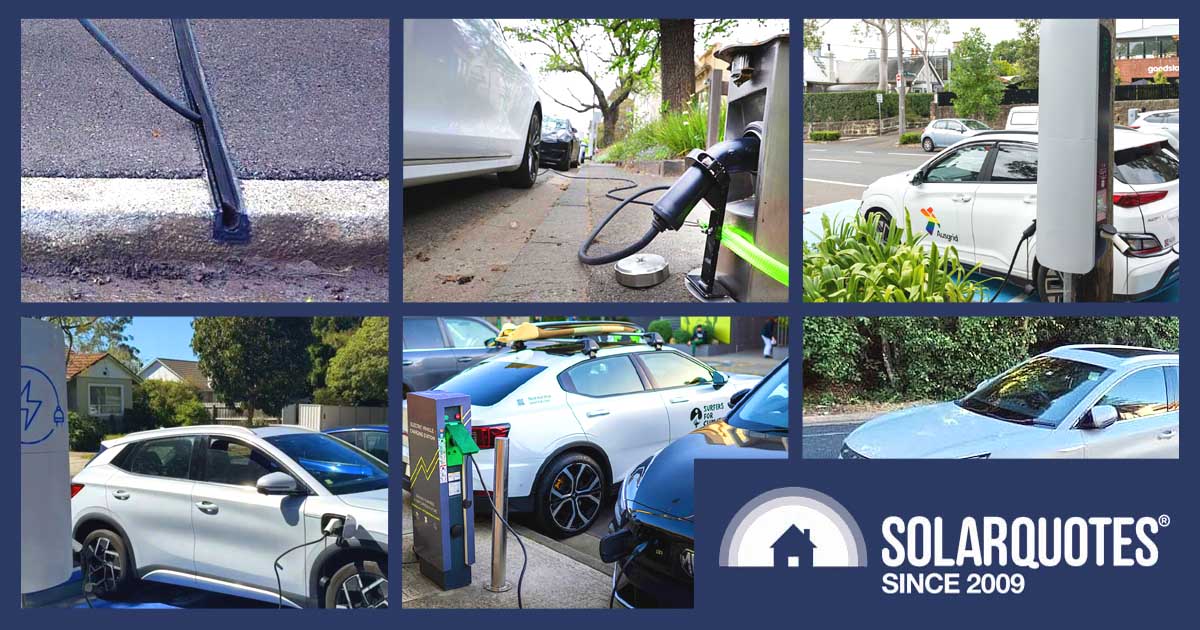
Two years ago, SolarQuotes explored one of the trickier challenges facing would-be EV owners: how do you charge an electric car if you don’t have a driveway?
The solutions ranged from cable covers and drainpipes to charge gullies and elevated cable systems. There was no shortage of ideas, and the comments section quickly filled with alternative suggestions, objections and debate.
Is Kerbside EV Charging Now Possible?
So did any of those ideas suggested in 2024 catch on? Some managed to, while others evolved. Back in 2024, many of the proposed solutions were effectively workarounds.
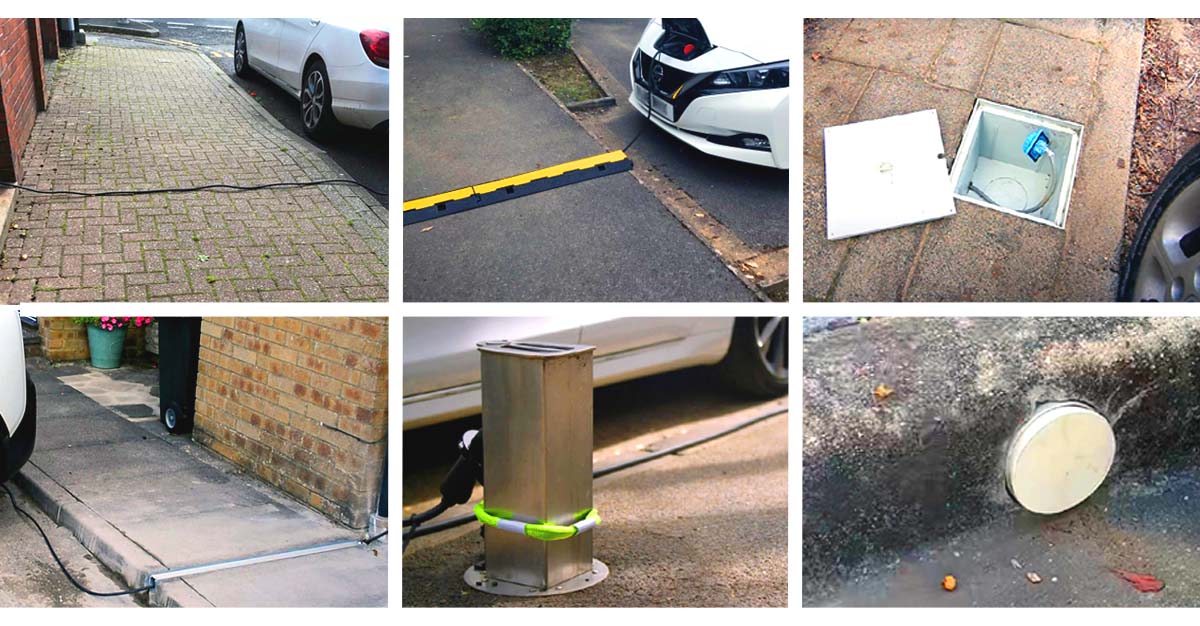
Some of the kerbside charging ideas discussed in SolarQuotes’ 2024 article, ranging from simple cable covers to purpose-built charge gullies.
Rather than residents trying to find ways around council restrictions, some councils are now trialling and approving charging solutions themselves. In NSW alone, government-supported kerbside charging programs have funded more than 1,000 charge ports across 38 councils.
Merri-bek City Council is currently trialling elevated charging systems that allow residents to charge street-parked EVs without trailing cables across footpaths. The council is also running a separate trial of pole-mounted public chargers.
Meanwhile, the City of Port Phillip has expanded its kerbside charging program beyond the Kerb Charge system featured in SolarQuotes’ original article. Residents can now apply for a range of approved charging options, including kerb-integrated systems and elevated charging devices.
In Sydney, Mosman Council has adopted a resident-led policy framework that allows privately owned kerbside charging infrastructure to be proposed and assessed on a case-by-case basis.
Sydney’s Inner West Council is already well down the kerbside charging path, with 136 public chargers being rolled out in partnership with EVX.
More Than An EV Issue
None of this means the problem has been solved. In many areas, households still don’t have access to an approved solution, so improvised approaches aren’t going away any time soon.
Even so, there are signs that the issue is being taken more seriously than it was two years ago.
Councils and policymakers are now taking a far more active role. The challenge has gone beyond simply finding a way to charge a street-parked EV to figuring out how charging infrastructure can be rolled out across entire neighbourhoods.
For inner-city areas with older housing stock and large numbers of vehicles parked on the street, kerbside charging is increasingly being viewed as an infrastructure challenge rather than simply an EV issue.
That shift may help explain why some councils are trialling multiple approaches simultaneously. At this stage, nobody knows which solution — if any — will prove most practical at scale.
The Data On Kerbside EV Charging
Another sign of progress comes from the growing body of real-world charging data.
A recent UNSW study analysed more than 27,000 charging sessions across council-owned kerbside chargers in Sydney’s eastern suburbs.
Rather than asking whether kerbside charging is needed, researchers focused on how people actually use it.
Among the findings was evidence that medium-power DC chargers in the 30–50 kW range may offer a sweet spot between cost, convenience and utilisation. The study also identified a rough planning benchmark of one kerbside charging space for every 70 locally parked EVs.
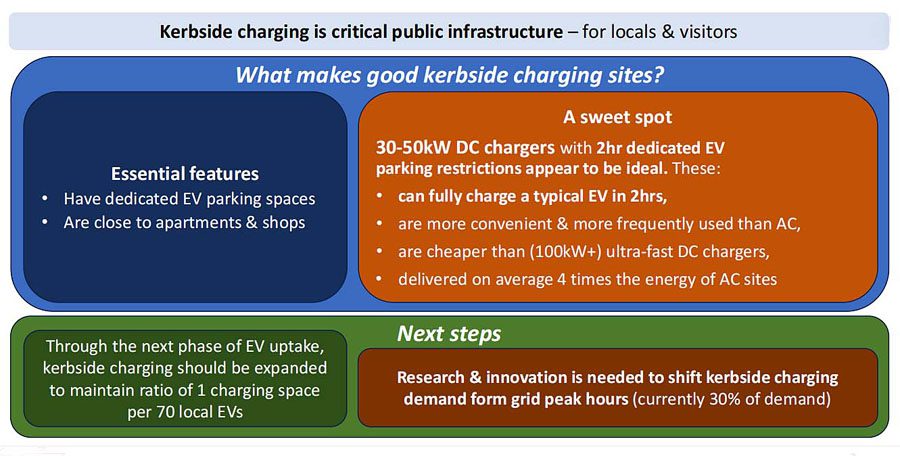
Key findings from UNSW’s study of kerbside EV charging in Sydney’s eastern suburbs. Source: UNSW (University of New South Wales.)
Two years ago, much of the debate centred on whether kerbside charging was practical at all. Today, researchers are analysing how many chargers may be needed, where they should be installed and how they are being used.
They’re even looking at ways to shift kerbside charging away from peak demand periods as EV numbers grow. But that’s a rabbit hole we’ll save for another article.
There’s No Home EV Charging Silver Bullet
If there is one conclusion from revisiting the topic, it’s that every solution comes with trade-offs.
Home-connected charging systems can make use of household electricity and rooftop solar, but they often depend on residents being able to park close to home.
Public kerbside chargers avoid that problem but require additional infrastructure investment and ongoing management.
For now, councils appear content to trial multiple approaches rather than pick a winner.
The Search Continues
Not everyone has access to a driveway, garage or private charging point. For many apartment residents, renters and owners of older inner-city homes, charging remains one of the biggest practical barriers to EV ownership.
At least we’ve now moved from asking “how do I run a cable across the footpath?” to “how do we make thousands of charging points work in real cities?”
And that’s probably progress.
For more on home EV charging, see SolarQuotes’ guide to EV chargers.
 About Kim Wainwright
 RSS - Posts






Maybe V2V charging should be considered, with EV owners sharing energy from limited charging infrastructure. Not very energy efficient but something that could be practical where several EVs are parked close by. Most commuters don’t need a full charge each day and many EVs are being parked at work (or an apartment car park) for hours with near-full batteries.
https://go-e.com/en/magazine/v2v-bidirectional-charging
Knowing that the former Road Boards, now councils have triplicated most public services, it will not surprise us that uncovered cables (see photo) present a tripping hazard and councils will straight away see the dollar signs with new regulations and fines for EV motorists.
“many EVs are being parked at work”!
This may be the simplicity of it thinking:
What if business installed GPO 10A/15A in car park bays for EVSE, use on controlled load Tariff and ideally these include the purposed 3 for free hours.
Type 2 charges cost closer to $1000 each but a GPO is much less and if cars are parked during work hours, 5 hours of low cost or free power can be >11kwh of charging daily.
Hi Bernard,
I think you’re onto something with that idea.
Missed one:
https://www.solarquotes.com.au/blog/ev-chargers-at-work/
Perhaps an update to the article to indicate providers allowing Controlled load connections.
Unsure if you can do a GPO with a sign, EV Chargers only.
Perhaps need flexibility with the rules for this?
Gemini returned:
In Australia, electric vehicle (EV) chargers are listed as approved appliances for controlled load (CL) circuits. Because electricity distribution rules are managed regionally, the networks that explicitly approve EV chargers on controlled load (such as Controlled Load 1, Controlled Load 2, or Tariff 33) include:
Ausgrid (NSW)
Endeavour Energy (NSW)
Essential Energy (NSW)
Energex (QLD)
Ergon Energy (QLD)
SA Power Networks (SA)
TasNetworks (TAS)
Jemena, CitiPower, Powercor, AusNet, and United Energy (VIC)
Hi Bernard,
Controlled load is cheap because it’s hard wired and though there are ways to switch a hot water service to soak up excess solar for instance, technically it’s illegal.
The DNSPs don’t police it because they know it’s helping the network, except Queersland because they’re… special.
“The study also identified a rough planning benchmark of one kerbside charging space for every 70 locally parked EVs.”
Seems a bit light on, if even 6 others want overnight charging, and with many others also wanting the same.
First in best dressed ? An EV parking queue, needing a dedicated EV parking lane queue ?
“DC chargers with 2hr dedicated EV parking restrictions.”
Idle / congestion fees ? A charger could handle that.
I wouldn’t want to be getting up at 2am, 4am, etc to move car, put car on charge, and again to take it off and move it . . . perhaps with no other street parking spaces available nearby either.
I feel it better to have the overhead cabling (ugly though) or under kerb cabling (better), so each EV owner can be responsible for an electrician install, kerb / paver works etc, part of EV ownership I guess.
Then I can see public street parking, others using the space, conflict, more EV hate.
Perhaps some people are not in a position to have home EV charging.
When we see Victoria’s $200B state debt, and $15B spent on yet another Melbourne tunnel for trains to run in endless circles while rural roads deteriorate, it seems remarkably intelligent for councils to trial various EV charging solutions, guided by uptake. What works now is what’s needed now – what works best later may be something else. E.g. As Na+ batteries drop in cost, with double life adding to lifecycle economy, time-shifting EV charging can be done by a fat battery on each suburban street – without a grid rebuild. ToU tariffs cover battery cost, I figure. Could lead to improved FiT too?
It has taken forever for us to reach this point in the adoption curve, but it is exponential, with the biggest change taking much less time – just the next few years.
Electric excavators on construction sites, with swappable battery deliveries instead of diesel, are becoming mandated in Europe. Some run on a 3-phase extension cord, I kid you not. Fossil diesel is medieval technology.