

Electric cars have notched up their biggest Australian milestone yet. In August, they outsold petrol cars for the first time, taking almost a quarter of all new vehicle sales. For households, that also means more transport energy is shifting from the petrol bowser to the electricity meter.
How Fast Are EV Sales Growing?
More than 27,000 battery electric vehicles (BEVs) were sold in Australia in August, accounting for 24.9% of all new vehicle sales.
That put BEVs ahead of petrol cars, which took 23.7% of the market, and diesel at 21.7%. The Tesla Model Y was Australia’s best-selling vehicle of any kind for the month.
One month doesn’t make a revolution, but August wasn’t an isolated spike. BEVs accounted for more than 20% of new vehicle sales in each month from May through August.
The longer-term numbers make the change even clearer. Australians bought just 1,053 BEVs in 2018. Sales reached 33,416 in 2022, 87,217 in 2023 and about 103,000 last year.
More than 154,000 had already been sold by the end of August this year. That’s around 50% more BEVs in eight months than were sold during the whole of 2025, with four months of the year still to go.
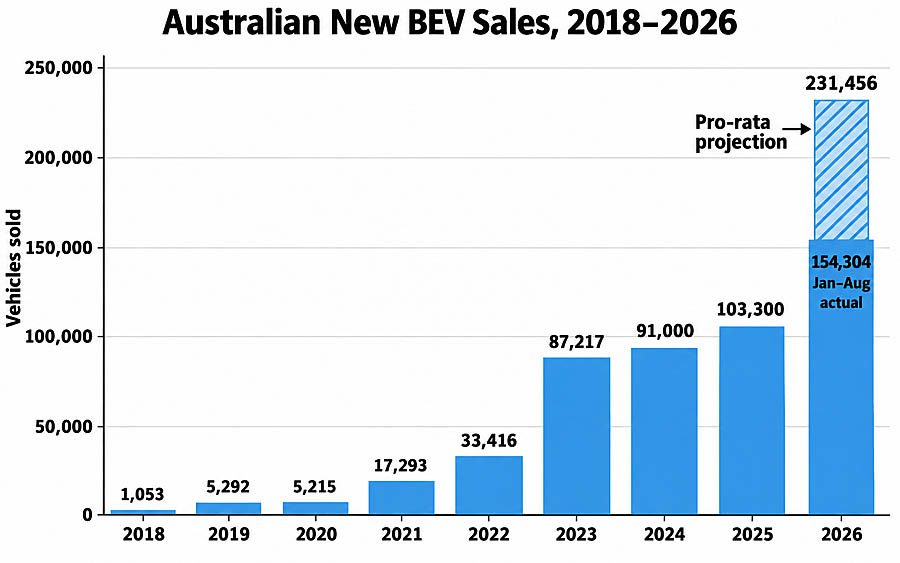
Australian annual BEV sales. 2026 sales are January–August; the hatched section is a simple pro-rata projection for the full year. Sources: VFACTS/Electric Vehicle Council.
The EV Boom Is Coming Home
The significance of household electrification becomes clearer when you look at where all those cars get their energy.
Around 80% of reported Australian EV charging happens at home, according to the Federal Government.
That means the rapid growth in EV sales isn’t just changing what Australians drive. It’s moving a sizeable chunk of transport energy from petrol stations into homes.
The average Australian car travels about 33 kilometres a day. As an illustration, an EV consuming 170 Wh/km would need about 5.6 kWh to travel that distance, before allowing for charging losses.
That’s substantial compared with the 11–23 kWh of electricity the government says a typical Australian home uses each day.
At the lower end of that household range, adding an EV that uses 5.6 kWh per day increases electricity requirements by about 51%. Even compared with a 23 kWh/day household, it’s an increase of around 24%.
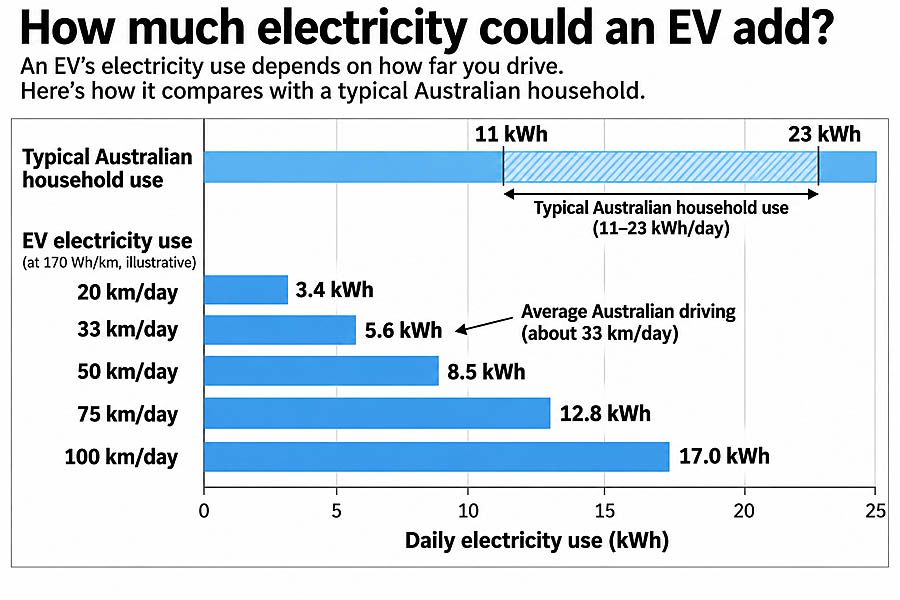
EV figures are illustrative, assuming 170 Wh/km and excluding charging losses. Australian Government guidance puts typical household electricity use at 11–23 kWh/day and average driving at about 33 km/day. Source: Australian Government.
Actual EV consumption will vary with the car, how far it’s driven and driving conditions, but the scale of the extra household electricity demand is hard to ignore.
Your Biggest Load Is In The Driveway
There’s another way EVs change the electrical equation at home.
A dedicated home EV charger can draw around 7 kW on single phase, potentially making the car the largest single electrical load in the house. Three-phase homes can support even higher charging rates.
Unlike many big household loads, however, EV charging is often flexible. Most cars spend plenty of time parked, so charging doesn’t necessarily have to happen the moment the driver arrives home.
That creates opportunities to charge when electricity is cheap or when rooftop solar would otherwise be exported to the grid. For households considering solar, an EV also changes the calculation, because energy that was previously bought as petrol or diesel can increasingly be supplied from the roof.
Eventually, some EVs may do more than consume household electricity. Vehicle-to-home (V2H) uses the car’s battery to power the house, while vehicle-to-grid (V2G) sends electricity back to the grid.
Neither is yet an everyday proposition for most Australians, but both are moving closer to the mainstream.
The New Home Energy Equation
Australia’s latest EV milestone, therefore, matters well beyond the car market.
As EV numbers climb, more of the energy Australians use for transport is moving behind the household electricity meter. That makes an electric vehicle an increasingly important consideration when sizing solar and deciding how and when a home uses electricity.
If an EV is already in your driveway or likely to be in the future, factor it into your plans before installing solar. SolarQuotes can help you get quotes from vetted solar installers who can size a system with your current and future electricity needs in mind.
 About Kim Wainwright
 RSS - Posts






500,000 home batteries, 500,000 EVs. Surely suburbia must be a wasteland inferno of ruined weekends and backouts by now.
I wonder if the nuttersphere has been fibbing all these years.
So with battery on wheels becoming cheaper, more available and with units designed for 2 way flow of energy to power our home or store our surplus PV (or store grid at cheap/free periods), do we need such a large house battery? If we want a lot of circuits to run “off grid” (most of them during dark hours or weekends) will the car suffice,…maybe a Plug in hybrid just in case the clouds are dark or the inlaws arrive.
Maybe a costing of the benefits might enlighten us?
In 2.5 years, I’ve only ever raided the 46 kWh house battery for a 15 kWh BEV top-up in 5 days of overcast, never the other way round. The house battery can then catch up all day at just 1 kW out of the 27 kW array, mining murk for photons. The BEV charger at its 1.6 kW minimum rate probably wastes a third of the input energy, so it’s better to accumulate in the house battery and then thump it into the BEV, I think.
Today, in cloudy weather, the off-grid yield was 48.1 kWh, with 28.7 kWh into the BEV, the house battery at 100%, and HWS at full temperature. Panels are cheap, and as battery prices fall, with Na+ batteries having double the cycle life now, by 2030 the average house battery size being sold will probably make V2H unnecessary for new installations. As the technology revolution matures, the economics change.
The doubling of gridscale batteries about to go in kills coal:
https://www.youtube.com/watch?v=YnlF5QoCdQw
“so it’s better to accumulate in the house battery and then thump it into the BEV, I think.”
Particularly if you can DC charge the EV directly. No AC conversion losses.
(Anywhere. DC from panels to huose battery ( at relatively low current) then to car battery at a higher power.)
From 8:30 this morning, in light cloud, the 7 kW going into the BEV, to bring it back up from last night’s 49% range, is leaving only 1.6 kW going into the house battery, but it’s at 98%, so that’s fine. The take-home is that the 9 kW total yield is all that 27 kW of arrays can do in the conditions. (It is nudging up slowly as the sun gains altitude.)
My experience is that where 9 kW of arrays might nearly do in summer, triple the amount of PV is needed for similar winter yield.
As the BEV is paying $1/kWh FiT-on-wheels in avoided petrol pain, that’s $26 payback on the solar capital investment today, before house usage is added. Without that, ROI would be rocky, batteries and all. A household with adult kids still home, could save faster for their move-out, given two BEVs and no fuel bills.
I wouldn’t buy a diesel car – $2.65/L could soar skyward, as the mired Trump Strait special military operation still blocks oil supply, and Russia increasingly goes offline too.
7 kW going into your BEV? That’s nice. Even with a large solar system (less than half of yours) I’ve barely generated 7 kWh thanks to cloudy weather, and I don’t expect the latter half of the day to show any better results. I should just cover what I use today, meaning I’d be fine if off-grid, but there’d be nothing for an EV. Thankfully petrol remains reliable.
Speaking of which, family are looking at a new vehicle. Probably not diesel, petrol seems to be the preference. There was a brief mention of a BYD option, but I believe that died fairly quickly!
John Alba: – “Thankfully petrol remains reliable.”
For how much longer, John?
US petroleum geologist Art Berman wrote in an piece dated 8 Sep 2026:
https://www.artberman.com/blog/the-iran-war-phase-shift-energy-shock-rising-complexity-and-the-end-of-the-old-growth-regime/
The world is rapidly draining petroleum inventories. Audited data from the IEA reveals that global inventories suffered an astonishing daily drawdown of 6.3 Mb/d throughout the duration of the conflict.
As inventories reach operational minimums the world will need to learn to make do with significantly less global crude oil supply.
Geoff,
Is the perception problem mostly due to China dropping oil imports by 40%, saving the world from an immediate Hormuz oil crisis, back then? Perhaps the expectation is that tank reserve depletion will now be cured by another miracle?
My expectation is that the cracking split will be managed to create just the required demand destruction, incidentally ramping profits through the roof. All that does is accelerate the transition to BEVs, not least, trucks. No big deal, given increasingly rapid gridscale battery deployment, and continued solar farm expansion.
Reduced Chinese fuel demand, due to their tens of thousands of electric trucks, signposted the start of the end of fossil fuels. The Hormuz caper, carefully kept boiling, merely assures stellar profits on the way out. It’s an intelligent tactic, fully taxpayer funded. That it might cut half a degree off the climate overshoot, due to accelerated energy transition, is not all bad, either.
Erik Christiansen: – “Is the perception problem mostly due to China dropping oil imports by 40%, saving the world from an immediate Hormuz oil crisis, back then?”
People don’t fill their vehicles’ fuel tanks with crude oil; they fill them with refined petroleum products, like petrol, diesel or LPG. Only refineries need crude oil in order to produce refined petroleum products.
US petroleum geologist Art Berman said in Aug 2026:
“I’m looking at what’s happening inside China. What’s happening with Chinese refineries? Chinese refineries are producing 3 million barrels a day less of the products that people need and buy. I’m saying I see problems with the party line answer.” https://www.youtube.com/watch?v=5Crb4V85nd8
The price of diesel (NOT crude oil) is the one to watch. The diesel crack spread reached an unprecedented level above $100/barrel (peaking around $106/bbl) in early Sep 2026. Normally, it would be $15-40/barrel.
IMO, a recession is on its way!
John,
You’re dead right, in a badly overcast week, BEV charging has to be postponed a few days when off-grid – even with 65 panels holding down the roof. The 27 kW of PV can be yielding barely 1 kW in overcast murk, just enough to keep the home ticking over, nothing for the BEV. That’s OK for one retired old fart, but a young family would need to be on-grid, I figure. (Or start the generator.) My guess is that having half the panels would only shave maybe 20% off the days I can charge the BEV at a rate worth walking to the garage and plugging in. (So 27 kW maybe not worth the extra investment? Dunno. Weather insurance? I reckon.)
Off-grid changes perspective. (Even new tips for the plasma cutter needs ordering in before the 64 km town trip can yield results. It’s such fun living in the sticks. Makes you buy extra. And learn patience – though not necessarily without grumbling.)
ICE payback is ever increasing fuel cost, very negative ROI. BEV pays itself off in fuel savings. Hmmm?
Well now they’d better get charging infrastructure and battery / range issues ramped up within say 3 – 5 years.?
All well and good for home charging, urban use.
Sadly going to be lacking for highway driving if the current rate of fast chargers and average vehicle ranges are maintained.
We probably need a lot more options for urban charging for high density locations too.
I am not sure why you think that current EVs are not suitable for anything more than urban use, I live on the mid north coast of NSW, My typical trips from here to visit friends and family as well as for recreation are to Gold Coast, Sydney, Canberra, Melbourne, Adelaide and occasionally elsewhere. I am looking to buy and Ev with a solid 450-500kms range – not difficult with current models, particularly if you don’t like SUVs. Flexible budget.
All the major highways I would use are well covered for chargers, the most likely EVs I would buy can use fast chargers, And I would leave home with a full battery and do no more than about 600=650kms per day and be able to recharge at night,
Please tell me why I couldn’t do that without problems.
If EV numbers take off Patrick, there’ll be far too many queues and delays with charging, it’s a huge issue in many countries that are far more advanced with EV numbers that Oz.
We have huge highway networks and lot more highways need better charging facilities.
The biggest issue I see is larger charging stations to cope with EV numbers, grid capacity.
IF you get 10 chargers full, the rate of charge drops significantly (shared between charger ports) to what the local grid can provide.
Australia already has very limited grid capacity in rural areas.
I must say the sons new MYLR is gret, managed a nice trip in it with minmal cost and time charging using the tesla superchargers, the RAA ones were a lot slower, but still 15 min charges are not too bad several times a day.
The old MX though, 290km or so, it’s just good for around town unless you want to stop 5 quick charges on a Melbourne run.
It’ll tkae a lot of getting used to 5 min stops for 700-800km range of ICE for a lot of people.
Les,
When ICE cars first hit the road, in USA, they refuelled at any “drugstore” (chemist) they could find, hoping that motoring spirit would be in stock. We’re a bit past that with BEVs, but still fighting the bottleneck where accelerated charger deployment needs more BEVs and that needs more chargers. Now that BEV sales are seriously airborne, there should be improved roll-out. But it must necessarily be tight, as any excess reduces profitability, underfunding further rollout. It’s cashflow all the way down. (And the imminent crunch will not help.)
It’s a 64 km shopping trip here, and even a base model MG4 suffices. Sister’s family has 2 Atto3s. They regularly do a 340 km round trip, recharging on return home.
But yes, Xmas & Easter will undeniably need an 80% SoC limit at public chargers, if we’re to avoid naughty words in the queues, I suspect. Faster charging is coming faster than longer range, at better cost.
We’ll get there, with some discomfort on the way.
Well, yes, this is what I posted . . . it’s going to painful in a lot of ways for some time, unless charging at home to be self sufficient, and the pain on trips on popular routes, limited other route infrstructure for a long time.
Hopefully a rollout will be an improved rollout, but who pays ?
Govco cannot be expected to do that, but they already do subsidise a lot of the cost.
Tesla site rollouts get an unknown grant if the chargers are unlocked for all makes / models, a percentage not easily found.
Other RAA chargers in SA got $12.35m to help with their border to border rollout, which I’m not sure is covered on all highways.
RAA sites are usually 2 outlets anyway, and only moderate charge speed.
Love our EVs for free or very cheap charging from the grid, even if paying more moderate shoulder tariff it would be cheaper than petrol by half.
Currently pay $1.65 / 100km for the larger SUV size MX to charge from the grid.
Interestiog FACTS!
What about writing a similar “story” for Hybrids.
As an OLD person, who doesn’t travel regularly the attraction of NOT having to recharge them on the home electrical system is relevant.
Regards
Lyn
Why would you go to a petrol station when you can just plug in at home at a time that suits you? Perhaps you can explain your situation more clearly Lyn. Any car that is not fully electric is far less convenient than one that is not!
If you’ll pardon the American it’s basically ‘gas and go’ versus plugin and try again tomorrow, or the next day, or …
Petrol is basically fast and painless. Charging at home, not so much. Remember the theory is you’re supposed to charge off your solar not rely on the coal powered grid.
Hi John,
When we headed out to get tea last night my wife said she wanted to go somewhere expensive.
So we went to the petrol station.
Rest assured it was indeed painless, I only had to wash the windscreen because fuel for my car costs about 58c/100km from my own roof.
WE have had a BYD ATTO1 for nearly four months now it is a great town car. We have an all charger at home and charge off the grid during the night. Our cost for charging is 8 cents a KWHr
Monthly we do around 1000 Km and it costs on average $12 a month to run.
Please write an article telling us how to wire our new-build houses with three phases for EV charging.
I’m assuming I will need a 15kw inverter and that one of the phases will be dedicated to the EV. But if there are two EVs …? And should the house’s air-conditioning have another phase dedicated to it?
Hi Nicholas,
You want a 3 phase circuit for an EV charger and 3 phase solar inverter too.
Most EVs use 3 phase on board chargers, but will switch back to 1 phase at low charging rate if they’re trying to follow solar yield.
Large air con can be 3 phase also, however a better approach is separate 1ph split systems for greater efficiency, better zoning & more redundancy.
I recommend a large switchboard and depending on layout, maybe a big subcircuit to a dedicated renewable/ev charger sub board in the garage.
Search the blog & FAQ for “switchboard” articles
And look at passive solar house designs.
Rather putting your finger on the scales there no SQ?
Yes electric just beat petrol and diesel in August (27,028 v 25,824 and 23,608) but the YTD sales are very different – petrol 243,673 v diesel 207,541 v electric 154,304 v
other petrol(hybrid) 142,210.Frankly the bigger story is likely that Bejing supplied 43,882 of the 108,760 vehicles sold this month – over 40%. Not sure YTD figures.
As far as brands for Toyota remains the clear market leader, more than twice BYD, or Tesla, and thrice KIA, Mazda, or Hyundai.
Given solar tends to perform poorly at night, and wind is grossly inefficient not to mention unreliable – it’ll take something like 100 GW of windmills just to replace the coal plants scheduled for decommissioning over the next few years, and batteries are prohibitively expensive for mass storage, exactly how is a mass increase in (night time) electricity demand to be met?
What’s more reliable than sunrise? Not steam engines.
As more renewables are deployed the grid reliability only goes up.
https://reneweconomy.com.au/five-years-after-blackout-south-australia-now-only-state-with-no-supply-shortfalls/
Grid batteries aren’t primarily about bulk storage like SnowyHydro 2, but they’re now eating the gas fired peaking plants for lunch.
Grid scale batteries also deliver more MWh to the Australian grid, at a lower price than open cycle gas turbines and diesel combined.
There is now more battery capacity behind the meter than in grid scale plants.
https://www.electranet.com.au/strength-reliability-boost-to-south-australias-electricity-network/
https://www.facebook.com/groups/NEMWatch/posts/2915340608864564/
Debatable actually. There’s only one sun, and if the day is cloudy, foggy, raining, snowing, storming, or otherwise obstructing the sun, solar performs poorly. Yes I know you have a hate on for was it Callide C4 (pun acknowledged but not intended), but coal\steam engine power is mostly reliable.
And yet gas power plants are still fundamental to SA power supply. Okay I thought they provided the majority of power still, but Open Electricity suggests not quite:
1Y – 16.5% gas, 13% imports (likely Victorian coal), plus 3% battery
30D – 19.5% gas, 11.1% imports, 3.6% battery
7D – 10.2% gas, 5.2% imports, 3% battery
1D – 14.3% gas, 11% imports, 3.8% battery
7pm – 43.9% gas, 16% imports, 19.5% battery
Yes private batteries may have greater capacity than grid batteries, but all they mostly do is allow for defacto off-grid status.
Hi John,
Even the crayon eaters can see the trend here.
https://explore.openelectricity.org.au/energy/sa1/?range=all&interval=half-year&view=discrete-time&group=Detailed
John,
All that anyone could ever want is that “de facto off-grid”. 😉
From the dictionary:
De facto De` fac”to [L.]
Actually; in fact; in reality; as, a king de facto, distinguished from a king de jure, or by right.
And, by gum, the last 2.5 years off-grid with my battery are so solidly De Facto that I’ve never had to start the backup generator, even in winter, all while powering the BEV’s 22,400 km 100% off the roof, zero fast charger input. (I still don’t know how to work the payment for that.) And the electric excavator is a 2nd BEV to power.
P.S. If you’re still set on buying a legacy car, e.g. Toyota/Ford/VW/Nissan/Mitsubishi, maybe consider how long they’ll last in the Aussie market? This old-timer puts it a bit bluntly, perhaps put out by the shocking collapse of obsolete companies: https://www.youtube.com/watch?v=UK7GTfRuIjA
VW is sacking 100,000 employees, and converting factories to arms production, or selling to the Chinese. An exit strategy? Like Nissan?
A random thought.
Per this article av. household electricity consumption is 11-23 kWh/day while EV demand is 5.6kWh for 33 km/day (av. Australian driving range), & 17 kWh for those doing 100 km/day. The av. driving range adds 1/2 to a 1/4 to power use, 100 km doubles it, & some folk drive far further.
Solar charging is only available when the sun shines – sunrise to sunset is roughly 7:30am to 4:30pm in June in Hobart & 5:30am to 8:45pm in December, with northerly cities having far less extreme options e.g. 7:00am to 6:30pm in June in Darwin to 6:15am to 7:00pm in December. Obviously this sun period excludes cyclones, storms, snow, rain, cloud, fog etc.
By & large the solar window is when folk are away at work, or offers twilight generation just before they leave or get home.
Doesn’t this mean EVs optimal for suburban (mostly) stay-at-home mothers, & (younger) retirees who can use the daytime solar to recharge for their irregular (mostly short) trips?
https://www.solarquotes.com.au/blog/daycharging-turns-evs-into-super-storage/
https://www.solarquotes.com.au/blog/evs-cold-countries-lessons
Again, daytime charging only works if you’re a stay at home mother or retiree. Oh or maybe a corporate or government executive with a personalised carpark and attached charged. Most employees don’t have carparks let alone recharging options.
There’s also a lot in America that are switching away from EVs back to ICEVs because they handle the cold better. Not perfectly mind you but better – I recall seeing a documentary where a minibus driver lit a fire in a pan and stuck it under his bus’ fuel tank to heat it up. No that isn’t Western OH&S approved! 🤣
Hi John,
Your comment makes me wonder did you even read the link about cold countries and EV charging?
https://www.solarquotes.com.au/blog/evs-cold-countries-lessons/
Anthony,
John has even commented on that article. We’re failing to communicate, despite all efforts. Admittedly, the grid transition is fundamental, a bit expensive, time consuming to roll out, and a lot of technical kit – a lot to wrap one’s head around. Even the people implementing that big Queensland gridforming battery were surprised by how quickly the second one could be commissioned. Experiential learners will only accept it once it’s done. Evidently, none of the many milestones achieved at increasing speed count for anything at all. It can’t be done.
On an aside, I had the electric excavator mechanic out today, having lodged a warranty job. The machine was working at half speed, despite exerting ample digging force. Turned out to be a stuck pressure regulating valve in the hydraulics. Good as gold now. (1.2T is a bit slow on big jobs. Good I’m retired. The 2T isn’t enough of a step up, though. I’ll hope for a 2.8T next year?)
Hi Eric,
To update an old adage;
You can weblink a regressive to information, but you can’t make them think.
The main reason we entertain the various naysayers is to give the casual observer a chance to see the argument laid out, without risking any personal embarrassment.
Most people don’t like change, many aren’t confident about the facts because they’ve been soaked in the fossil industry’s paid disinformation & useful idiots sowing doubt for 50 years.
We’re here to explain the economics & underline the environmental good with them.
As you’ve explained, 40% of the worlds shipping is just moving fossils yo be burnt elsewhere.
The average oil tanker is scrapped at 22yrs.
Repeatedly setting fire to billions & billions of dollars, annual sponsorship of extremist theocracies & tax avoiding corporations makes no sense.
John,
Your posts seem to assiduously shy away from the grid impact of the mountains of batteries now going in. Yes, direct home daytime BEV charging allows the BEV battery to do all the energy time-shifting. My 46 kWh house battery, and the 80 kWh house up the road, can top up for a trip to town in 5 days of overcast, without grid draw or generator start.
Yes, a majority will though draw on the gridscale batteries already providing major grid support 5 – 9 p.m. It’s not just what’s in place now, more what’s there 2030 onward – a scary great ramp to a mountain of batteries, as coal plants crumble to dust. It’s a done deal – all that remains is the roll-out, slow enough to pay for itself. Battery cost limited them to 4 hr grid support, but price drops now aim them at 8 – 16 hr. At night they will *BE* the grid soon. Cheapest option, solar fed. Observe reality.
Two BEVs here, so up to 62 kWh daily consumption, but ALL off the roof, zero grid draw, zero $, petrol costs far too much.
Not shy away so much as consider negligible. Unless private batteries are turned into defacto public utilities then those houses are basically off-grid.
Or are you talking about gridscale batteries going in? As of 2024 Australia reportedly had 1.5GW of operational grid scale capacity. According to Open Electricity there was 620 GWh generated by NEM in the last 24 hours. That’s over 413 times the battery capacity!
In the last year you’re talking 219,954 GWh, or roughly 25 GW/h, though of course there’s fluctuations by minute, hour, day, month, season etc. Even at 25GWh however that’s roughly 17x battery capacity. Yes presumably 2026 capacity is greater than 2024 capacity, it’s still garbage.
Plenty of folk here still rely on fossil fuel backup because it’s reliable and considered cheaper than massive battery options.
Perceptions of reality differ!!!
Hi John,
Australia only needs about 5 hours battery storage capacity once we scale everything appropriately.
It’s been modelled using the last 5 years of real world data from the NEM.
We know how, we know it’s proven cheaper than coal, we just have to get on with it.
The information is in this link and it’s prepared by people who actually have expertise in the field.
https://www.facebook.com/groups/NEMWatch/posts/2915340608864564/
John,
Your numbers make a good point – the exponential growth of gridscale batteries is closer to destroying coal than previously understood. As you say, just 1.5 GW in 2024, SIX times that now in use, and cumulatively over TWELVE times that funded & building now:
@0:39 in https://www.youtube.com/watch?v=YnlF5QoCdQw
The portion of that 24 hr 620 GWh demand which would currently be planned to fall to batteries is 4 hrs = 620/6 = 103 GWh. The 55 GWh currently landing means only half is handled this coming year. We could fairly comfortably build out to handle 8 hrs a couple of years after that doubling. So coal power stations are history around 2032 or so. (2029 for some)
Understanding that gridscale battery rollout didn’t finish in 2024, and has really just begun now at x12 on that, reveals that the exponential growth can cover our current needs in just a few years of rapid buildout. Coal’s rapid market loss pays for it! A smidge of gas peaker fills any small gaps for now. Job done.
John,
Even though gridscale batteries have since 2024 only made a modest start (x12) on the battery mountain being built, there is already a significant material benefit to the grid:
https://www.youtube.com/watch?v=jltRq_KlGH4
The reason for current renewables deployment showing up in consumer bills only around midday is that a bit of gas peaker output is still needed in the evening … just for the moment. When batteries displace that, the Aussie “top-dollar-for-everyone” pricing model drops down to cheap renewables, instead of dirty expensive fossils.
So … it is the fossil fuels which are well on the way to being negligible. (If the real world counts for anything in one’s analysis.)
Speaking of Hobart, John, if you live in Tassie you have the option of super-off peak tariff from 12-4am – adds more range than the average 33km, and costs less than charging from solar! (10c kWh vs 11c FiT)
As mentioned in the Post, EV owners typically have flexibility. In my situation I have good options with an EV, plenty of rooftop solar and 26kwh home battery. When home battery is full – and even before that, it makes sense to change EV from solar when the price is zero or negative. Why waste electricity sending it to the grid when you can go hell for leather charging and using whatever you can. Zero impact on the grid except for peak evening when I can support the grid with excess from my battery. Seems like win-win. However I recognise that that not everyone has this capability. Winter in Canberra changes things a bit with occasional tops up from public charging.
For me the big issue will be charging at holiday times when travelling until the charging infrastructure has caught up with the reality of the surge in EVs on the road. Newer EVs with faster charging and more superchargers will improve things.
EV 24.9% of all new vehicle sales. Petrol 23.7%. Diesel at 21.7%.
That adds up to 70.3%. What were the other 29.7%
HEV/PHEV makes up the balance, https://www.drive.com.au/news/australian-new-car-sales-in-august-2026-electric-outsells-petrol-for-the-first-time-as-tesla-model-y-tops-charts/
And the energy for HEV and for almost all PHEVs (in practice) is provided by … petrol. So, the headline “EVs Outsell Petrol” is, shall we say, gilding the lily just a little.
Hi Michael,
As a 10 year owner of a PHEV I can explain to you that the plug in part means my wife & kids are largely powered by sunshine from the solar on my roof, and at 150,000km the car still has about 70% of its factory fitted brake pads left.
In fact when you consult the fleet average, taken from real world data, gathered voluntarily from owners using https://www.phevwatchdog.net/app.php you find the consumption meets 1.9 litres/100km claimed by the very optimistic factory windscreen sticker.
The car uses around 6 litres/100km loaded with people on a highway holiday, so it all points toward a trend even the crayon eaters from Sky News can’t deny. Hybrids use less petrol, plug in hybrids use significantly less in practice, which is exactly why people buy them.
Spring is when the Echidnas roam the paddocks here in greater numbers. When disturbed, they scrabble to submerge like a submarine, or if there’s no time, just fiercely dig the long claws on all four feet deep under the tussock roots, and hang on for dear life.
The socially prevalent defensive reaction to the pace of the energy transition does, now that Anthony mentions it, seem to have distinct similarities. For the nervous, the trick might be to just adopt enough of the cheaper new tech now to not be left totally behind, as the rest of the world races ahead. (Accelerating BEV sales being just one indicator.)
For city dwellers that are able to charge at home, I see an intereting dilema forthcoming.
They are average folk. Live in suburbia. Usually catch public thansport to and from work because it’s cheaper than petrol for their car.
Then, they consider an EV because petrol is expensive. But they use public transport to and from work.
Well one reason they buy an EV is to save transport costs. So they drive the EV to work.
Now they cant take advantage of cheap (or free) power during the day to charge their EV.
The soiution is to use public transport some days (and charge the EV at home), then drive the EV to save transport costs.
They could even check the weather predictions and use public transport on sunny days. Use th EV when the weather is poor.
Of course, there is always the possibility of working from home and charging the EV for those times one has to go into work.
(Sorry for the sarcasm).
Jeff, probably inadvertently, raises perhaps an unforeseen consequence of the move to sunshine-powered private transport.
Many people use public transport as its more economic that ICE cars. If we’ve now invested heavily in an EV, are we more likely to drive it to work as it’s cheaper than the bus fare?
More congestion! Albeit non-polluting 🙂
Hi Clive,
The cost and convenience of parking isn’t going anywhere soon. If you look at what they’re doing in places like Paris now, or the Dutch did 30 years ago, people will much prefer to ride bikes. Even amazon is now running bikes instead of delivery trucks in New York now.
Properly designed cities don’t need cars.
The EV commuting discussion seems to ignore “off peak” charging at home at night. It used to be claimed that this relied on coal power. That is no longer the case. For example, in South Australia, wind now accounts for most of the supply at night. Generally it is second to solar during sunny days:
https://www.solarquotes.com.au/blog/sa-renewables-milestone/
Hope SA doesn’t get too many windless nights. Or too many nights where the wind is too strong.
Where’s Goldilocks when you need her.
Hi Forrest,
What’s more reliable than sunrise?
As more renewables are deployed the grid reliability only goes up.
It’s so obvious even the “conservative” party claimed credit for it.
https://reneweconomy.com.au/five-years-after-blackout-south-australia-now-only-state-with-no-supply-shortfalls/
Grid scale batteries now deliver more MWh to the Australian grid than open cycle gas turbines and diesel combined.
Battery prices have fallen 99% since 2010 and they’re unparalleled at providing FCAS, that is fast frequency control.
Tesla big battery at Jamestown has already saved SA consumers literally tens of millions of dollars.
Waratah is 560% more powerful with 865% more storage.
And there is now more battery capacity behind the meter in Australia than there is grid scale batteries.
https://www.facebook.com/groups/NEMWatch/posts/2915340608864564/
No need for Goldilocks then. Good to know.
A timely heads-up for anyone still vaguely considering buying a new ICE car this late in the energy earthquake:
https://www.youtube.com/watch?v=OmQPocDe4a8
Norway and China are ahead of us in BEV uptake, and as secondhand BEVs barely begin to come on the market, secondhand ICE clunkers are already beginning their rapid reclassification as heirloom scrap, no longer viable transport.
High-IQ Donald’s refusal to help the Saudis kick the Houthis off the islands blocking the Bab El Mandeb bottleneck at the Red Sea exit seems clear evidence that fossil fuel scarcity creation is the prime purpose of his Special Military Operation. Expecting anything other than high fuel prices during this fossil fuel exit phase, does seem weird wildly wishful thinking.
It’s all about the money – our money becoming their money, hand over fist. Fossils can’t compete with infinite free solar – so second extinction coming now. (No-oooh, not second coming – this one’s terminal.)