
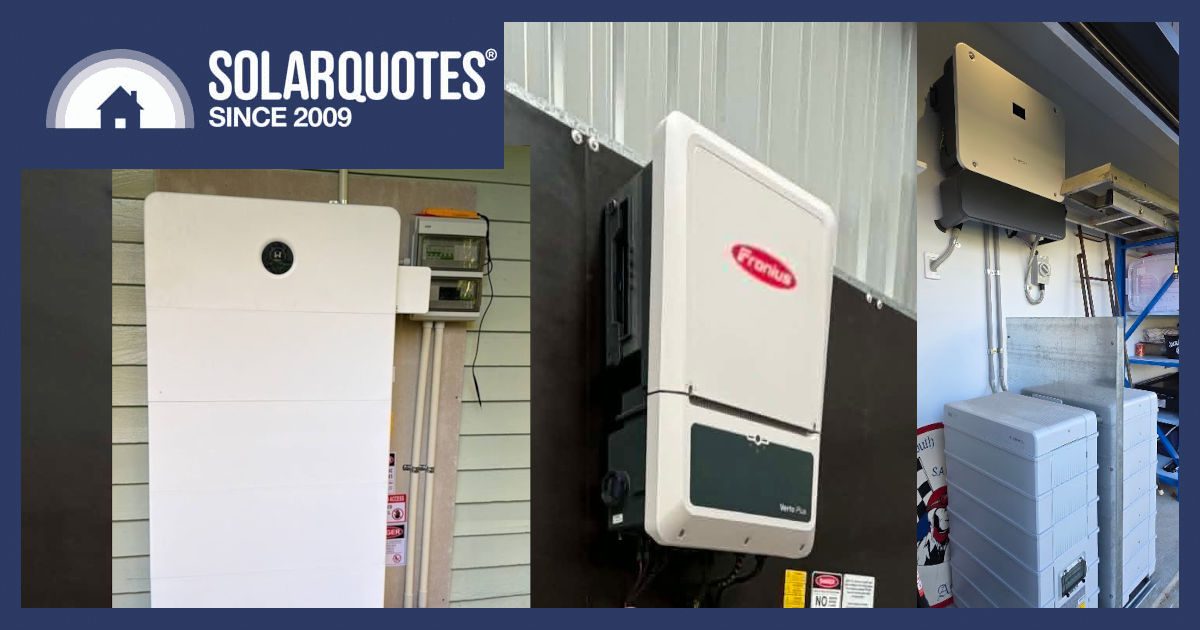
We’ve seen a big change in the solar industry recently. With batteries becoming standard, everyone is getting backup.
The problem is that poor design and sales misunderstandings are leaving people, especially three-phase customers, with a total oxymoron: unreliable backup power.
The good news is that solar power is being installed in huge numbers, and the attachment rate for batteries has gone through the roof. Some companies are even giving up on solar-only installations; if the customer doesn’t want a battery, the installers don’t want the job.
However, a few installers and customers alike have been caught out with an embarrassing lack of capacity.
Single Versus Three-Phase
I’m told that 80% of National Electricity Market customers have a single-phase supply, while two-phase & split-phase aren’t common, three-phase is becoming the new normal as houses grow and EVs proliferate. If you’re not sure what you have, read this explainer.
The vast bulk of appliances are single-phase, but on a three-phase property, they’re spread over three adjacent supplies, and often the house will be wired in three segments because the poles-and-wires network wants loads balanced within 5 kW if possible.
It’s not uncommon for a three-phase house to have a modest 5 kW single-phase battery backup system. They’ll supply 21 Amps, and there’s nothing wrong with that. However, as prices have fallen and appetites rise, more people are opting for full three-phase backup because it can save the cost of rewiring a third of the switchboard.
Things get awkward, though, when a numpty who’s used to selling 8 and 10 kW single-phase systems doesn’t automatically triple their recommendation to customers with a three-phase house.
10 kW Three-Phase Inverters Are Junk
The headline number isn’t the only factor to consider, as we’ve recently outlined, but the thing to remember is:
A 10 kW single-phase inverter is pretty gutsy.
- 10,000W ÷ 230VAC = 43 Amps
- That’s around 68% of your normal 63 Amp grid supply.
- It’s reasonable to expect it to back up the whole house.
However, 10 kW spread across three phases is only 3.3 kW each.
- 3,300W ÷ 230VAC = 14 Amps
- It might run the fridge on one phase, and the lights on another.
- Compared to the mains, you only have a very modest 22% available to any one appliance.
I Recommend At Minimum A 15 kW Three-Phase Inverter
A 15 kW three-phase system will at least provide capacity comparable to the modest 5 kW single-phase machines like the Tesla Powerwall 2. I still wouldn’t try a whole-home backup; a large single-phase air conditioner will overwhelm it. Provided you can do without a few big things, 15 kW makes partial backup quite feasible.
You Need A Power Surge
Electricians are trained to know that an electric motor will impose a huge demand on the supply at the moment it’s switched on. This surge in power, referred to as inrush current, means your 400-watt rainwater pump can draw up to 3,200 watts as it spins up.
The ability to supply this extra energy for a second or two is really important, even if modern air conditioners and washing machines often use “inverter” technology to make them softer on startup current.
Whatever system you choose, make sure it has enough battery. Some inverters will work with a minimum stack of, say, 3 batteries, but they won’t deliver their full rated output unless you have 5 or 6 batteries to really give them some punch.
Does What It Says On The Tin
The best way to judge a hybrid or battery inverter is to see exactly how specific the numbers are on the specification sheet. You’re looking not just for what they’ll surge to, but how long they’ll do it.
For example, the best units are very specific, with large overload figures guaranteed in 30-second, 30-minute, and 1-hour brackets.
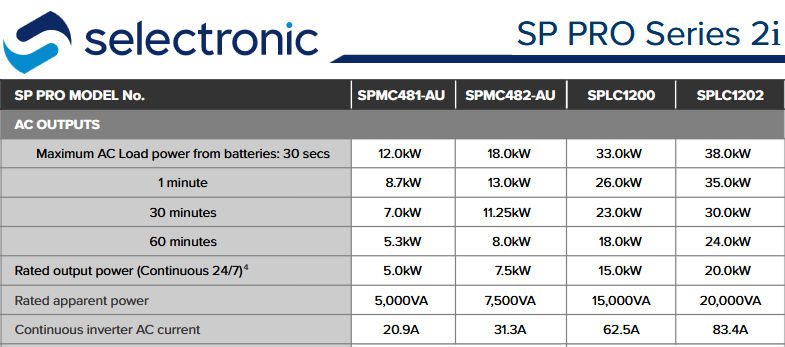
Just a sample of the range, Selectronic will peak at either 90% or 140%. They publish numbers you can hold them to, and I’ve measured it first-hand.
Tesla Powerwall 3 offers a stout 10 kW continuous and uniquely ‘murican spec of “185 locked rotor amps”, meaning it should surge to an instantaneous 42 kW! (185 A x 230 VAC) The 160 A fault current figure is a bit more credible at around 36 kW. Neither of these hefty claims is backed by a time, though, so you’re relying somewhat on the manufacturer’s credibility.
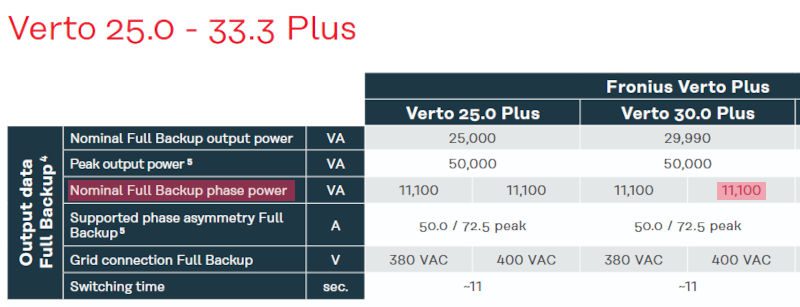
Highlighted in red is the important number for most people, which is around 11 kW of single-phase backup from a three-phase inverter
Other reputable brands have nominal and then 10 second surge ratings. GoodWe ESA single-phase has 10 kVA nominal output and some brackets claiming 20 kVA, or 100% extra for ten seconds. However, it’s worth noting that the 30 kVA three-phase units only offer 50% more surge capacity.
For more 30 kW comparisons, the new Fronius Verto+ hybrid is rated at a full 29,990 W with 50,000 W for ten seconds. While some curse the Austrians for being slow to market, we know it will be a solid, well-tested solution. 67% extra from a three-phase inverter is nothing to sneeze at.
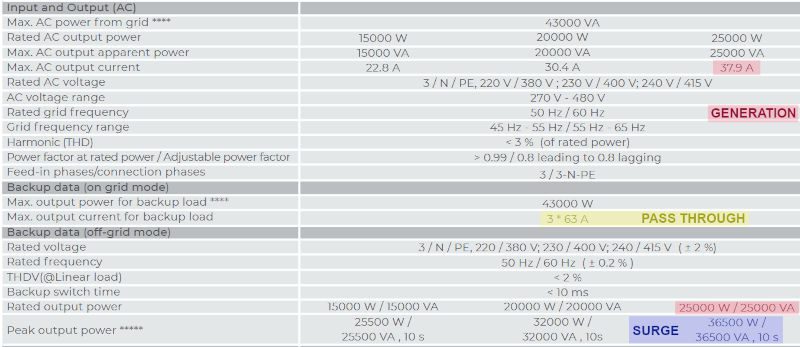
You basically need to be an electrician to decipher some of these specifications. Sungrow have a series hybrid that will pass 63 A through when it’s on the grid. It will generate 37.9 A, but you have to calculate 36,500 W ÷ 3 ph ÷ 230 VAC to conclude about 52 A for surge current.
Sungrow 10 kW single-phase offers numbers along the lines of 9999 VA rated output with 13680 VA surge rating, that’s 35% extra for 10 seconds. Their three-phase offering is rated at 25 kVA but has a 45% surge rating.
However, if your prospective inverter has a nominal kilowatt rating and only 20% extra for surges, I wouldn’t buy one. If it mentions nothing more for surge current, just a flat delivery figure, that’s a red flag in my book.
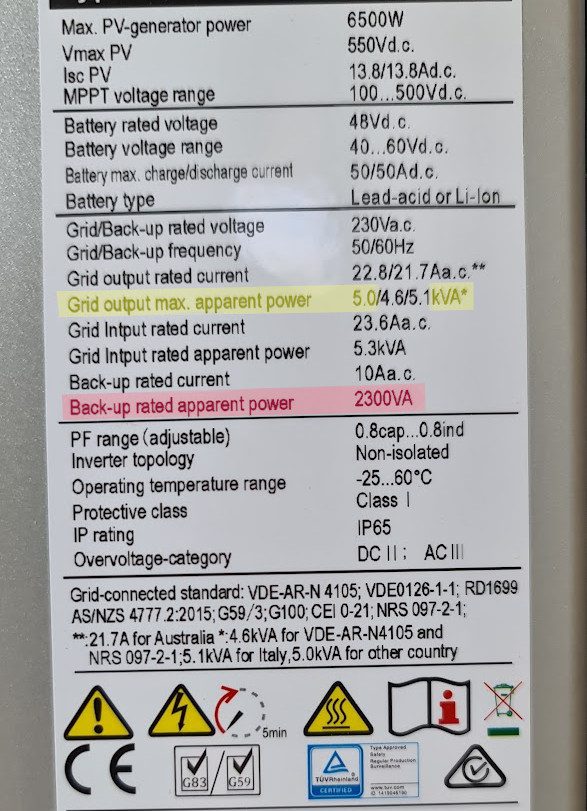
I was tasked with installing this AlphaESS unit 5 years ago. It was rated at 5 kW (yellow), but the backup supply was less than half that figure (red). It would barely start the fridge, but if the lights were on too, it just tripped out. Explaining this to disappointed customers swore me off cheap, lightweight junk.
A Series Of Excuses
We recently had to sort out a dispute between a SolarQuotes-approved installer and an unsatisfied landlord. He wasn’t an electrician, but he understood the issues well enough, and as soon as he mentioned what they’d sold him, I knew what the problem was.
It didn’t matter if the stove was gas or not, the notion that you could put a 10 kW three-phase supply on a food service business, with fridges, range hood, microwave, sandwich press, and a coffee machine; that’s patently absurd.
Part of the email conversation from the installer looked like this passage below, so I’ve added some helpful interpretation in italics.
“Originally, he did not specify the exact loads, and there is limited evidence that he clearly outlined that a backup of a fully operational commercial kitchen was expected.”
- They won the job as part of a resilience grant through Ausnet.
- The idea is that the doors stay open, and the coffee keeps flowing if there’s another bushfire in the Dandenong Ranges.
- They can’t say the place will be resilient when the system installed isn’t reliable.
“Most of the verbal communication has been lost as it was quoted 2 years ago with employees who have left.”
- Sounds like the dog ate my homework and my company documentation.
- They did a site visit and found a commercial chassis switchboard staring them in the face.
The issue is that backing up a commercial kitchen is not a small job.
- Yes. Correct. So they need to design the system properly.
- Or they need to tell the customer there is a limited capacity.
- AND they need to segregate the switchboard to make that limited capacity reliable.
Even if we did it the first time, it’s a significant upgrade, like buying a 4-cylinder car and then saying, “It’s not as fast as I wanted, give me a free upgrade to the V8”
- The customer showed them his tri-axle caravan, yet they sold him a Corolla with a towbar.
The silver lining in this situation is that the parallel-connected, stackable hybrid inverter will be easy enough to swap, though the 20-metre supply cable may need to be enlarged.
They’ll also have a great deal of data now that the system has been up and running for some time, including real-world measurements of peak demand at the site as it currently operates.
- The cable they installed might be good for more than 10 kW.
- Maybe the max demand means they can put a 20 kW inverter in, and that’ll cover the load without replacing the cable.
- However, the demand might be big enough that even a 30 kW system is going to struggle.
In either case, the switchboard might need to be segregated for essential and non-essential loads. Which, in this case, means a fairly involved process of installing another enclosure and removing circuits from the main switchboard.
My bottom line with this installer is to ask, “Do you ever sell 3 kW backup systems?”
Of course they don’t, yet they did site visits, and they looked at a commercial switchboard for the hospitality business… and they designed a system based on a 10 kW three-phase machine. 3.3 kW of backup is effectively useless, and that’s a failure they must own.
They Turn Up On Social Media
Finn recently detailed a real-life problem where customers didn’t realise what they were getting into. I’ve dealt with a rash of similar complaints via the SolarQuotes support channels. One in particular boiled down to a salesman who missed a 7 kW floor heating load, so whether the grid was available or not, the system would overload and shut down intermittently.
Lightweight Hybrid Inverters Are Not Good For Off-Grid
I recently saw an electrician requesting help with an off-grid system that was failing under the load of 4 domestic deep freezers. On paper, it was passable, but in reality, the Sigenergy hybrid inverter proved unfit for purpose and had to be replaced with a proper Victron off-grid system. Thankfully, this bloke was big enough to admit every day is a school day, and sometimes you learn the hard way.
For installers, it’s particularly difficult because they should damned well know better. When things go pear-shaped, it’s not only expensive, but it also causes a lot of reputational damage. There’s often a bit of he-said-she-said; that’s where you find verbal contracts are fickle.
At the end of the day, if an installer has promised unconditional backup, then they’re on the hook under Australian Consumer Law. Either they deliver a solution that works, or they offer a refund that includes funding from the Cheaper Home Battery Program.
I can’t stress it enough; if you’re looking to get blackout protection for your place, make sure everybody is on the same page. Grab your sales representative and write down what you expect the system will, or will not do.
Don’t let a headline kW number decide your backup power. If you’re on three-phase and shopping for a battery, get up to three quotes from SolarQuotes’ vetted installers and ask each one, in writing, exactly how many kW you’ll get per phase, not just on paper. Every quote is backed by the SolarQuotes Good Installer Guarantee.
 About Anthony Bennett
 RSS - Posts





The second solar panel and battery system that we had installed was for 3-phase, and I must admit that I’m not sure of the size of the inverter. What I did find out was that the postie might have done a better install than the lot who did ours. It was only because I read this site news that I found out that the backup on our SUNGROW battery was not installed – no wires, no connections. The installers left without even connecting the system to Wi-Fi, because they didn’t know how to do that!
I’ve had my battery and inverter for 8 years now. Single phase as back then it was all that was realistically available for home batteries.
When I upgraded my whole home ducted AC a few years back I hit a small issue – the new AC had a larger inrush current than the old one. Not by much, but enough.
The result was that the inverter had a panic as that phase was still on the battery when road main resumed and available power sagged on that phase, the AC killed itself, then the inverter would come back up, the AC would try and start up again, inverter would cut out, and an endless loop occurred of inverter panic until someone was home to force off the AC to allow that phase to switch back to the road.
The simplest solution I could think of was to install a phase relay / low voltage relay on the breaker for the aircon. When a phase drops, the breaker for the aircon “trips”. It’s not going to work on a single phase anyway, so who cares? Once power is back, reset the breaker.
There used to be rules that mandated a mains fail relay for all air conditioners back in the daze…
Hello Anthony. I have a Hybrid 10kWatt Gen 24 Fronius Inverter, the largest inverter that AusNet would allow at the time it was installed in 2021. I would have liked to install a larger inverter as I have a 3 phase home plus a large solar array. What are my options to increase the inverter capacity? Can I parallel couple another Fronius inverter (of course if AusNet would allow it). Regards, Francesco
Hi Francesco,
I’ll assume your 10kW Gen 24 Fronius Inverter is a “Primo” ie single phase? Fronius brand their 3ph stuff as “Symo” and the gen24 now comes as 12kW max.
Generally, networks allow 10kW per phase, so 30kW total, but they normally want it balanced so there’s not more than 5kW difference between phases.
You could parallel more Fronius on other phases but I don’t think they’ll form a 120º synchronous grid, they’d need to be separate. However I’m told Fronius are working on firmware to make them more flexible, as currently they will only run a single unit during an outage.
You could however install the new Fronius Verto, available as 15, 22(?) 30 & 33kW.
Slow to market compared to other brands but I’m confident they’re well tested, so they’ll do what they say on the tin without using customers as guinea pigs.
they might be slow to release new equipment. but it will work.
and what do you expect from one of the oldest inverter and welding equipment manuafacturers.
one of their first products was a battery charger for workshop use.
it also explains the premium price tag
Hi Chis,
Fronius have specific testing rigs, using our typical materials & methods they do “Australian” installations of the equipment back in Austria.
Along with thousands of real life data points via remote monitoring, Fronius test the s#it out of everything.
They simply don’t ship things they’re not confident will work, whereas many lesser manufacturers are content to use the customers as development mules.
You get what you pay for, including a fan, which is nothing to be sneezed at.
Good advice Anthony.
Lawrence Coomber
Whats the answer for 2 phase property wanting battery backup. on both phases 2 solar systems already on the roof
Hi Kevin,
Depends if it’s two phases out of three, (120º between phases) or split phase from a SWER transformer in the countryside. (180º opposite waveform)
I believe Sigenergy can do battery backup on 2 phases with a 3p inverter. All other brands would need two single phase inverters with dedicated batteries.
However the only soulution I would call native for 180º split phase is using two Selectronic inverters. Can use a common battery but you’ll need Fronius or Fimer PV inverters to do the solar. Proper bulletproof system though.
Apropos the replacement of a hybrid inverter with Victron off-grid, my recommendation is to use two battery inverters (whether Victron or Selectronic), for redundancy. When one fails, even 15 or 20 years down the track, I still have fridge, microwave, lights, and internet. OK, I could start the generator, but that’s ugly, if it takes 3 weeks to replace. (And mine is too small for HWS etc. Anyway, heating water with 25% of the petrol’s energy is fully nuts.)
Here, it’s two Victron battery inverters + two Fronius PV inverters, for a 50:50 AC/DC coupled system. The DC coupled provides Black Start, while the AC coupled is a percent or two more efficient when charging the BEV.
Without a grid fall-back, it’s even more important to design a resilient capacious system. (Here: 16 kVA from battery + 12 kW AC coupled.) As BEVs proliferate, think two, plus house loads – in a few years at least.
It’s just painful for both clients and vendors to be learning together.
In what way did that Sigenergy hybrid inverter prove unfit running those 4 freezers off grid?
Hi Rod,
Simply wouldn’t get them started as I understand it.
The installer apparently had other sites with no issues, however this one struggled with random overload/shutdown of the inverter. They tried a number of combinations, but even if only one freezer was plugged in, it simply wasn’t reliable. The customer expected to get more freezers in the future, so it wasn’t tenable to use a lightweight grid hybrid when it had proven incapable of off grid work.
Schneider & SMA are no longer available, so for remote area reliability you really need CT&E, Xess, Victron or Selectronic.
And with VIctron or Selectronic, you just parallel up another battery inverter and more batteries when the system needs to grow. Nothing wasted as system capability rises. All smooth sailing, given room on the wall. (Indoors here) System monitoring is touch-screen/phone app/LAN/cloud, very nifty.
Here there’s two Victron 8 kVA battery inverters, two 6 kW Fronius battery-compatible PV inverters, and three 15.5 kWh LFP batteries, with an additional 210 Amps charging capacity from MPPTs.
As it’s off-grid, the Victrons are grid-forming, so expansion would have to be battery inverters before more PV inverters. That also increases night-time output, so all good. The battery enclosure has room for another 15.5 kWh.
Two of everything allows one to go down without having to eat the icecream first. And MPPTs provide black start without need for the generator.
At least one aircon will run all night off battery, quite a few nights, this summer, we can safely predict.
Great article. Tired of people telling why their single phase 10kw inverter and 50kwh sitnstare battery coupled with 10yr old panels and a ducted air system is rubbish. They focussed on brand not specification. They know it doesn’t have backup but were told it would cost more. So would the right inverter
I have a 12kw 3 phase running with a 64kwh 48v battery. I have the phases reasonably balanced but know that I will have an issue if the two largest a/cs (another 3 small units across a couple of buildings and three heat pump h/w units) are running with the oven in action. So I’m about to run a second 12kw hybrid in parallel to future proof with the possible addition of extra water pumps for fire fighting. Everything is a moving target
Question prior to installing
I have a 3-phase connection, but I put all the important loads that I need during a blackout on one phase only.
Solar system is 3-phase.
Is it then better to install a 1-phase system (looking at Sigenergy) with the 10kW inverter rather than the 3-phase 10kW inverter? On top of that it would be cheaper.
Hi William,
The existing solar being 3-phase will be rendered useless during an outage but where you might run into issues is getting network permission. Some only allow 10kW of inverter capacity per phase, others allow an additional 10kW of battery inverter, but not hybrid inverter (meaning you can’t have DC solar on the new hybrid unit)
DC coupled solar is a good option so you might end up ditching the existing inverter, connecting your legacy solar and some new solar to the hybrid unit.
I think you might find there are a lot of Solar Quotes sourced systems with a “useless” 10kW three phase inverter.
I certainly have one. Yet another one of those “if only I had realized” moments.
Do you upgrade the inverter or just live with AC and spa that can’t be backed up and watch what you use in a black out?
The later will need a map of every gpo and hard wired appliance mapped to which line they are on to avoid overloading one line. That should be fun.
Hi Matt,
I know customers and installers who’ve both had that realisation so I’m sorry if this article has come too late for some.
One of my best mates has a 6kW Fronius, but he’s aware of it’s limitation and seeing as it was $500 secondhand he’s willing to live with it because that’s less than the software update needed to make it a battery compatible unit.
Just have to live with 2kW of backup in that instance, enough to run his gas HWS igniter, which is a lot better than nothing.
not difficult to do. just takes time. and you can do it your self.
turn all breakers off
number each breaker
turn them on one at a time
have a worklight plug into each power point.
if it lights up its on that circuit. right the coresponding number on the outlet.
it fairly safe to assume all outlets in a room are on the same circuit. do check though.
also if there is a outlet on the oposite side of a wall to antother outlet chances are they share the same circuit too.
once you have gone around the house and checked each outlet, turn that breaker off again and do the next one.
rinse and repeat till each one is done.
there should be some labled circuits in the switchboard such as lights, stove, hotwater, aircon
you dont have to worry about those much. you only need to look at the ones marked power.
the “fun” and costly bit is seperating outlets onto new or other circuits. and is where a tradesman comes in.
Good method Chris.
You can’t assume anything though.
I have two power points behind my fridge, about half a metre apart vertically… on two different circuits.
…. that’s to keep you on your toes Anthony! BTW, are you doing system designs yet?
We had an installer put in a Huawei system a few years ago for our large two-storey Port Stephens home plus granny flat. They installed a 15kWh battery connected to a 6kW three-phase inverter and an additional 5kW single-phase inverter that just connects some panels to the grid via the meter box. I was very naive at the time but I wish I had been told that the 6 kW inverter would only deliver 2kW per phase and explained to me what that would mean in real backup terms. As such the house wasn’t able to be backed up so the installer put the backup out to a GPO on the wall that backs up a garage door when the grid goes down. To try to fix this I’m in the process of sorting another battery so that both batteries combined will be able to output 8.33kW per phase when connected to a 25kW inverter to be purchased sometime in the future.
Don’t expect the majority of installers to know much (or anything) about the Australian SRES Legislation that Governs the Renewables Industry. This is what the Clean Energy Regulator has framed the Renewable Energy Credits regulations around. If you want to understand how you can properly design and install multiple power plants at your property to efficiently and cost effectively satisfy all of your loads, get the right advice and tag up with the right system designer. Start by reading the legislation and technical appendixes. Importantly understand the STC (per system) and aggregate systems at the one property. Always consider including “Specific Circuits” off Grid Systems as appropriate, extra to your existing Grid Connect System. Understand the new 1st Oct up to 1 MW aggregate rules for STCs at your property. Get educated on the subject, and tag up with a power engineer to fully exploit your options. Lawrence Coomber
3 phase options are much better than they were a few years ago, and there is more info available for people who are trying to do a bit of research in to what they actually need to get the result they want, but backup with 3 phase still seems to be a bit of a mine compared to single phase.
Talk to a professional system design engineer about installing multiple systems at your property (STC’s payable for any number of individual systems you want).
Single phase On Grid + 3 Phase Off Grid no problems. Generation is a foundation technology science – it is not governed by popular opinion or standard solutions trotted out via the media.
What about installing another 3 phase EV charging Off Grid solution to your existing On Grid single phase system. No problem. What about a single circuit Off Grid Pizza Oven plus Pool Heater. No Problem.
I see a lot of discontent in the community around the Renewable Energy industry at large. I am not surprised. It has evolved mainly to be a “a one trick pony” rather than an expansive engineering revolution.
Keep agitating and probing – and get what you want.
Lawrence Coomber
Hi Lawrence! You by chance dont have a list of said system design guys that you would trust by chance who do domestic designs ??
The result is exactly the problem you have just encountered:
You have an entirely reasonable engineering requirement — but finding somebody prepared and qualified to engineer it from first principles is remarkably difficult.
That should never have been allowed to happen in a country with Australia’s engineering capability and renewable-energy resources.
John, contact me directly. I’ll help you work through your system concept — no charge.
Lawrence Coomber
John, there isn’t a national list of Renewable Energy Engineers with the depth of experience needed to design non-conventional domestic / commercial RE systems. And that, exposes a serious weakness in the AU RE industry.
Over many years we have allowed the industry to become progressively dumbed down into a largely standardised sales-and-installation model: select approved products; follow standard templates, connect it and move on to the next job.
That’s installation – it is not RE engineering.
AU lacks a formidable home-grown RE engineering capability; including engineers capable of designing multi-system installation; specialised off-grid and independent multi-phase systems; purpose-built generation and storage architectures; and entirely new technologies.
Instead, we have become heavily dependent on overseas hardware, software, technology platforms, and increasingly overseas design thinking.
There are of course reasons for where we find ourselves.
Lawrence Coomber
Hi Lawrence,
As you say, most garden variety grid connect solar is designed using an aerial photo and software. Have you used Pylon, Helioscope or OpenSolar yourself?
Thanks Anthony
They are versatile platforms Anthony. Not my day to day work these days though, I cut my teeth on Ret Screen; PV Syst and SAM. Before that though (2008 era) we were doing our own Excel VBA applications from scratch and achieving similar core results without the bells and whistles of course.
Interesting though you mentioned software because at the moment I am doing a Master of Engineering – Applied Research (Electrical Systems) with EIT and my thesis is titled:-
“Energy-Autonomous Solar-Electric Ocean Cruising Multihull: Integrated Optimisation of Hydrodynamic Resistance, Electric Propulsion, Battery Storage and Weather-Route-Aware Energy Management”
Only yesterday I pencilled in PV-Syst as having a small but important role soon in some of the solar plant solution design.
Lawrence Coomber
I was pretty disappointed with the 3 installers I got from Solar quotes because of this very issue.
Spoiler alert, I have a B. Eng in electrical. Having a 3 phase supply, I expressly wanted a 3 phase inverter and whole home backup. The main reason is not everyone is an engineer and didn’t want my wife and family worry about what needs to be on or off and on which circuit. Technology should simplify life not complicate it.
The installers instead pushed the idea that the net meter balances the math. This made me furious. Even when I pushed back and told them it will not cover the power envelope, they persisted in the solution they wanted to provide.
While I dearly would have love to get a 30kw 3ph sig, I went with what the wallet could stretch to with 20kw. I only had one phase that might temporarily hit 6kw (yes the central AC and its single phase). However once it dies guess who’s getting a 3ph AC unit. Power outage recently occurred, so the party was at my place…literally.
Hi Charlie,
The solar industry has a stereotype enemy, held in equal parts fear and ridicule.
It’s a trope, shorthand for “jebus this punter is difficult”
Everyone has a story about their least favourite customer… the retired engineer!
Now in many cases it’s someone who just wants the job done right.
Or a person with exacting standards, an eye for detail and a specific design & brand of gear with specs they’ve researched.
The flip side is that often the installer knowing what the sell and selling what they know is really reliable, and as you note budgets are always a concern.
I’d love your review on the Sig equipment.