
Across the country, installers are bending over backward to get systems in before the federal battery rebate reduces on May 1. Note I wrote “reduces”. The rebate is declining, not disappearing.
When Does The Federal Battery Rebate End?
While the Cheaper Home Batteries Program incentive will fall in May, it’s not scheduled to end until December 31, 2030. If you don’t have an installation lined up prior to the end of April, you haven’t missed out. For a battery size suitable for a typical household, the rise in the installed cost will often be under 10%. It may not even be that much, thanks to falling battery prices.
But according to some solar installation companies, the federal battery rebate is ending. While I don’t believe they think this themselves, it is what their online advertising says.
Whacky Adverts
This error-ridden advertisement from SolarRun is enough to give me the runs:

The ad starts with:

Except it’s not. But this doesn’t stop them from going on to say…

But people aren’t going to miss out. The rebate isn’t going to end for nearly 5 years. From May through December 2026, it will still be possible to get nearly $7,000 in rebate – provided the installed battery is really big.

Neither this month nor the next is your last chance to save thousands. If you get a 14kWh battery after April, the rebate will be over $3,700. If you get a 28kWh battery, it will be over $6,000. And with a 50kWh battery, the total rebate is close to $7,000. As for your carbon footprint, you can still get a battery and reduce that after the end of April. No one’s going to stop you. The rebate just won’t be as high.

Perhaps they included the above line above because they’re aiming at the sort of homeowner who’s into sustainability involving composting cow pats with various grades of bull shit. If you get a battery after the end of April, the amount you pay may change, but nothing about its sustainability will alter overnight.

Here’s that $7,000 figure again, and I don’t know where it came from. If you get a 20.9 kWh battery installed now, the maximum possible rebate would be exactly $7,000. But it’s really weird to assume that’s what people are going to be missing out on. I kind of doubt they only install 20.9 kWh batteries, and after April that battery will still receive $4,920 in rebate.
Even More Whack
Here’s another ad heralding the end of the battery rebate. This one is from ElectrifyHome:
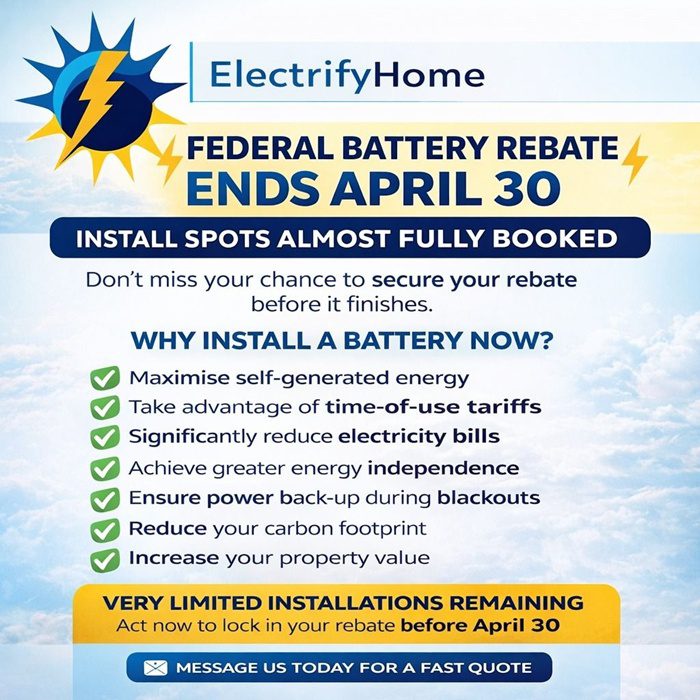
This one came as part of a social media post containing additional information that explained that what’s written above isn’t correct. But that doesn’t stop what’s up there from being BS. You can’t scrub away perfidy using small print. What’s perfidy? Well, here’s an example:

That’s not true. Not only is it not true, there has never been any reason to even think it might be true. At no point has the government suggested the rebate might end then. While the government has already overhauled the scheme once and could do it again, to expect them to announce a surprise ending on April 30 is completely bonkers. Even if Richard Head down at the pub swore blue that it was ending on April 30, and for some reason you believed him, you still have a responsibility to check how likely that is before basing an advertising campaign on it.

Because 4 years, 9 months, and 3 and a half weeks isn’t long enough? Because that’s the amount of time before it ends.

Is that April 30, 2030? If it is, that’s still a bit early, as it’s a whole nine months before the rebate ends. Talk about needing a long time to get your ducks in a row.
It Didn’t Have To Be This Way
Most installers are bust to bits and struggling to get systems in before the rebate drop at the end of April. You’re going to have a hard time finding anyone who’ll commit to installing a battery before May, so instead of plastering dodgy advertisements on the internet, all these companies had to do was advertise that they can get a battery in before the rebate is reduced, and they would have got plenty of interest. But instead, they went for advertising that makes them seem either…
(a) Wildly incompetent, or…
(b) Dishonest.
Or in my opinion, both.
Rebate Reduction Depends On Battery Size
The end of April rebate cut will hurt, but by how much depends on the size of the battery. If you’re getting one from 12-16 kWh, which is an acceptable size for most households, it will be unpleasant, but not unbearable. But if you’re planning to get a big battery from 30-50kWh, then the cut will sting so bad it’ll feel like it came with free lemon juice.
Right now, the battery rebate is straightforward $333 – or very close to it – for every kilowatt-hour of usable capacity for the first 50 kWh. So if you get a 14 kWh battery, the rebate would be $4,662, and for a 50 kWh battery, it would be $16,650. There are administration costs that have to come out of this, which make the rebate smaller in practice, because they have to be paid whether or not your quote says you’re getting the full rebate. But I’m not going to worry about them, and you shouldn’t either, as there’s nothing you can do about them. Just keep in mind they reduce the actual size rebate by around 3-10%.
From May 1, the rebate becomes much more complicated, switching to a tiered system, with the rebate amount depending on battery size. The rebate per kWh will drop to $270 – a 19% decrease from what it is now. But only the first 14 kWh of usable storage capacity will receive that much. That’s the first tier. There are three of them, and they work like this:
- Usable capacity from 1-14 kWh (5kWh minimum): $270 per kWh
- Usable capacity from 15-28 kWh: 60% of $270 = $162 per kWh
- Usable capacity from 29-50 kWh: 15% of $270 = $41 per kWh
Rounding issues mean the rebate may not work out to those amounts on the dot, but they will be close.
When put into a graph, it looks like this:
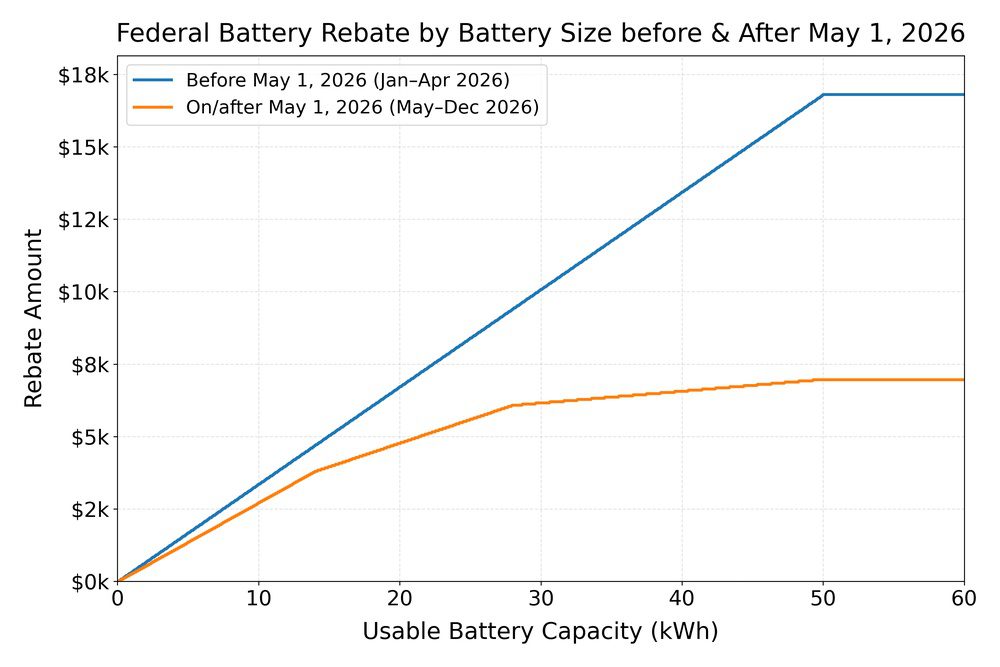
It starts off as a moderate cut for up to 14kWh, then grows to a much larger cut by the time 28 kWh is reached, and by the time it hits 50 kWh it’s enormous. By battery size, the rebate reductions on May 1st will be:
- 14 kWh battery = $880 rebate cut
- 20 kWh battery = $1,960 rebate cut
- 28 kWh battery = $3,320 rebate cut
- 50 kWh battery = $6,960 rebate cut
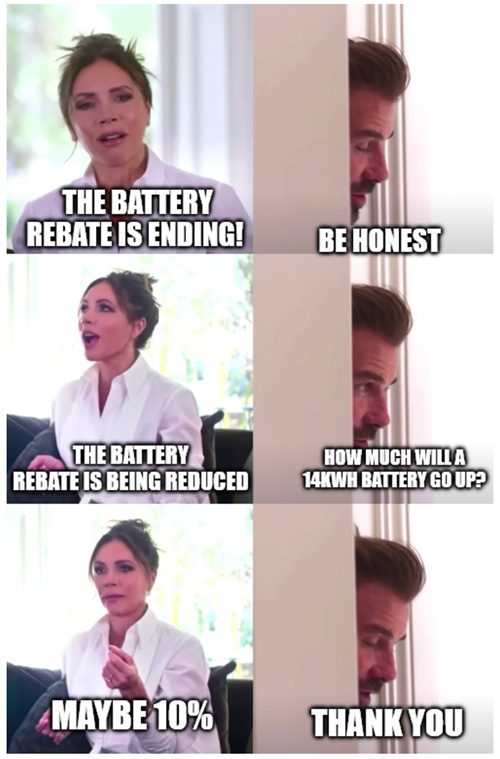
Even if you’re only planning to get 14 kWh or less, that’s enough of a drop to hurt. But, as a percentage of the installed price, it’s not too bad. If you are getting a pricier battery, such as a 13.5 kWh Tesla Powerwall 3, it might only add around 7% to the installed cost. For one that’s lower cost, but still decent quality, it might add 11% or more.
To find out what amount of incentive you can claim for your preferred battery, use our federal battery rebate calculator.
Price Increase May Be Less Than Rebate Decline
If you’re getting a 14 kWh battery and the rebate falls by $880, it’s reasonable to expect its installed cost to rise by about $880 from May 1. But the actual increase may be less for 2 reasons:
- Battery installers won’t be so rushed and may lower prices as demand falls.
- Batteries will continue to fall in price.
There’s no guarantee these effects will apply, but I’m expecting them to at least slightly offset the rebate decline.
The Rebate Ends In Nearly 5 Years
The actual end of the federal battery rebate is over 4 years and 9 months away. The rebate will reduce over time, but it won’t disappear until then, so it has a lot of life left. Or at least it does if the government doesn’t change it, which they’ve already done once, with government departments reportedly modelling further changes, although Labor has given zero public signal that it intends to further reduce the incentive.
Hopefully, they won’t alter it again. While I can’t be certain they won’t keep their fiddly fingers off it, I have unshakable faith they won’t suddenly announce that it’s ending in April.
If I put all the currently planned future rebate reductions into a graph, I get this ugly monstrosity. I intended for it to look pretty, like a rainbow, but that’s not at all what happened:
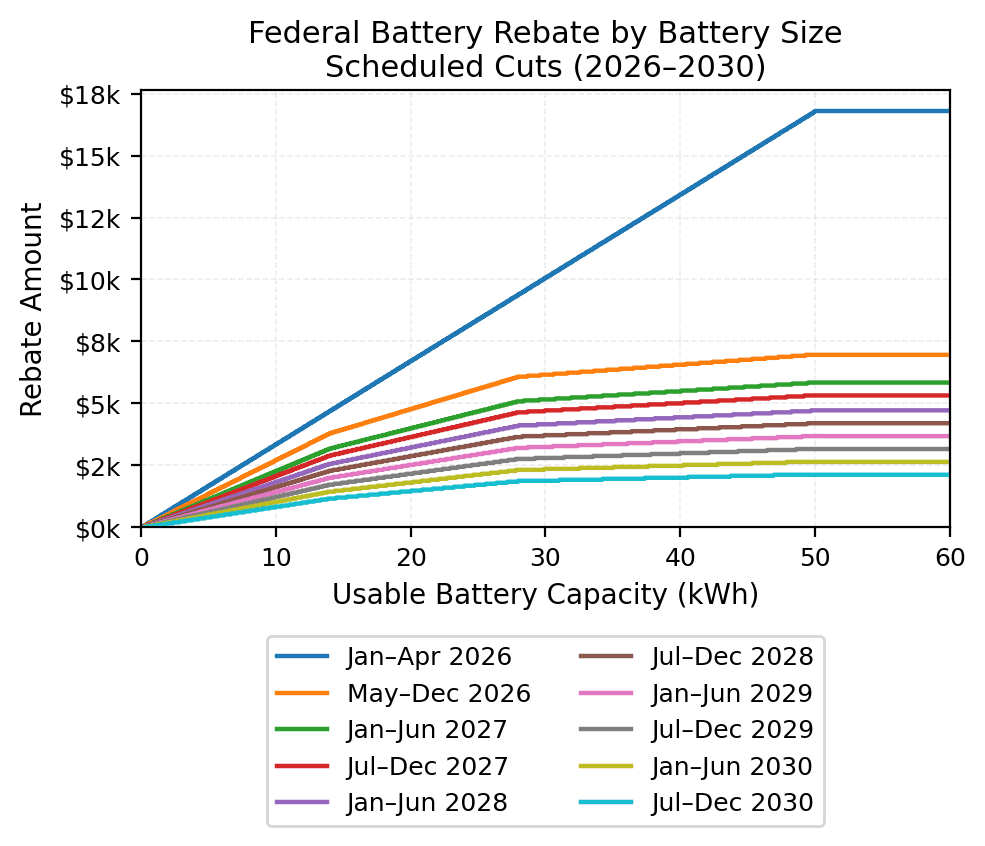
If you get a 14 kWh battery from July to December in 2030, at the very end of the battery rebate, then it will be 25% its current amount, while for a 50 kWh battery, it will be 13%. But these figures leave out inflation. If this averages 3% per year, the rebate amounts at the end of 2030, as a percentage of the current rebates in today’s money, will be:
- 14 kWh battery: 22%
- 50 kWh battery: 11%
Don’t Panic!
The battery rebate isn’t ending on April 30 this year, and is scheduled to continue until December 31, 2030 – although it will be pretty low by that point. If you want to avoid the April reduction, it’s going to be very hard to find an installer who can fit you in. The two ads I’ve displayed on this page show it’s not impossible, but it is going to be hard to find an installer who’s trustworthy. And when you’re blowing the one and only time a property can use the federal battery rebate, you definitely want an installer you can trust.
For accurate information on the Cheaper Home Batteries Program, read our guide to the federal battery rebate.
 About Ronald Brakels
 RSS - Posts






. . . installed, inspected, and commissioned prior to April 30th.
This is going to slow down battery installs, but until Dec 26th it’ll probably be minimal.
I’d like to have seen the first threshold go to 20kwh, it’s a figure that allows most homes to cover their own needs for an evening, and probably send an easy 10 to the grid early evenings to help out both the grid, and reduce payback.
As it is now, stacks will allow up to as close to sub 14kwh as possible, seems to be tailored for the PW . . . but fixed sized batteries around the 10kwh like SE, you’ll have to go home need only or lose nearly 2 grand to double up.
PW double up is going to hurt those choosing or needing that option.
The graph drop offs past Dec 2026 is going to stifle investment across the board expotentially.
It is what it is, something for nothing, with longer payback as time goes by.
yeah “reduces” – for a big battery – sort of like the worlds supply of oil at the moment is “reduced”…
So for a 16kWh system like we have, after the rebate reduction, would it make sense to get a 14kWh stack to get the higher rebate and then add another brick to the stack afterwards with no rebate. Might come out cheaper overall than a single install at the lower rebate?
Dave, outside of exceptional circumstances, I’d always recommend getting the extra battery module installed along with the first 14kWh. This is because the first 14kWh will still get the full post April rebate, while any extra capacity up to 28kWh will gets 60% of the full rebate per kWh. On top of that, it will save you paying the installation cost when the extra module is added.
I had Solarrun install my battery and their after sales support is woeful.
With the sigenergy recall I have not been contated by them and any e-mails or phone calls have been ignored.
After contacting Sigenergy they are organising someone else to replace the inverter.
Hi Peter,
Sig are farming out a lot of their warranty work.
Have tou left a review for your installer?
https://www.solarquotes.com.au/installers/s.html
The rebate reduction IS very material. Back in Nov we booked and had 43kw of battery a inverter (15kw) and 30 panels foxess installed. Out ex rebate cost $12k. Now $15500.
If we installed 1 May it is ckoser to $25k
No amount of discount will be comparable from May
The rebate reduction does end the opportunity to get a reasonably sized battery at a reasonable price.
Families use 20-40 kWhr per day and need to store at least that much energy storage to make a battery worthwhile. There’s very little point getting a 10 kWhr battery that fills via solar before 11 am, makes you sell your excess solar for nothing during the rest of the day, then runs dry by 8 PM.
Getting a 30 kWhr battery after the rebate reduces will cost thousands of dollars more, effectively killing the opportunity. So the ads aren’t too far off.
In terms of RoI, there’s no need to try to make your battery meet all your demands, all seasons.
if it can get you through the evening peak, then top-up overnight on off-peak rate, and get you through the (winter) mornings – you’ll be getting maximum utilisation from your battery, without paying excess for a large battery that may be quite poorly utilised over summer.
In terms of social benefit- it’s better to get small-medium batteries installed across many households to ease the cost-of-living pressures on average Aussie families, and remove he evening peak grid demand, rather than subsidising better-off people obliterating their power bills and then profiting of selling excess back into the grid (including aribtrage between night and day rates).
So – for many indivdual households, and to ease pressure on the grid, a 8-14kWh battery is a perfectly reasonable size with good RoI, great cost-of-living savings, and effective peak shift for the grid.
actually no, your incorrect. you don’t need that much storage at all.
in reality you only need enough storage to cover from the evening peak period to the morning peak period each day with a little margin.
because your consumption during the day is covered directly by your solar.
for most homes 10 to 15 kwh would be sufficient. and the average home without a ev would need 6 to 8kw of solar generation to get there usage during peak sun hrs. remember solar is still producing for about another 3 to 5 hrs outside that peak period.
The federal government MUST step in an take charge, but stopping these false and misleading ads. The government MUST take a ZERO tolerance toward businesses that act in this way and remove accreditation (if such a thing exists). Does it?
Come on Chris Bowen. You’ve been a great minister in your current role. Become even greater by stopping those trying to take advantage of people.