
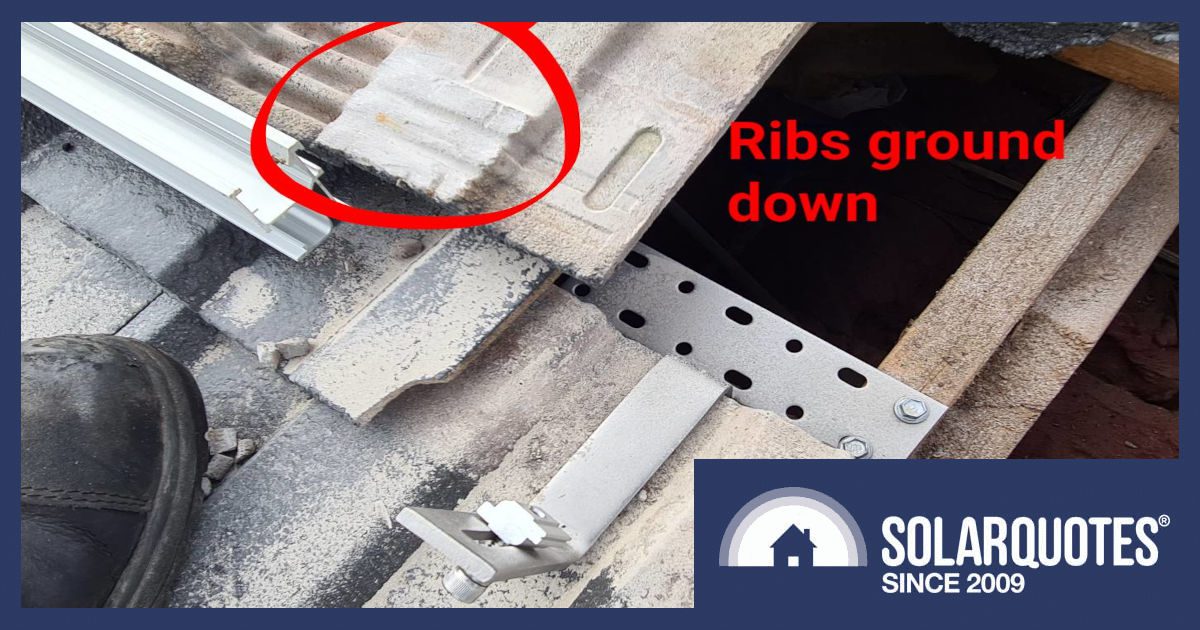
You might have noticed that grinding artificial stone kitchen benchtops was banned in 2024.
Health and safety laws have caught up with the silica dust created when grinding cement products, and for solar installation that means dry grinding tiles is no longer acceptable.
Solar Installation That Grinds My Gears
Recently I fielded a complaint from a punter and it was disappointing for everyone concerned.
The installer had lifted a few tiles, ground them for bracket clearance and screwed the system on with great efficiency. Problem was that the homeowner had recently paid good money to vacuum all the dirt and dust from the roof space and installed new bulk insulation.
This work was laid to waste because the new insulation was now filled with concrete dust & tile fragments.
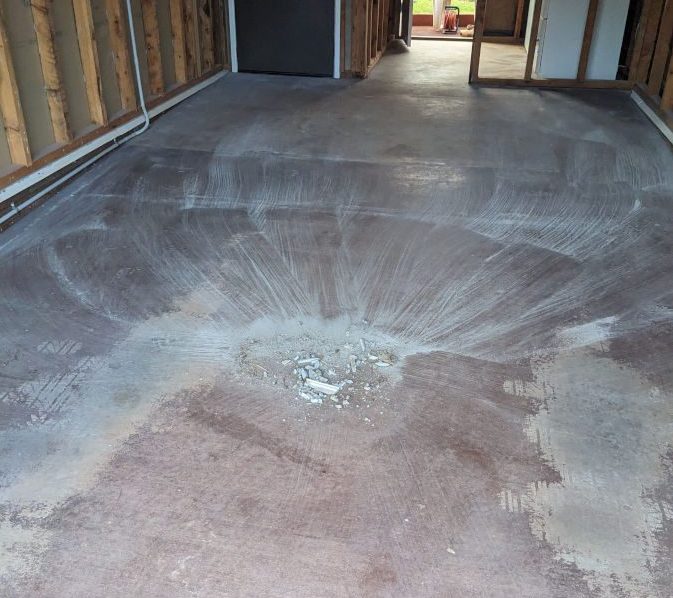
What a mess.
Dear SQ,
I don’t have anyone qualified/experienced to ask to get some advice on what is/isn’t acceptable practices for solar installation. I don’t know if I’m being unreasonable or if this is a real issue I need to pursue.They cut my concrete roof tiles in-situ (still on the roof) to install the brackets, used no dust control and filled my house with concrete dust – in the roof cavity and some inside the house itself.
Picture is of garage that has no ceiling – so all dust created above it fell on the floor. The rest of the roof cavity has significantly more brackets and more dust. It is a LOT of dust, the picture does not do it justice – please refer to video.I installed new roof insulation literally last week and now it is as dusty and in as poor condition as the old stuff I removed – getting rid of the dust out of my roof cavity was entirely the point of that exercise. I am frustrated.
As mentioned, hoping to get some guidance or advice on what is reasonable in this situation. It’s out of my wheelhouse.It would be good to know if I am being an unreasonable customer or if I am within my rights to be upset.
Kind regards,
Aanon
Rules Require Tiles Are Modified
Some of the installers I’ve worked for took a fairly libertarian approach to the rules – they ignored them. Bang the brackets in, slide the tile back down and get on with the job.
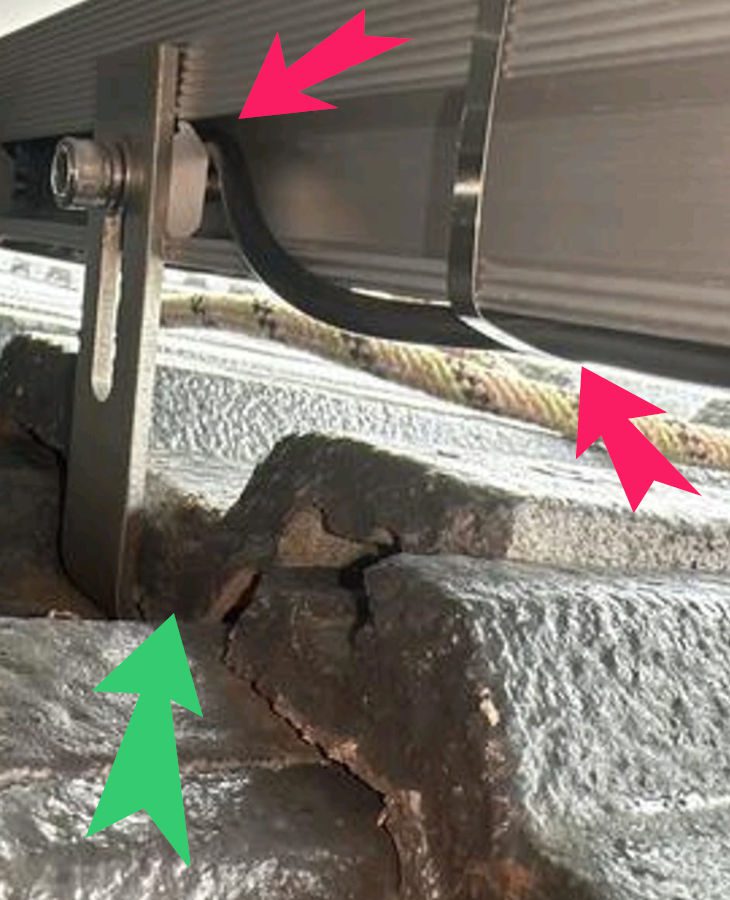
Green arrow shows where tile isn’t fitted properly. Bonus sharp edges to damage DC array wiring arrowed in red.
Apparently none of them leaked, except the 100kW – 300 panels on a pub. A disaster that was only fixed by removing the solar altogether because the roof pitch was always too low.
These days, everyone must make sure the tiles sit back exactly where they were, which means making space for the bracket.
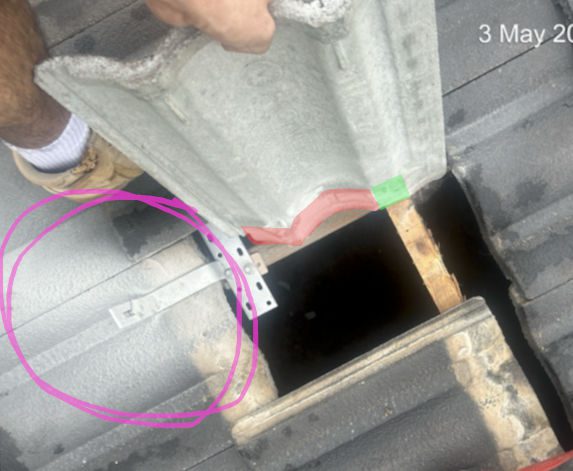
The bracket circled is quite narrow so the green shaded section needs to come out, not the whole bottom edge shaded red.
There’s variations on method but many installers would prop a tile up on their boot and poke a 9” grinder under the chosen area to blindly carve ribs off the bottom of the tile. A classic quick and dirty way to get through the day – I suspect that’s what caused this particular complaint.
I’ve personally marked, flipped and ground tiles with a 5” wheel for a closer fit, which at least left the detritus on top of the roof, rather than on top of the ceiling. It was still a filthy job.
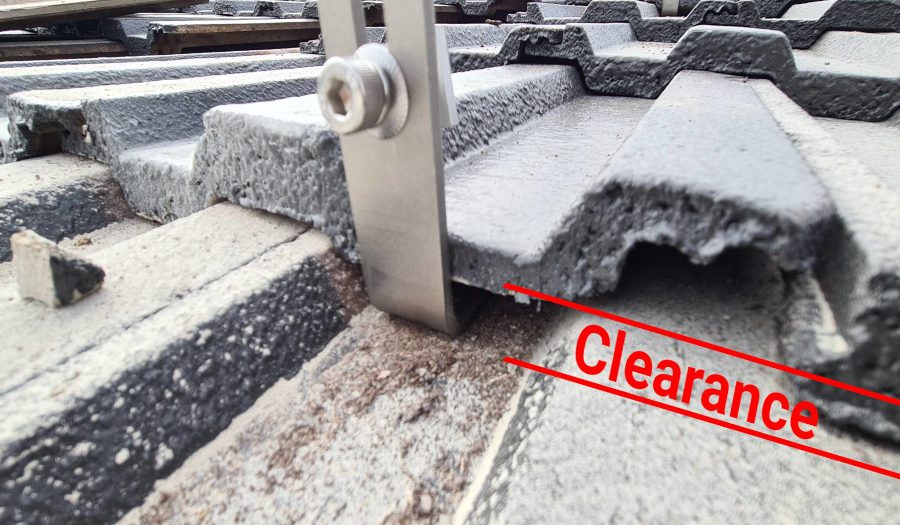
Different tiles need different approaches.
Compliant Works
For many the best way is to use a scutch hammer. With a few deft blows you can get a reasonable fit without making any dust and it’s probably just as quick as flipping and grinding once you have practice. However it’s not always going to be neat and in some instances may not work, such as when you have to modify both top and bottom of thin terracotta tiles.
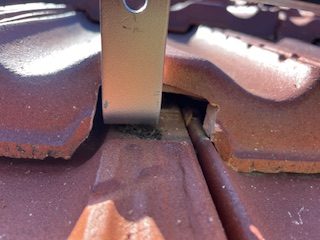
Terror-cotta is an installer’s nightmare in many cases.
Wet grinding is the best but creates its own issues. Tiles need to be marked, numbered, dragged off the roof and processed where you clean up a mess afterward. At a pinch your cardboard solar panel carton would contain the spray and slurry, but effectively this is the same operation needed to cut pavers or bricks.
Regardless I would always recommend a wet diamond holesaw for electrical penetration.
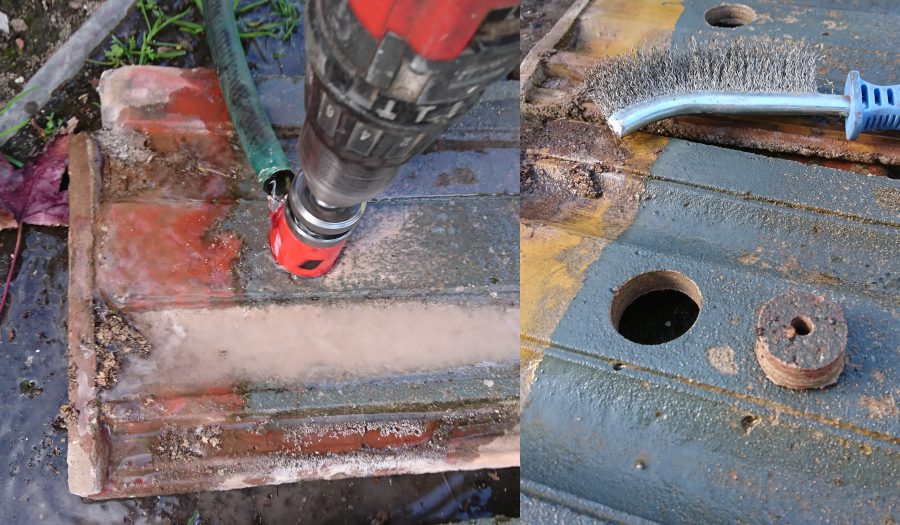
Making a clean hole in a 70-year-old tile without smashing it.
Tiles Are A Joke Really
The whole concept of building a house strong enough to support a roof of broken masonry just beggars belief. If it wasn’t already considered normal, tiles would never get up as a new idea.
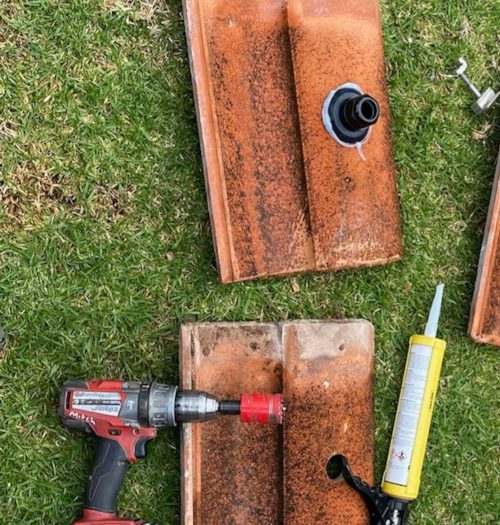
The best roof penetration I know of is a gland fitting made by Cobalt.
If you have problems with your tile roof and it needs money spent on a restoration, you’re best to simply do away with it. Throw the tiles in the bin, insulate the house while they’re off, and then reclad with iron. It’s stronger, lighter and longer lasting, plus cheaper to install more solar.
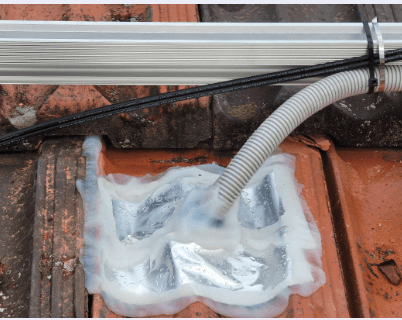
If you found a SolarQuotes installer making holes like this rubbish, I want to know.
Maintaining Quality
I’ve often tried to explain to people that SolarQuotes isn’t just a customer acquisition process. We don’t just collate names and addresses; we offer a third-party guarantee to the consumer and offer business coaching and quality assurance for the installers.
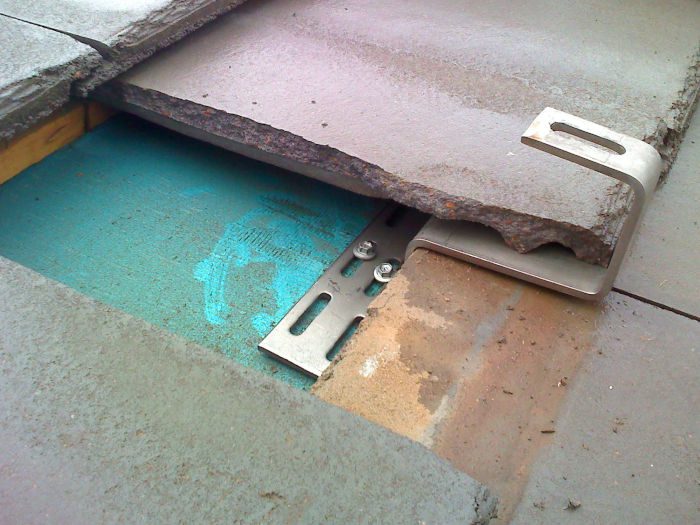
This shows how the bracket is supposed to be let into the underside of the tile. The tile broke when an installer stepped on it because it hadn’t been ground out.
So when we bring a new installer onboard we make sure they understand that phone calls are expensive.
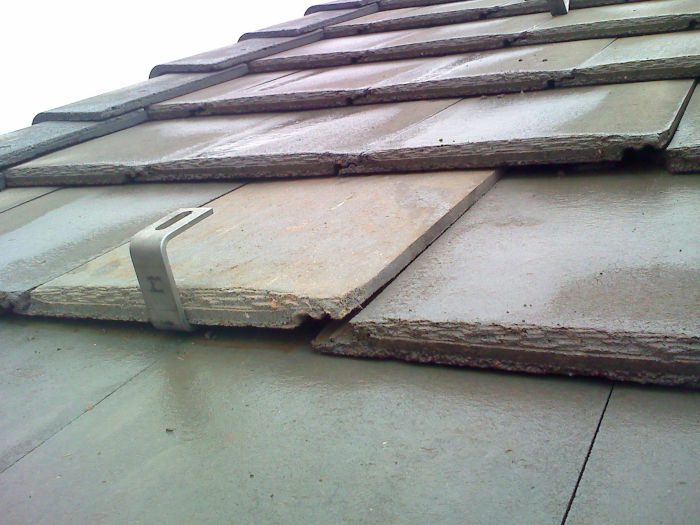
2009 takes me back. Notice that two tiles are displaced by one bracket.
Customers are comfortable contacting us with concerns they think might be trivial. When these emails turn out to be real complaints, my phone rings, then the installer’s phone rings, and then there’s some soul-searching and sadness all around.
Some Customers Are Psychos
Not every complaint I answer is from a rational human being. Some of them get their own article, others send us photos they’ve acquired from installers during court cases they’ve already lost. That’s a story for another day.
In most cases, we get to assure the customer they’ve already got a good job, or we arrange a return visit for the installer to correct some problems, however honest or embarrassing. We’ve paid for some third-party audits, but after hundreds of thousands of installations, we’ve shelled out for less than a handful of rectifications. The system works.
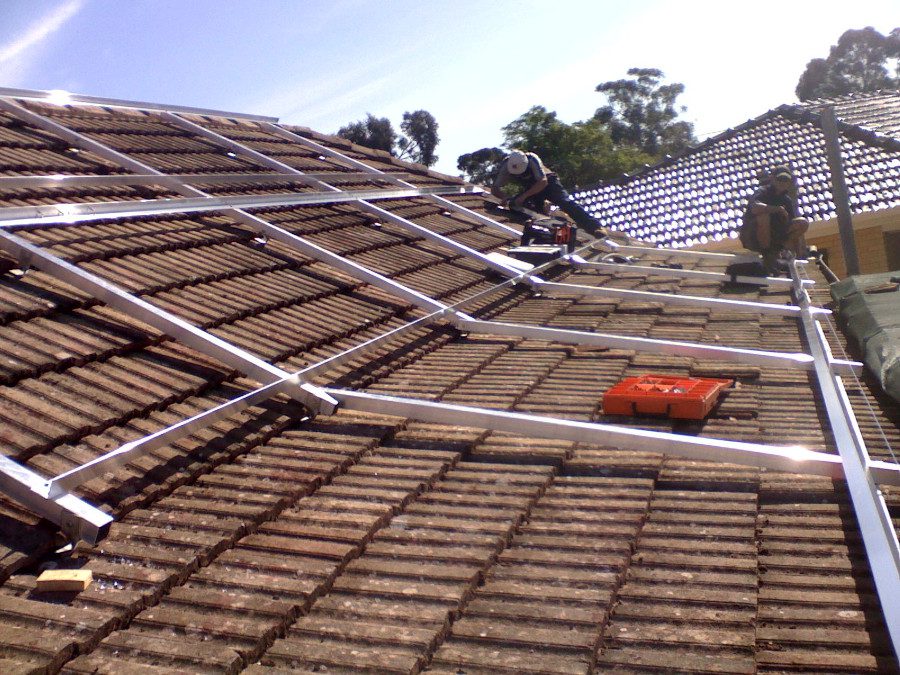
In 2008, we were using handmade tile brackets and a bespoke frame to span straight over the low-pitched extension here. The customer specifically wanted to shed water off what was already a somewhat leaky roof.
This Has Cropped Up More Than Once
In this case, the installer has come to an arrangement with the customer, but my advice is generally that an electrician will spend time more profitably doing electrical work. So long as the solar company has learnt a lesson, we mark it down on their file and explain that the best people to make good on a problem like this are the insulation industry.
However, the best option is always to have a discussion with your trades before install day.
To find a quality installer in your neighbourhood who won’t leave a filthy mess, put your postcode into our Solar Installers Near Me page.
 About Anthony Bennett
 RSS - Posts





Never understood the attraction of tiles, they seem to create so many problems.
If you’re not a fan of being woken in the middle of the night by rain on tin sheeting then you’ll appreciate the quietness of tiles.
However I agree. Tiles and tin each have their pros and cons. I accept tiles are more ‘challenging’ for solar panel installers.
There is also the fact they do not rust when building close to the sea.
40 year old tile roof on a holiday place has only had pointing redone in that time.
Friends much newer place a block further from the beach has had all the roofing screws replaced and the sheets are rusting at the screw holes.
Maybe a better option near the beach if you can get a competent roofer and a competent solar installer.
Both 40 years ago, and on the more recent owner-build, I used Klip-Lok or similar, so zero roof penetrations for fixing. The steel decking is stomped down onto clips underneath, totally weather & spray protected. I suspect that Colourbond or similar, with paint on zincalume, would then last well even on the coast.
But in the Dandenongs, and now here in Gippsland, the ember attack vulnerability of a gappy tile roof would be far too dangerous to consider. The racking for my 65 solar panels clips over the decking tray ridges, again with zero roof penetrations, so zero roof leaks or corrosion points.
Now if solar panels came as 2m² weather-tight roofing tiles, then you’d have something. (Though architecturally limiting.)
Ah, but I love the sound of rain on the roof, for me its quite soothing.
In Alberta, Canada we get 2 to 3 CM hailstones every few years. But we still use asphalt composite shingles because they’re cheapest.
Much less often we get up to 10 cm hailstones, tornados, etc. Doesn’t really matter what you use then. Rubber tiles might survive.
Hi Randy,
I’ve always been surprised as to what passes for a roof in North America.
In Australia I think we gave up on timber shingles 150 years ago? Tar paper, asphalt & vinyl never got a look in but we did flirt with asbestos tile & deep 6 corrugated sheets.
Your plywood sheath construction covered with standing seam or corrugated iron would be bulletproof, but a vapour wrap & battens would make it better again.
Do they use a vapor membrane in your experience?
There’s many a farmer of the same mind, Lindsay.
Rain on the tin roof is balm to the soul when you’re on tank water, and you’re still scarred from the time your family had to shoot 80% of the cattle herd because no bale of hay could be begged, borrowed, or stolen in all Victoria. No blade of grass, only rock-hard cowpats on dust. The remaining herd galloping in, bellowing, when you started the truck or tractor, all hoping for feed.
The tropics, with 3m of rain, might be something else, I’ll admit, but here every drop is welcome. And with the Ogallala aquifer emptying in USA, as in India and elsewhere, decades of water profligacy will come to an end soon. The timing is suboptimal, as temperatures climb: +2°C before 2035, +3°C by 2060.
The new planet will be ever less hospitable. Significant adaptation is necessary. A decrease in obesity is likely. Once over the population peak, food issues will stabilise, but habitability not. We have some manning up to do … once we get serious.
Terrible choices for graziers. Crops probably not much easier but without the emotional damage of seeing animals under one’s stewardship suffer. The case against farming and eating meat is ever more overwhelming, particularly with increasing populations and receding resources.
Cover your tin roof with solar panels to reduce the noise of the rain 🙂
Capital idea Mick.
Blanket insulation under the tin helps too.
For a typical roof shape that would require several triangular solar panels. Something I’d love to have. Finn did post a photo he took in Japan some years back depicting triangular panels. Looked very slick. However I still haven’t seen any ‘in the flesh’ here is Oz.
Yep, I had the misfortune to have a well known brand of roof tiles installed on my brand new house in 2002, which started to leak around 2012.
My Insurance company didn’t want a bar of it, i did a bit if research and it is a very common problem. Dust collects on the tile hold down clips where they sit on the tile and blocks the drainage channels and causes them to leak.
So I spent 5k having all the tiles removed cleaned and put back with new clips that were supposed to not leak – but the next wet season it still leaked. So I had to put up with constantly removing clips where they started leaking (and i could reach them), then patching my ceiling underneath where they had leaked, until i could afford to replace the entire roof with Iron when i retired and could access my super. Cost me 60k, but that included nice new insulation and new gutters.
I will never own another house with a tile roof.
I experienced the same however it was some time from installation that I was in the roof and could not understand the grey layer on my freshly installed top grade insulation. On closer inspection noted wire clips laying in the dust on top of the insulation. These clips were supposed to be securing the tiles that had been removed or moved to facilitate installation. After questioning some air conditioning installers they indicated that the installers “Kick” the tiles back to gain access dislodging the wire retainers. I spent some time in the roof reinstalling the clips fortunately for me Brisbane experienced a cyclone a couple of months later and I felt lucky I had rectified the problem.