
This winter solstice has just rolled by, and while the days will be getting longer, the season is far from past.
While the conditions persist, it’s worth checking in on your battery to see how it’s coping with the cold.
It’s a simple fact of physics that batteries, especially lithium-based chemistries, will only work properly in a specific temperature range. Going too cold will reduce performance, but getting too hot could take your battery from 10 years lifespan to a spectacular 10 minutes.
In reality, a battery fire is a vanishingly small risk, but as we’ve written before, everyone must be alert to the risk. Adding insulation to a battery might seem smart but it’s fraught with danger.
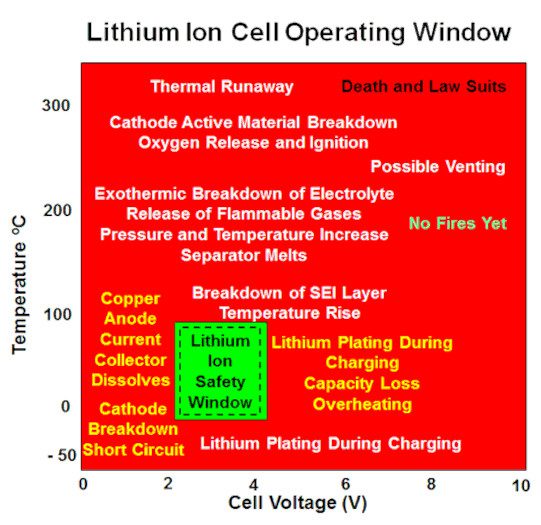
Lithium batteries are a lot fussier than a dumb bucket of lead.
So we know batteries really won’t endure the radiant heat from a blazing afternoon sun – it’ll void the warranty and shorten the battery life.
You Don’t Want Your Battery Chillin’
Lithium batteries don’t cope well with extreme cold. Down to minus 20°C you may be able to discharge them, (at a lower than normal rate) but the recharge rate will die from exposure once you get close to freezing.
As a battery owner this hurts your back pocket because winter days are often cloudy and always short. When the sun does shine on a cold morning, you need to grab all the energy you can and stuff it into the battery quickly.
Geez It’s Freezing
Opinions vary a little, but generally charging lithium batteries below 0°C must be avoided. When cold, lithium ions can’t properly intercalate into the anode and instead plate onto the surface as metallic lithium.
This lithium plating is irreversible, causing permanent capacity loss. When pushed further, dendrites can form in the battery. These tiny needle-like structures can grow enough to pierce the separator and cause an internal short circuit, rendering the cell useless or setting it on fire.
Don’t Panic
All decent lithium batteries include a Battery Management System to protect them from their owners and the environment.
Notice your cordless power drill doesn’t seem to lose performance as the battery gets flat, but cuts out suddenly? That’s the BMS in action, preventing you from discharging the battery too much. If you’re overloading the drill with a big hole saw, which jams, the drill stops instead of breaking your wrist? Again this is the BMS responding to an overload.
A BMS has temperature sensors throughout the pack and monitors voltage on every cell. Controlled by clever algorithms, measured currents are fed through a loom of wires to balance individual cells.
In a nutshell, you can’t really damage a home battery because the BMS prevents charging outside the safe threshold. The exact high and low temperatures might vary from one maker to the next though.
Makers of some toys, scooters and e-bikes are too cheap, lazy or careless to include a proper BMS. They’re the ones that catch fire.
Home batteries are much bigger and pose a greater danger simply because they store more energy. Depending on the brand, the quality of the cells used and the maker’s appetite for reputational and warranty risk, the BMS programming can be more or less conservative.
I don’t have hard numbers but going on the number of complaints I’ve fielded recently, an educated guess tells me that expensive batteries might be happier to sail closer to the wind. Better brands will go closer to zero before they go into protection mode, because customers who spend on quality are more demanding.
Whereas bargain bin shoppers are less likely to complain when their investment doesn’t perform quite as well in extreme conditions. So for cheaper brands the temperatures could be more conservative.
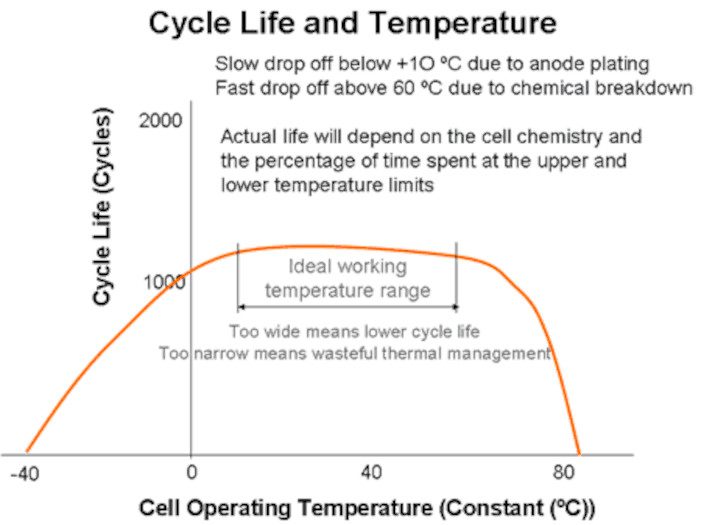
To be honest the ideal battery temperature is about 20°C but you might not want to run air conditioning just for the battery.
Batteries Are Heavy
There’s not much air inside a battery. Installers will readily tell you they’re packed with gravity, as you’d expect from anything full of solid metal.
Pumping electricity into a battery will also warm it up, so not only does all that mass tend to push your pavers into the ground, it will maintain temperature for hours after sundown or may warm up at midnight if you’re ploughing cheap grid electricity into it ready for the morning.
Which Battery Brands Handle The Cold Best?
Some modern batteries have internal heating elements to help maintain functionality of lithium chemistry in cold climates, but they can be hungry little parasites, consuming energy overnight.
For those who want one, my understanding is that GoodWe offer them as an option in Europe but I’ve not confirmed Australian availability yet.Th
Hiconics, Tesla PowerWall 3 and Franklin WH have battery heating as standard, so does Sigenergy.
However the internal topology of a Sigenergy system is also a bit wasteful. Jumping 32 Volts up to a 300 – 900VDC bus means each battery in the stack is wasting energy in a DC-DC conversion which customers complain to me uses kilowatt hours overnight, all year round.
The Anker Solix X1 features active thermal boosting, with the company claiming the system drives the cell temperature up to a 20°C optimal baseline to unlock full charging capacity rapidly, avoiding thermal shock by ramping up charge power alongside the temperature rise.
SolarQuotes founder Finn Peacock recently wrote about how Fox ESS lacks internal heating elements, although the system’s monitoring app at least alerts owners when battery temperatures get too cold.
Heating is something we never needed with traditional lead-acid batteries in remote area power systems. Performance will be impacted at low temperatures, but provided they’re charged, lead will survive down to minus 40ºC.
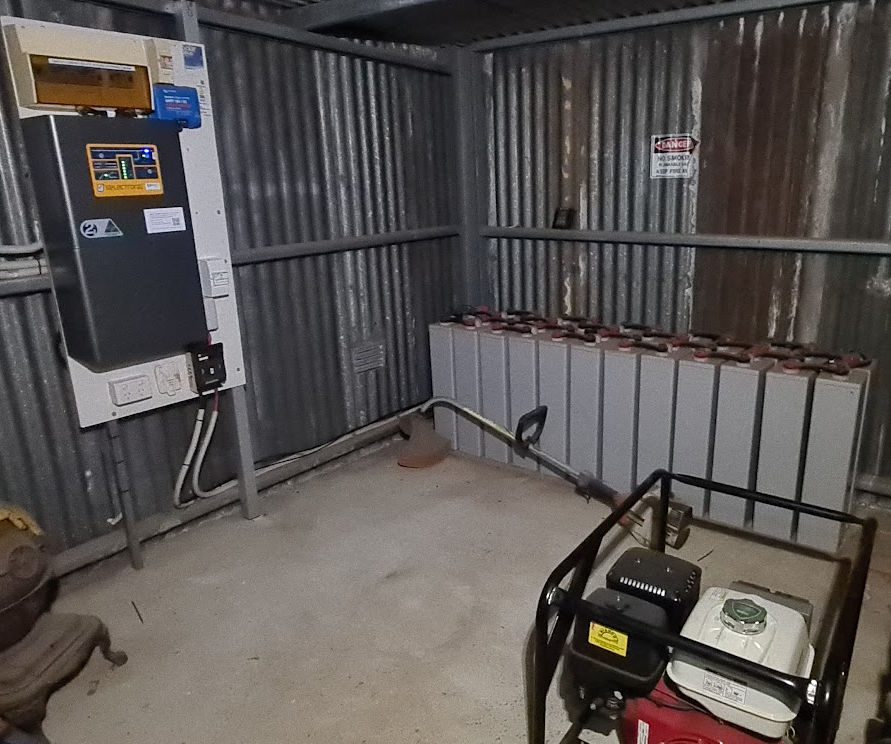
This basic little off-grid power system has a ton of lead acid batteries (the grey ones are 2 Volts each) – but its downfall was a switchboard full of mice looking for a nice warm home.
Batteries Use Energy
In a perfect world you’d get just as much energy back from a battery as you’ve put into it, but in reality there’s always losses, in this case referred to as round trip efficiency.
Roughly speaking lithium batteries deliver around 95% of the energy you charge them with.
However, if you’re charging with grid power, an extra 10% goes missing as heat because there are losses through the inverter as you charge and discharge. It might sound like a lot of waste, but when you’re picking up free electricity from the sun, nobody really cares.
It would be interesting to study the cost of running a battery heater, in terms of kilowatt hours consumed and warranted life used up.
I wonder if it would compare favourably to just cycling the battery and using its internal losses to keep warm?
It might be feasible to charge for cheap during an overnight TOU window, then turn to exporting through the morning peak for a reasonable feed-in tariff, with the aim of being warmed up and ready for solar charging once the sun has risen over the yard arm, so to speak.
You Need Good Support
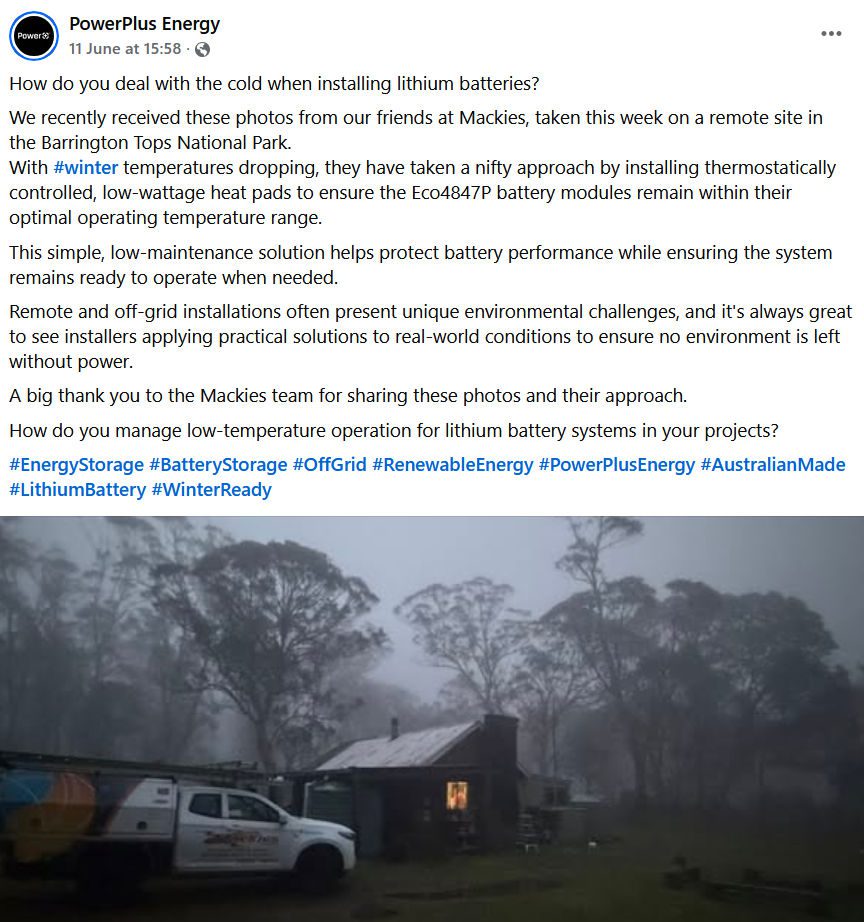
For frigid winter conditions, PowerPlus offer a 30 or 60 Watt heating pad, so at worst, that’s 1.4kWh/day.
For real-world numbers, I reached out to ask about my own battery bank. I’ve got a dozen PowerPlus 4847p, but plugging 105Amps (5kW) into them for hours straight during summer, they hardly raised a sweat. Chris Stork explained :
“There’s very little heat generated during charging/discharging, as they’re very efficient. It’s only around 2% loss. If you’re putting 105A into 12 batteries, that’s around 9 watts loss in each battery. (108W total) With that much thermal mass (516kg) its going to take a LOT to warm them up.”
Which proves at least one thing to me, the quality of your battery is only as good as the people who stand behind it.
To compare battery brands for yourself, check our our solar battery comparison table.
 About Anthony Bennett
 RSS - Posts





Heh Anthony. Could you explain this bit please
“Jumping 32 Volts up to a 300 – 900VDC bus means each battery in the stack is wasting energy in a DC-DC conversion” and how this qaste could be avoided
Cheers rick
Rick,
My battery bank has three (nominally) 48v batteries wired in parallel. Connecting another with a different SoC, except first through a precharge resistor, would make sparks, and risk heavy balancing current, with resulting heating. But there’s no DC-DC waste.
In products with a DC-DC converter on each battery, that acts as a gearbox, matching the battery bus voltage, regardless of individual battery voltage. That allows adding new batteries to a stack of old (saggy) batteries, without problems. But there are always conversion losses, even if only 2 – 3% each way. Even on a substantial system, that only eats the output of half a PV panel, and on 3-free-grid-hrs, it also costs nothing, so the system expansion convenience can be worth it.
My brother added newer model Zenaji LTO batteries to his system, but they repeatedly tripped out due to mismatch. They replaced his old ones to make it work.
With or without can be made to work, but battery expansion is something else.
P.S.
The small energy loss in Sigenergy’s battery-integral DC-DC converter could be beneficial in very low temperatures, substituting for a heating pad, if you have enough overnight load to actually generate measurable losses. A continuous load of 2.4 kW would generate around 60W of converter heating, but would totally exhaust a 24 kWh battery in 10 hrs. (If the bus voltage is 900v, rather than 300v, then losses would be a little higher, as converter efficiency drops a smidge with higher conversion ratio.)
A thermostatically controlled heater pad is much more targeted energy use.
(I should make one for my Monsteria Deliciosa, in its little doghouse-sized plastic greenhouse over winter. A bag of power resistors, bought as cheap “surplus”, is to hand. Warming the ground during the day would conserve battery charge, but risk a wet pad. Now I just need the “Round Tuits”. (There are images of ’em on the web.)
Anthony,
Apropos battery warming by mere cycling loss, my three LFP batteries report from 16.2 to 17.7°C at 9:35, inside the insulated but only single glazed workshop wall, with room air at 18.0°C. The quarter tonne of batteries isn’t heated lots by the 1.07 kWh of post-midnight consumption, yielding only 27 Wh of one-way losses. And the 2.5 kWh of previous evening aircon draw over five hours also does little to stave off a frigid night. The AI reckons we had 9.9°C overnight.
I don’t have a battery heater, but could leave the workshop aircon on overnight, as the batteries only dropped to 92% last night. But most of that heat would be lost via the two windows. Better would be a small heater pack with a thermostat, placed in the small-suitcase-sized battery box void between left & right battery stacks. (I’d run that off the 48v, HRC fused. But it’s not needed here, I figure.) It would be easier to add insulation outside, than move the battery box to do it inside.
I’m hoping that sodium batteries will be available by the time I’ve finished building my new house. They should perform better on a chilly July morning in Canberra, when it’s minus 6 degrees.
Try looking up Powercap in Qld or wait for CATL sodium to turn up in retail systems (they’ve signed for 60GWh in utility systems, so they’re getting real)
GoodWe ESA series (at least, not sure about the rest of their range) do have a model of battery with integrated battery heating (Batteries ending in G20) and with some of the colder days, it’s been very useful to have that to maximise what I can draw from the grid!