
 The minimum level of charge a battery will keep up its sleeve can be customised to best suit your priorities – whether it’s maximising energy trading profits, blackout protection or reducing degradation. You can even tweak it temporarily in response to unusual conditions – as I found during a power price surge earlier this week.
A Price Spike That Drained My Battery
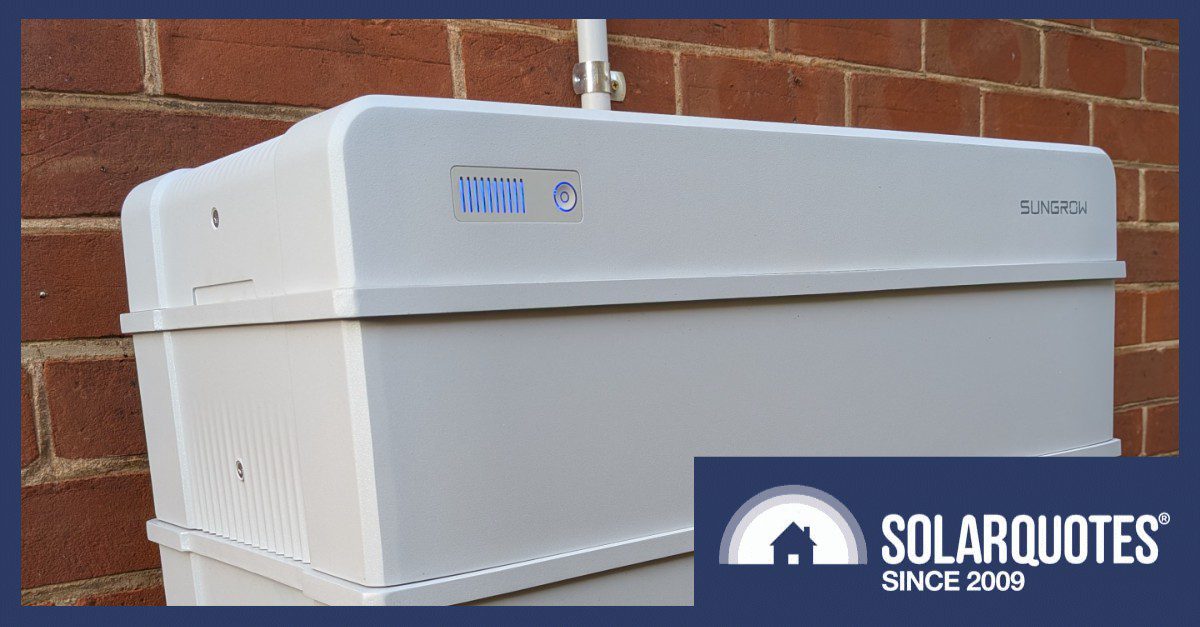
I had a Sungrow SBR home battery (pictured above) installed a couple of months ago and joined Amber, to see what life on the wholesale price rollercoaster was like.
It had been a pretty uneventful ride until last Sunday night, when wholesale electricity prices skyrocketed in part due to a severe wind drought – an event that prompted Pauline Hanson to falsely claim that us South Australians were paying $5 just to boil a kettle (despite almost all non-Amber households being shielded from price spikes behind flat retail rates).
Amber’s AI-driven energy management system, which is still getting to know my home’s consumption patterns, got a bit excited about cashing in on the very attractive prices, and ramped up exports of our battery’s stored energy for profit.
I was happy enough with this – until realising that it had left our battery at just over 25% capacity ahead of a cold evening. Suddenly it looked like I was going to have to buy back the energy I’d just sold, with the prices still sky-high.
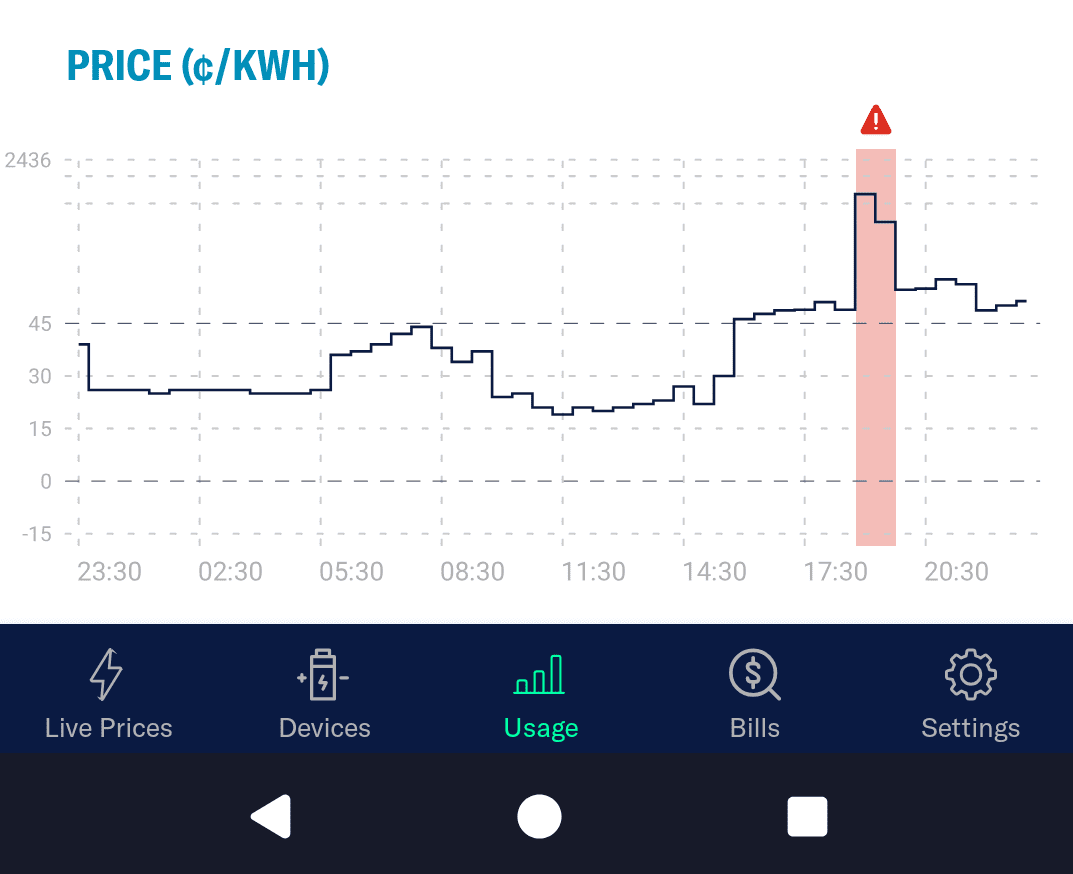
The June 21 price hike, as shown in the Amber app.
Time For A Fireside Chat
My partner raised a skeptical eyebrow when I intercepted her as she was on the way to turn the ducted heating on, and I suggested out of nowhere that it was a great night to get our little-used fireplace going.
She wasn’t buying it, and I had to begrudgingly admit that after forking out thousands on our new energy storage system, we’d better both put an extra jumper on rather than turn on the ducted reverse cycle.
But then I had another thought: why not instead lower our battery’s minimum reserve level so it uses more of its stored energy than usual to get us through the evening with the heater in full swing, without supercharging our energy bill by drawing from the grid?
A Battery’s Minimum Reserve Level
A home battery generally has a programmable minimum reserve level that the system doesn’t drop below, ensuring homeowners will be able to keep the lights on and the fridge humming in case of a blackout.
This is usually set between 10% and 30% of your battery capacity. Setting aside at least 2 kWh is advisable, but what percentage level you choose should really depend on the size of your system, what your priorities are, and what kind of backup features your system boasts.
The higher you go, the longer your payback period will be, as some of your battery capacity is going to sit unused most of the time. But likewise, the lifespan of your battery is extended as there’s less battery degradation.
Go for a lower reserve however, and you’ll put the battery to work more often and enjoy better financial returns – less drawing from the grid, more exporting for a profit.
Modern battery chemistry will reliably work much harder than legacy lead acid for instance, but you will also put more strain on the battery and risk degradation, especially if you routinely cycle below 20%.
Allowing charge levels to drop very low in exceptionally cold weather is also bad for the battery, although this applies more in freezing conditions we don’t see often in Australia.
You will obviously be more vulnerable to running out of power during a blackout, which might be more of a going concern if you’re in a fringe of grid area that experiences them more frequently.
Manufacturers often specify recommended level to set your battery at, as well as maximum depth of discharge (DoD), which can in turn impact warranties, so consider that before mucking around with your minimum reserve level.
Sungrow set a floor on their battery so you can never use the last 5%, whereas other makers allow 0%, but immediately force a grid charge to recover a safe level.
How Do You Change A Battery’s Minimum Reserve Level?
The answer depends very much on your brand of battery, but a good installer will ask you what your preferred level is during the install and do it for you – and might even take you through how to adjust it yourself.
In my case, in typical Sungrow style I had to navigate a slightly convoluted adventure through obscurely-named options buried in menus and submenus of the brand’s iSolarCloud app (to be fair, many other brands subject users to similarly Byzantine journeys).
The menu path for me in the app was:
- Hit the small hexagon symbol on the right of the home screen and choose the ‘device’ option;
- Select ‘energy storage system’ (the inverter);
- Swipe right through several menus to get to ‘settings’, then select ‘general settings’;
- Find and select ‘backup mode’ and enable it;
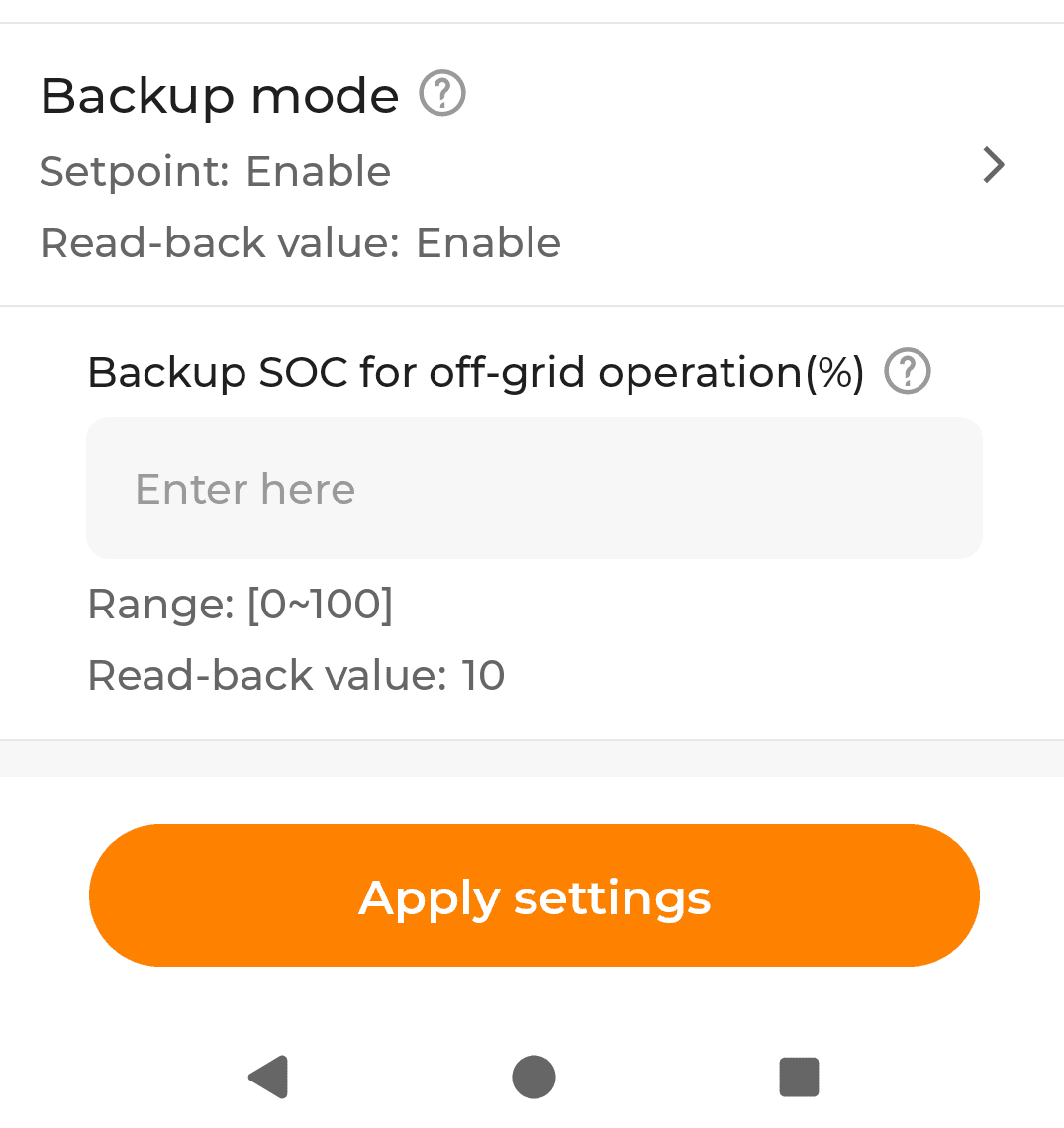
- This will make the ‘reserved battery SOC for off-grid (%)’ field appear (as shown below);
- Enter the percentage number preferred for the minimum reserve level at (the ‘read-back value’ below this number shows what it is currently set at);
- Then hit ‘apply settings’ and ‘confirm’.
All about as intuitive as trying to locate a needle in a haystack in a hurricane, but once you know the steps, it is straightforward enough.
As I’m with Amber, I had to use the Amber app to additionally select ‘devices’, ‘SmartShift settings’, and then enter the new minimum reserve level percentage in the appropriate field, so Amber’s AI could know where I had set it to (it won’t sell to the grid below 25% anyway unless you order Amber to).
Amber actually has a pretty good rundown on how to tweak the minimum reserve level on other brands, from Sigenergy to Fox ESS to Anker.
You Might Only Do This Once
In most cases, this function is something to typically set and forget when the battery is first installed, but it does give options when you’re facing unusual circumstances. With the battery under more strain than usual in winter conditions and energy prices up, this presented the opportunity for us to stay warm through the night without paying through the nose by having to draw from the grid.
So I adjusted our settings from the 20% level we usually run at down to 10%, and restored the old setting once things were back to normal.
There’s risk and reward here – times of high energy prices reflect a grid under strain, so you there’s potential for a higher-than-usual chance of a blackout.
But with energy prices exorbitant enough that I was inclined not to use much electricity anyway, I figured we might as well.
There’s other circumstances you might want to temporarily change your minimum reserve level – perhaps wild weather is forecast and you want to set it higher to see you through a prospective blackout, or a letter in your letterbox has specifically warned ahead of time of a scheduled power cut.
In our case, by reducing our minimum reserve level temporarily, we were able to use our heating without racking up a great big bill during a price spike – and our fireplace has still not gotten a call up.
For more on home energy systems, read our guide to solar batteries.
 About Max Opray
 RSS - Posts






Hi Max
I’m not with Amber, but understood their SmartShift algorithms factored in both predictive wholesale pricing (to plan for spikes) as well as the user’s current battery state of charge, which it then blends with their historic usage patterns etc. to determine optimum behaviour? Obviously no prediction can be foolproof and a system might sometimes be caught short, but I’d have thought much of this sort of adjustment should be the exception rather than the rule?
The Tesla algorithm-ecosystem does all of that for me, minus predictive pricing of course (more weather and usage based).
I haven’t been with them long so it might still be getting a feel for our usage patterns, particularly as winter sets in and we start using the ducted heating, which is much more energy intensive than anything else we do other than charge the EV. Also Amber seems to have been having some technical issues this week, including manual commands to discharge not working at times and missing usage data.
An open fireplace is a wasteful anachronism, I’ll dare to venture. It foofs 90% of the heat up the chimney. When we had one, I remember slightly blistering the varnish on the front legs of a chair, while freezing on the back of my neck. The old cementsheet farmhouse had no insulation then, not lots now. But it does now have a closed wood heater. They yield around 40% efficiency, which is 400% better than the fireplace. The reduced firewood use has to be good at today’s prices, but the reduced wear on chattering teeth is even better.
The 6-star extension, with insulation & double glazing is kept cozy, despite only 6°C outside now, by just 0.6 kW into an aircon, with 2.6 kW bringing the battery back up, and 2.3 kW into the HWS. The woodheater here is only worth firing up on a frigid deeply overcast day.
Generation beats storage. A big array can still charge up the house battery in overcast, if BEV charging is postponed till next sunny day. A big battery can be charged harder = nice.
put a pedestal fan blowing toward the chimney and ceiling, and you will garner a further very large percentage of the heat from being lost up through the chimney, and lost through the insulation near the flue. I find I burn 1/2 the amount of wood and have a much warmer house for the small cost of a fan running.
For what it’s worth I got one interesting thing when my Powerwall 2 was shut down prior to its (free under warranty) replacement. This was all done remotely & I had no control over it.
Battery was first shut down at about 50% charge. Which made it unusable.
Battery was then slowly emptied at exactly 0.3 kW per hour. Which took quite a while. And alarmed me as nobody told me battery was being replaced.
The interesting bit: when battery was emptied to an indicated zero in the app (that’s 10% below the set reserve) it continued to discharge at 0.3 kW per hour for a further exactly 10 hours.
So when it showed zero it had 3kWh of storage left.
Please do not rely on this for your battery, but there is definitely evidence that what we have presumed is true – that manufacturers keep a bit in reserve as final safeguard against battery terminal failure (no pun intended).
Yes, as with lots of things in this world, I think there is a lot of “talk” about DoD etc, and little fact. Fwiw sigenergy recommends 0% minimum discharge level. I see the same “beyond zero” discharge that you mention sometimes too. This Sig tech sheet is enlightening re DoD and min reserve level, for those who own one: https://www.sigenergy.com/uploads/en_download/1757061588324377.pdf
Hi Christo,
I hadn’t seen this. Thanks.
Presumably you don’t want to keep 10-20% in case of a blackout when you’re near/at 0%?
I know having those two events coincide would be unlucky, but it’s a non-zero possibility (another pun on this page).
No I usually don’t keep any in reserve, my grid connection is pretty stable. I’m not worried about that DoD stuff, since I read that sign tech sheet – their approach makes sense to me, it’s what I would do if I were warranting these things.
I occasionally increase the reserve to 5 or 10% if I’m running critical work stuff on computers. But I think it is probably wise for most folk to keep a little to cover blackouts if you have a backup gateway, and definitely if you have a larger battery.
Cheers.
And, Sungrow promote and market its SBR battery using what is in the datasheet; that the battery energy is 100% usable with 100% DoD capability. Neither of which is true, unless you use installer login details to access system configeration settings via inverter wifi dongle and change the “reserve which is hidden”* to 0%; not advisable for a couple of reasons.
*This turn of phrase direct from Sungrow when explaining why my 19.2 kwh battery only ever discharged 16-17kwhs from 100% to 0% SoC. “Hidden” alright, from prospective customers until they have paid up.
It’s false, misleading and unconscionable conduct that is illegal in Australia.
Dont hold your breathe with the isolarcloud app, in the 2 years i have had my sungrow system, the menu process to access you battery minimum charge settings has changed at least 4 times…
I do tweak it a bit in storm season, particularly if a cyclone is coming – or when we have had several days of wet cloudy weather and it looks like I might actually have to pay the scum sucking pigs for power. But i dont access it very regularly, so there was likely more changes in that period than those i noticed.
And of course there is no notification of changes, or what they changed, when the app is updated…
My biggest bug bear with the Amber system is that it will discharge your battery during a spike (at the solar rate of say $1) and then immediately put the battery into a charge cycle at $1.30.
As grid power is always more expensive.
Amber says this is to protect and prepare for the next spike that might happen several months down the road.
So who is Amber truly invested in?
There is the other issue that the Amber start and stop system is not based on a continuous “hand shake” signal, often the stop discharge signal does not make it to our inverter, so the battery keeps on discharging.
Most of the time I have Smartshi[f]t turned off because it does wierd things. Yesterday, with a full battery is was using 1kw of grid power at .40c … to plan for evening spike forecast to max out at .11c i guess. It discharges as soon as fit hits 15c even though later forecast is much more.
The isolarcloud app has shortcuts for charging and discharging, even scheduling discharge, on the Dashboard now. Crude, but better than using Amber’s settings to do it…imo
Sunday night? Surely Monday evening would be a better example? $840 per MWh! That’s … 84c/kWh?
A quick Duck suggests a full jug uses 2.2 kW for about 5 minutes. To be generous lets say 0.25 kWh total, but with a 2kWh+ spike on your inverter data.
That equates to about 21c per jug right?
And if you want to save money\power then you only boil the mL\cups you actually need to use, not a full jug each time, with most of the water wasted.
Ooh helps if you check sources\read for comprehension – $1,187.92 Monday 22nd June, and the post was on the 23rd, so not this week. Still means $1.19/kWh and at 0.25 kWh total, about 30c right? What assumptions\raw data\reports was she working off?
I like Hanson, but in this case it appears a mistake may have been made.
Hi John,
Part time Poorlene shows up for half of parliament sittings & 12% of senate estimates
She takes her supporters as patsys
25% tax on existing gas? No, she abandoned her gas reservation to announce (at a gas conference) a “Norway style” policy but with 48% less revenue.
PBS affordable medicine will be cut by Hanson while the gullible cheer on slashing
https://www.netimes.com.au/2026/06/27/concern-brewing-as-buried-hanson-policy-threatens-affordable-medicines/
Her guiding principles are grift and dog whistling
https://www.abc.net.au/news/2019-03-26/secret-recordings-show-one-nation-staffers-seeking-nra-donations/10936052
Charges her patsy candidates for printing her grimace, collects 4% of the vote, then claims AEC funding. $12,379 per seat in 2025 & $3.39 per vote.
https://michaelwest.com.au/taxpayers-to-pay-pauline-hansons-phon-3m-for-no-seats/
https://theyvoteforyou.org.au/people/senate/queensland/pauline_hanson/policies/86
Anthony…can you please explain how your statements relate to my 2 Tesla batteries and umpteen solar panels that power all of my disability requirements, please?
In kW format with all of their cents per item would be good or are you stating that I get $3.39 per kW that I get if I move to Amber?
The Aussie version of Trump often proves she shares his mental capacity & demagogic tendencies. But it is nostalgic clinging to a disappearing world, by perhaps half of our population, which feeds those troglodyte politics.
ICE transport is unviable in the face of +2°C by 2035, +3°C by 2060, plus unreliable fossil fuel supply, and global war within 3 years, if Putin doesn’t fall before. (Finland has just legalised nuclear armament, another step.) Either way, solar & wind & Na+ batteries @ $40/kWh for double cycle life = $20/kWh LFP equivalent will now kill coal fast. Exponential deployment of veritable mountains of cheap batteries is the stage 1 civilisational survival solution, utilising the growing solar surplus. Understanding is slow, change is accelerating.
This immigrant supports immigration limits, though. Housing *must* be fixed first. Then workers’ earning power relative to rampant corporate price gouging. Climate adaptation will cost us all. Save up for it, if you can.
Anthony and Erik, I also have solar, can you tell me how much you saved and what panels and if you a battery please?
Also, do you get a higher quote because you voted for someone that owns a solar company or just go for the cheapest panels?
Sorry, question 1 and question 2. Hoping for honest answers on this SOLAR site.
Erik, I am not getting $20 or $40 per kW for my feed in. Please let us know where you are getting these feed ins as I only get 3 cents?
Just on battery reserve setting – I have a fairly recent Alpha ESS system and on the “new” app, you just go to settings, Self-Consumption, and there is a 0 to 100% slider looking at you that can be dragged left or right for any setting you want. Instant and easy. Hard to beat that. On the Amber thing – I have looked at it, but my battery (20KWH) matches my usage fairly accurately, and although I rarely go below 30% overnight, I don’t really feel like losing control and maybe selling what I should have kept.
Rob
The above assumes one can fully charge the battery over the day.
In winter, us Canberrans can’t unless we have a LOT of solar, at the right angle.
I am thinking Tasmanians will be even worse off.
But yes, I did set the battery I have to 10%. I haven’t seen enough solar energy since then, to be able to fully charge the battery, so I can put it back up to 20%.
But the process is very easy:
Open the app.
Click on the inverter icon.
Top left icon is settings (next to the inverter serial number) – click that
Click Battery settings.
All is revealed.
It also allows different max and min charge levels for online mode and blackout mode.
It also logs any changes along with the date/time of that change, so be aware warranty might be affected.