
Last week I went to Intersolar Europe in Munich, and the first thing to tell you is the scale (watch my video above to get a real feel for the exhibition).
The show floor was eighteen halls big1. All Energy in Melbourne, our biggest solar conference, would be about a hall and a half of that. So roughly twelve times the size. It is absolutely massive.
The second thing that stood out was the weather. It was 35ºC outside, about fifteen degrees above average for Munich in June. Everyone was hot, hot, hot, and the air conditioning was visibly struggling. Fifteen degrees above average is nuts. The Earth was making its point about global heating, and it made it in the week half the solar industry was in town.
Panels Are A Commodity
Solar panels have become a commodity. Everyone walks up to a stand assuming they’ll get something twenty-four to twenty-five percent efficient that turns light into electricity, and they’re right.
The star was probably LONGi’s EcoLife range. The 505-watt panels you can actually buy now top the mass-production charts at about 25 percent module efficiency. LONGi was also waving around fresh lab records on the same stand: a 28.13 percent back-contact cell and a 26.4 percent module. Worth keeping the record kit and the shipping product separate in your head, but either way it’s incredible stuff2.
There were plenty of big stands disagreeing about how to get there. AIKO and Tongwei were essentially arguing about whether top con or “bottom con” wins. AIKO reckons back contact, or bottom con if you like, is the way forward, with the best low-light performance and the best efficiency. Tongwei had a big stand making the case for TOPCon.
Which one’s right for you? Doesn’t matter. They’re all excellent panels. Just buy a good one from a manufacturer that actually supports Australia and stop worrying about it.
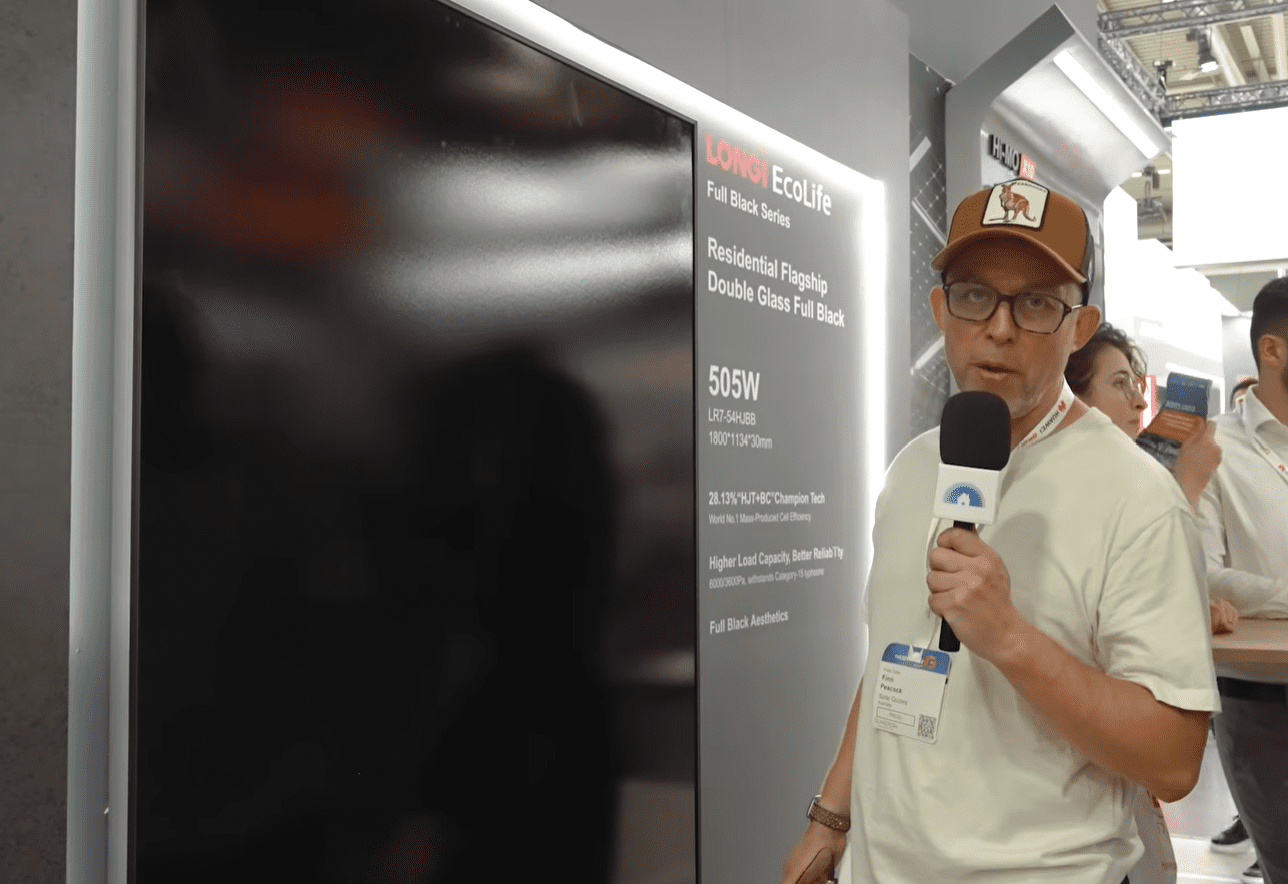
LONGi are making some big cell efficiency claims with their EcoLife range.
How Do You Stand Out Selling Black Rectangles?
When everyone’s selling efficient black rectangles, the question becomes how you get noticed. The answer this year was building-integrated PV, everywhere. Solar in the roof, the floor, the windows, fences, shades, even pool furniture. Flexible panels, coloured panels, every colour under the sun, different shapes and patterns. Some of it looked magnificent.
The bottom line: if you want a solar panel in any shape, any colour, any pattern, with any amount of flex, you can get it now.
Every major manufacturer on the SolarQuotes approved list told me Australia matters to them. Ulica Solar told me the reason they pulled out of Australia years ago was that we expected A-grade gear at B-grade prices. I spent a while wondering which retailers were demanding that. I’ve got a hunch it was some of the big ones flogging dirt-cheap systems back then, several of whom have since gone broke.
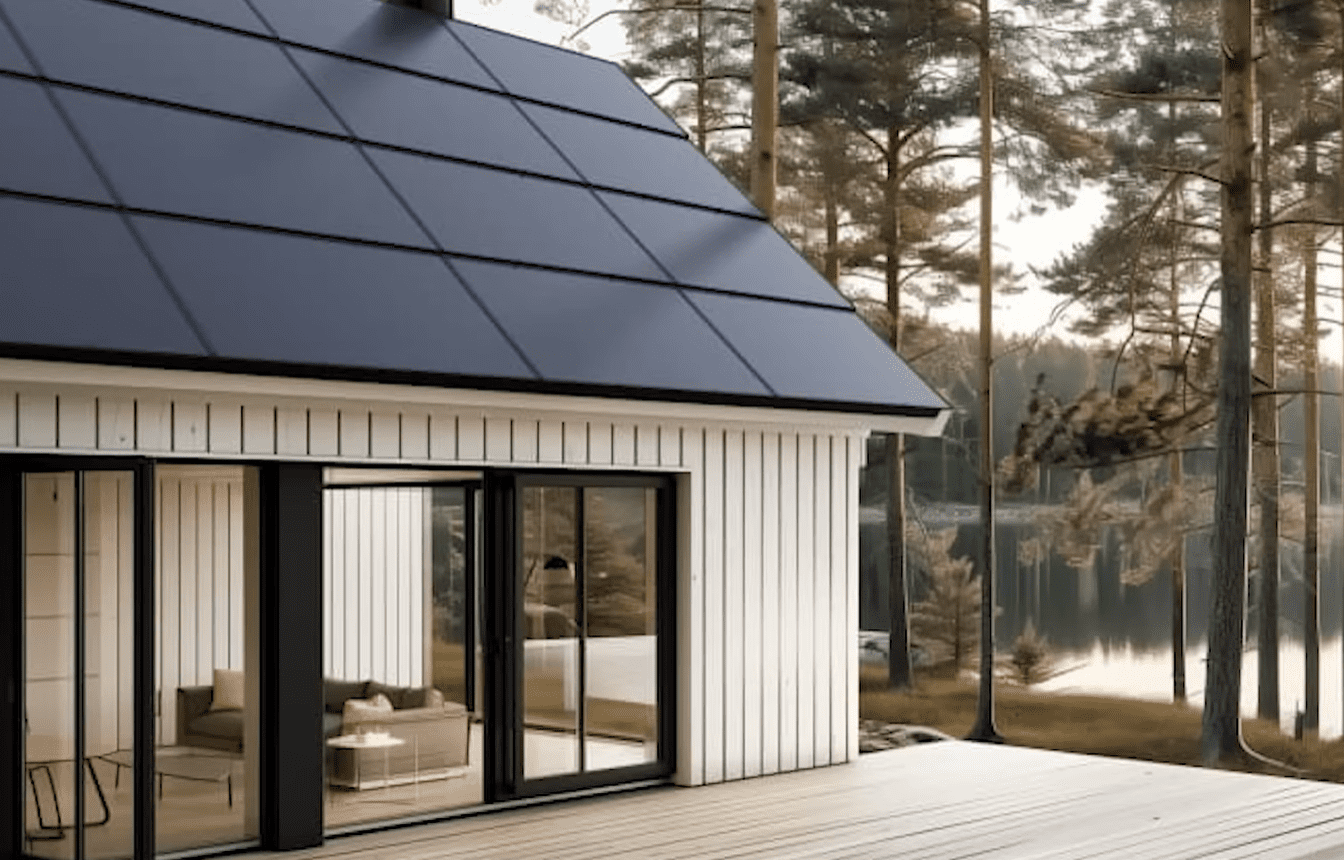
Lithuanian firm SoliTek’s building-integrated solar roof.
Balcony Solar And Balcony Batteries
The other big standout was balcony solar. Lightweight panels you zip-tie to a balcony railing and plug straight into a standard power socket (GPO). They were absolutely everywhere. Legal in France and Germany, currently illegal in the UK, the US, and, of course, Australia.
I bumped into Jordan from Artisan Electric, a UK installer and electrician with a popular YouTube channel, who told me the UK government is leaning on its standards body to make balcony solar legal. If that succeeds, it’s an example Australia could follow.
Speaking of balconies, balcony batteries were everywhere too. Picture a mini version of a stackable home battery, about half the size, that sits on the floor, plugs into a GPO, plugs into your balcony solar, and feeds in behind the meter to trim your bill. Fantastic for renters, and exactly what Australia needs. If Germany allows it, and Germany has some of the strictest rules in the world for this stuff, I can’t see why we can’t.
Hardwired Batteries: Everyone’s Going All-In-One
For proper hardwired home batteries, the whole industry has moved to all-in-one. Not just battery modules stacked on each other, but the hybrid inverter built into the same stack. And now they’re going a step further and integrating the gateway too, the switching and breakers that handle backup. The future of the hardwired home battery is one sleek stack against the wall. There’s huge competition, which is great to see.
The architectures differ. Sigenergy puts a DC-to-DC converter in every module. SolarEdge runs everything on an 800-volt DC bus, which may make you nervous about every cable, but it gives a beautifully flat efficiency curve. So even when you’re pulling a small 300-watt load overnight, efficiency stays high, where something like the Sigenergy approach drops off at low overnight power. SolarEdge assured me their safety systems make those 800-volt cables safe as houses. They would say that.
The other approach is Enphase, who run everything on a 230-volt AC bus. Microinverters on the back of each panel, low voltage, AC. About the safest way you can do it.
Enphase Finally Has A Battery Worth Getting
I was really pleased to see Enphase has finally designed a stackable battery with decent energy density. The current third-gen Enphase battery is so small in capacity, so big physically and so expensive that I don’t think it’s viable. Honestly I’m surprised they released it. Enphase owners have been stuck for a good AC-coupled option, and the best bet right now is probably the FranklinWH.
The new one is the IQ Battery G5, and it looks properly thought through. Enphase claim 1.9 times the energy density of the third-gen battery in a slim, stackable design. It’s AC-coupled and scales from 5 to 30 kWh in modular 5 kWh blocks, with every module carrying its own grid-forming microinverter. It runs single phase or three phase, uses something they call PowerMatch to squeeze more usable energy and efficiency out of the pack, and is built to drop onto most existing Enphase solar and battery setups. Fifteen-year warranty. Europe gets it in Q1 2027, Enphase tell me Australia is in line for early next year too, and they’re promising it’ll be substantially cheaper than the current unit.
Apologies, I didn’t come away with decent photos of it, but you’ll see the G5, and every other battery I talk about in this post, up close in our second Munich video, out next week.
So if you’ve got Enphase on your roof, or you want it, you can finally stay in the ecosystem with a decent battery stack.
SolarEdge’s One-Inverter Trick
SolarEdge had some interesting gear about to launch. Same 800-volt DC philosophy, but they’ve gone stackable like everyone else, and they’re making just one stackable inverter model: twenty kilowatts, which you software-lock down to whatever output you need (most likely because DNSP rules cap you well under twenty). One model size means one fixed production line configuration, which keeps costs down. And the battery stack looks genuinely nice, a big step up from the clumsy ten-kilowatt-hour boxes on sale in Australia now.
For the record, the all-in-one systems I saw came from FoxESS, Solis, GoodWe, Sigenergy, SolarEdge, EcoFlow, Anker and Sungrow. The notable holdouts still doing discrete inverters: Fronius and iStore.
EV Chargers: Stay In Your Lane
A one-way AC EV charger is, as our in-house installer Anthony Bennett likes to say, “a glorified extension cord”. Nearly every manufacturer was badging its latest charger “bidirectional ready” and pointing the finger at the cars, which don’t do proper AC bidirectional charging yet.
But you’d be mad to buy an EV charger from a brand that didn’t also supply your battery and hybrid inverter. The good news is every decent battery manufacturer now makes its own charger. Sungrow’s only arrived last year, and I’m amazed it took the industry this long. Keep your inverter, battery and charger in one ecosystem and the whole lot coordinates through one app. That’s how it should be done.
My Favourite Stand
My favourite stand was Enphase. It was very modest compared to the giant Chinese manufacturer stands and tucked away at the far end of the show. But I was happy to find it – mostly because I was so happy about that battery. It looks easy to install, and paired with either their uni or bidirectional charger it finally makes the whole Enphase system stack up for Australians.
Which suits me nicely, because I’ve got thirty-five Enphase microinverters on my roof.
Tune in next week for a second, in-depth video on the new battery tech at the show. Or even better, subscribe to the SolarQuotes YouTube channel so you don’t miss it.
 About Finn Peacock
 RSS - Posts





Hopefully Enphase can get their pricing with the G5 right. They’re currently charging $1,440 per kWh for the 5P per the Solar Quotes Battery Comparison table which is almost 5x the cheapest FoxESS options and double the Tesla Powerwall 3.
Anything above $7.5k for 10kWh will just lead them to becoming more and more irrelevant.
Great video to watch, a tough gig in Munich, Finn pulled it off in fine style.
I like the solar umbrella as well! 600watts isn’t to be sneezed at in comparison to the balcony solar.
That would be quite handy here as well as the balcony solar!
It could plug straight into something like a portable battery pack like a bluetti or similar for a camping trip or run your entertainment area as well!
Now Now Finn, the bean counters will tell you your 35 enphase microinverters on your roof are sunk costs and shouldn’t be part of your future planning 🙂
So many beers, so many sausage types, all darn tasty. And Bavaria is full of good tourist destinations. (A Spaten, Sauerkraut, Knödel, and a Kransky, enjoyed on a terrace by the pub halfway down the hill from Neuschwanstein – well worth the trip from Munich.) But climate change has stripped shops of fans and aircons in the last week: https://www.youtube.com/watch?v=kvOZYeUYDes
(If German with a broad Bavarian accent isn’t your cup of tea, turn on CC for subtitles.)
The French disdain aircons, but have 1,000 extra dead in a week or so. Adaptation is slow. Mitigation is slow. Understanding is slow. Aaaaargh! Why oh why do we only learn in hindsight?
The super El Niño will doubtless hit here in six months, but we are better prepared – in general. I’m not sure how good a window aircon is, but renters might want to save up for one, and order it early. It’s the lack of recovery on stinking hot nights which brings people undone, doctors report. Let’s ward our old folk. Summer’s Coming.
Finn, Anthony,
Any idea how effective in-window aircons are? My cousin in Copenhagen, nudging 80, is worrying about gaining permission from the body corporate to install an aircon in her flat. An impermanent installation should solve that, and provide quicker relief, I figure. She’d want to find the quietest one, I guess.
The IEA estimates an extra 4 billion aircons by 2050, consuming 4,000 TWh p.a. (Australia’s 2019 grid usage x 10), raising global temperature by 0.5°C:
https://www.abc.net.au/news/2019-01-12/rising-demand-for-air-conditioning-alarms-climate-change-experts/10710956
Three billion living where aircon is needed 300 days per year. That can only increase.
Corporates expect to profit from that: @ 11:30 in https://www.youtube.com/watch?v=3FYFJNKgJR0
They expect profits in a +3°C world. Guess who bears the costs?
The good old window rattlers work well. I used them for many years when living in various rentals.
You just make a frame from plywood (painted so it isn’t ugly ) to seal around them in the window opening to close off the gap, they only take a couple of screws into the jam to hold the air con and the frame in place, but that probably also means you need the landlords permission these days.
Erik Christiansen: – “The French disdain aircons, but have 1,000 extra dead in a week or so. Adaptation is slow. Mitigation is slow. Understanding is slow.”
In Paris, external air con units are next to impossible to get approval for installation in apartment buildings. But portable air cons are acceptable so long as the external building envelope is not altered. But Paris apparently has a chilled (4 °C) water pipe network serving 800 buildings, per this YouTube video: https://www.youtube.com/watch?v=MBD-SddY0yo
Portable air con units are less energy efficient.
https://www.choice.com.au/home-and-living/cooling/portable-air-conditioners/articles/the-best-and-smallest-portable-air-conditioners
Estimates of livability & survivability at varying combinations of air temperature & relative humidity are shown in Fig. 4.
https://www.nature.com/articles/s41467-023-43121-5
Updated survivability limits: Tw = ~25.8–34.1 °C (young) and ~21.9–33.7 °C (old)—0.9–13.1 °C
The European Commission reportedly switched off AC for the folk downstairs in their Berlaymont HQ building whilst ensuring the feudal masters remained nice and cool.
In the UK, some councils are going around forcing residents to remove AC units, especially in London where AC is PNG! Residents are being told to rely on natural cooling via open doors and windows (a security risk), and to use ceiling fans (dust-catchers, a health hazard for taller folk, & prone to burning out). Councils claim AC units make the surrounding micro-climate hotter, but they continue to support concrete jungles aka urban heat sinks.
Paris’ deputy mayor blames the US for Europe’s weather whilst ignoring CCP China CO2 etc emissions. Americans naturally responded … poorly, amongst the politer comments being posts to say they’re lowering the AC to even cooler temperatures.
As for El Niño, Aussies will celebrate the end of months of cloudy weather & terrible solar! Having enough solar for AC will be great!
John Alba: – “As for El Niño, Aussies will celebrate the end of months of cloudy weather & terrible solar! Having enough solar for AC will be great!”
Careful what one celebrates! The latest update from NOAA indicates a “super El Niño” is underway.
https://bsky.app/profile/climatecasino.net/post/3mpo6cjzj7s2u
On 4 Jan 2020, Penrith Lakes, NSW, experienced a record max. temperature of 48.9 °C. On that day, Penrith was officially the hottest place on Earth & set a new record for the Sydney basin.
https://www.bom.gov.au/climate/current/month/nsw/archive/202001.sydney.shtml#recordsTmaxDailyHigh
I wouldn’t be at all surprised if many high temperature records are smashed in 2026-27.
Improving access to air-con is important, but let’s not pretend that everyone will have access to air-con. And the food crops & livestock in the fields certainly won’t be air-conditioned! Wildlife & oceans also won’t be protected from the increasingly more frequent lethal heat extremes.