

The first performance results have been published under Australia’s new National Vehicle Emissions Standard (NVES) — and while the immediate impact on electric vehicle numbers is modest, the data hints at changes that matter for rooftop solar and household electrification.
How Many EVs Are Being Sold In Australia?
Data from the initial reporting period under the NVES indicates that EVs made up roughly 12 % of new vehicles supplied during the first reporting period, and were sold by 40 different entities.
About two-thirds of vehicle manufacturers met their emissions targets — including EV powerhouses like BYD, Tesla and Polestar.
The remainder, including petrol and hybrid-focused brands like Mazda and Hyundai, fell short, and could face fines if they don’t improve.
The numbers don’t point to an electric vehicle boom, but they do show the car market beginning to bend in a way that could steadily increase electricity demand in Australian homes.
For solar households, even gradual shifts in EV uptake can make a meaningful difference to how solar energy is used — and how valuable it becomes over time.
What Is The NVES, Exactly?
The NVES is Australia’s first national policy aimed at reducing average emissions from new passenger and light commercial vehicles. Rather than banning petrol or diesel vehicles, it sets annual fleet-wide emissions targets for each manufacturer.
Car makers can meet those targets by selling more low-emissions vehicles, such as electric cars and efficient hybrids. Those that don’t face penalties over time. The latest release marks the first set of performance data under the scheme.
What The First Results Show
The numbers suggest the policy is starting to work — though progress is gradual.
In total, 59 entities entered a total of 620,947 covered vehicles on the register between 1 July and 31 December 2025.
While this first release of data, covering the second half of 2025, does detail the number of vehicles supplied under the NVES, actual sales may lag slightly.
Manufacturers are supplying more low-emissions vehicles than before, including EVs and hybrids. However, the results stop well short of signalling a rapid acceleration in electric vehicle adoption.
EV sales in Australia are rising year-on-year, more models are available, and prices have eased compared to the pandemic-era supply crunch. But EVs still make up a minority of total new car sales, and an even smaller share of the vehicles already on Australian roads.
Demand also remains uneven from month to month, and much of the near-term emissions reduction is being carried by hybrids rather than fully electric vehicles.
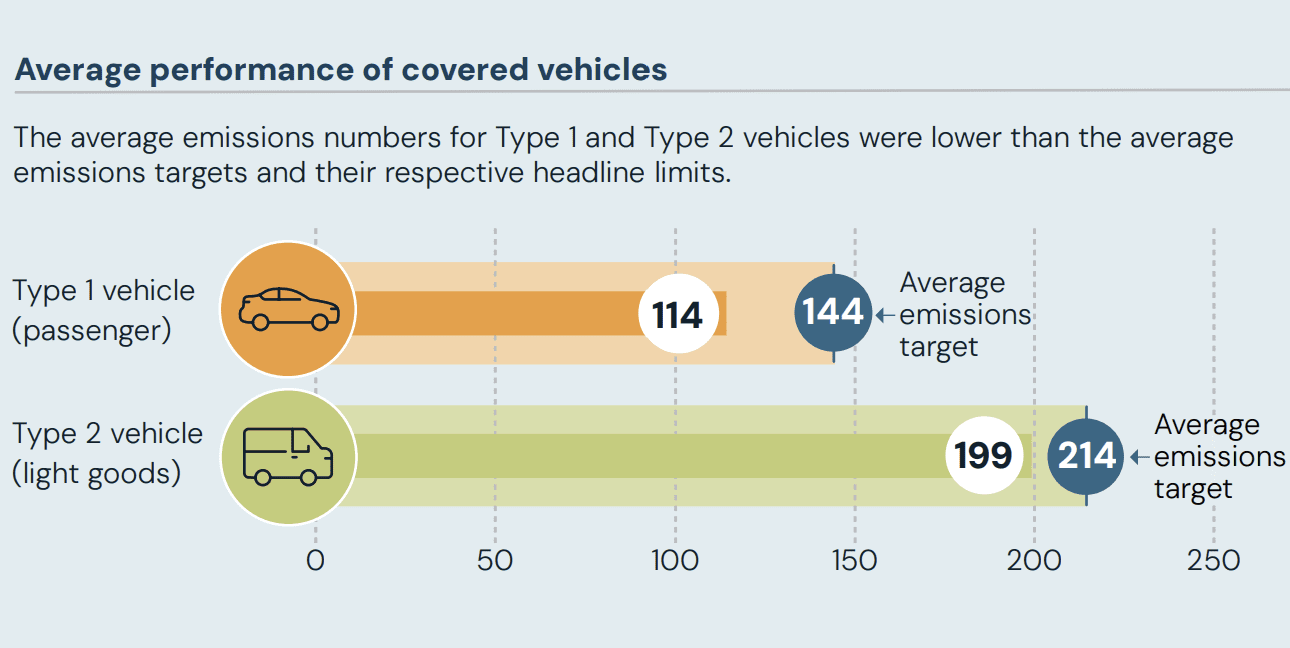
On average, both passenger and light goods vehicles came in well under emissions targets.
Why Solar Owners Should Care
For households with rooftop solar, even slow change matters.
An electric vehicle is the single largest new source of electricity demand most households will ever add. One EV, charged primarily at home, can consume as much electricity as a typical household. When that charging happens during daylight hours, it can significantly lift solar self-consumption.
More EVs on the road means:
- more incentive to charge during the middle of the day;
- less solar exported to the grid for shrinking feed-in tariffs;
- stronger economics for smart home EV chargers and solar batteries;
- a faster shift toward all-electric homes.
From this perspective, NVES isn’t just a transport policy. Over time, it influences how valuable rooftop solar becomes at the household level.
No Boom — But A Clear Direction
The early NVES data doesn’t suggest EVs have suddenly gone mainstream, and nor does it guarantee rapid changes in household charging behaviour. Barriers such as charging access, electricity pricing, apartment living and simple consumer hesitation remain.
What the numbers show is that manufacturers are adjusting their fleets to meet the scheme’s requirements — exactly as intended. Combined with falling EV prices and closer price parity with petrol cars, this helps support steady uptake.
If NVES continues to apply steady pressure, the result is unlikely to be dramatic. Instead, it points to a gradual rebalancing of Australia’s vehicle fleet. That kind of change may not grab headlines — but it quietly improves the case for using more of your own solar energy over time.
For more on how to ensure your home EV charger draws on your own solar power rather than the grid, read our detailed guide on charging EVs using sunshine only.
 About Kim Wainwright
 RSS - Posts






I was seriously considering a PHEV for my next purchase, but with all the talk about road user taxes being brought in, with no idea of the scope of the charges or how they intend to collect them, I have no idea what the economics of purchasing an EV will be at this point.
Andrew: – “I have no idea what the economics of purchasing an EV will be at this point.”
Meanwhile, Australia is currently reliant on 93% petroleum-derived imports, which I think is an increasingly precarious energy security issue.
https://www.solarquotes.com.au/blog/future-built-by-people-you-dont-like/#comment-1728718
Journalist Rachel Donald had a discussion with physicist, mathematician & environmental scientist, Antonio Turiel, last year. Turiel said:
“The problem is that, uh, when you look more precisely to the fuels that we are deriving from oil; the serious problem is in diesel. Diesel production attained a plateau in the years going from 2015 to 2017, and from that point on, it has experienced some roller coasters, or sometimes going very down, then up, and so on. But right now global output, uh, global refinery output of diesel is around 15% lower than it was in this period running from 2015 to 2017.” https://youtu.be/iV61lUm_vPQ?t=966
Is there a market opening for an EV with a swappable battery. One stays home charging while the other powers the vehicle.
The work from home crew have it made as have any retired people who can direct charge their cars
A parking place at work with solar panels to provide shade may become an attractive part of a renumeration package?
Hi Ian,
We did cover the idea in this article.
I think it’s a goer but I need to get a charger installed at work myself.
Have to get the landlord on board of course. 😉
Ian: – “Is there a market opening for an EV with a swappable battery.”
I’d suggest if BEVs have swappable batteries, then they are unlikely to be swapped at home. See Just Have a Think’s YouTube Feb 2025 video at: https://www.youtube.com/watch?v=B8uUGax8_jk
Janus Electric has a swappable battery system for heavy trucks.
https://www.januselectric.com.au/
Meanwhile, battery technologies are continuing to improve. CATL’s 5th-generation LFP cells apparently provide:
* 210-220 Wh/kg energy density;
* 4C fast charging, meaning 400+ km range in 10 minutes;
* 91% capacity retention after 200,000 km, with a 12-year/1 million km lifespan;
* 85% capacity at -20°C;
* Mass production began late-2025.
https://enertherm-engineering.com/catl-revolutionizes-ev-market-with-launch-of-5th-gen-lfp-batteries-and-shenxing-plus/
And CATL’s Naxtra sodium-ion battery is also being deployed.
https://www.catl.com/en/news/6720.html
Geoff,
I saw the ‘JANUS Electric’ battery swapping video filmed in Germany.
Whilst I think that it is a brilliant setup they didn’t want to admit that the purpose built trucks had a much higher Centre of Gravity than the trucks they replaced. Fuel tanks on conventional trucks are pretty close to the ground by comparison. Drivers of course would adapt or find out the hard way.
Geoff: – “I saw the ‘JANUS Electric’ battery swapping video filmed in Germany.”
Janus Electric is based in Australia. What video are you referring to that “was filmed in Germany”? Link please…
Geoff: – “Whilst I think that it is a brilliant setup they didn’t want to admit that the purpose built trucks had a much higher Centre of Gravity than the trucks they replaced.”
What evidence/data do you have that “the purpose built trucks had a much higher Centre of Gravity than the trucks they replaced”?
Geoff: – “Fuel tanks on conventional trucks are pretty close to the ground by comparison.”
Evidence/data? It seems to me the Janus Electric 750 VDC, 300 kWh capacity / 2 tonne weight each side battery packs are “pretty close to the ground” in this video: https://www.youtube.com/watch?v=V91Ja2ZnOgI
Diesel fuel weighs roughly 0.84 kg per litre. A pair of 500L tanks (1000L total) holds roughly 840 kg of fuel; tanks + fuel total 950–1000 kg per side.
The company I was referring to was “Sany Electric” based in Germany.
Their system has a Battery pack that sits behind the prime mover cab ( what the US calls the “tractor” )
Sorry I didn’t watch the Janus Electric video.
Sorry Geoff,
I was referring to videos I saw from India and Germany. I think they may have been showing the method Sana Electric used where the swappable battery was as high as the cab of the truck. Fast to swap but not a low center of gravity.
Anthony Bennett asked if I recall the “Black Saturday Bushfires”. I certainly do but I noted that very few houses had any sort of active fire suppression in place. I’m talking about a diesel pump in the pit next to their swimming pool.
Sprinkler systems could have saved most of those houses and could be automated to start without human itervention.
Did any readers see the video of the physics teacher (who was also a SCUBA diver.) living near Canberra I think? She stayed in the pool while the fire front melted her pool fence but her house was saved. She said her only fear was that she would have been too COLD in the pool in the 15 minutes or so she spent in the water. Needless to say but she was no ordinary teacher.
Hi Geoff,
Having spent years doing remote area power systems with backup generators, I can assure you the main purpose of the genny was to make my phone ring.
It was of course designed to charge batteries but in reality it seems that was just a by-product.
Getting diesels to reliably auto start isn’t that simple.
Geoff: – “I was referring to videos I saw from India and Germany.”
A link to the relevant video(s) would be helpful. Then one could perhaps make one’s own assessment about whether your assessment that: “Fast to swap but not a low center of gravity” is valid or not. But it seems it’s not the low CoG Janus Electric battery swapping system; yes?
Geoff: – “I’m talking about a diesel pump in the pit next to their swimming pool.
Sprinkler systems could have saved most of those houses and could be automated to start without human itervention.”
Intense wildfires can cause internal combustion engines (ICEs) to fail, stall, or refuse to start. Reasons ICEs fail in wildfires:
* Oxygen depletion;
* Air intake clogging from smoke/ash;
* Overheating, due to the engine’s cooling system not working effectively;
* Vapor lock, due to high temperatures vaporizing fuel before reaching the engine;
* Electrical failure, due to melted wiring disabling the ignition system.
Swappable batteries have been around a long time. In the underground coal mining industry (I’m now retired) we had electric -powered locomotives back in the 1980’s. Simply haul the loco out of the mine to a charging bay, lift out depleted battery, drop in fresh battery and back to work. I’ve never understood why that concept hasn’t translated to cars/trucks etc.
Higher ìnsurance eg our tesla mdl3 $1300 compared to $450 for our corolla .Higher rego .Super chargers around $00.66 cents a kw . Love the driving experience and the ability to charge at home using solar and low off peak rates but financially will most likely always not make sense especially if a road users tax is applied .All electric should be encouraged.
Not buying a bargain at Bunnings – just because it might not be there next year – is weird analysis paralysis – much better to grab it now. Many thousands of BEV drivers have saved $3k pa for up to 5 years = $15k off the car’s purchase price in fuel savings.
An Atto1 at $24k, or MG4 at $33k is no dearer than an obsolete fossil burner, and the Atto1 is free after 8 years, if you drive a bit! The NVES carbon tax proves we are going the other way – increasing taxes on evil unwanted fossil burners, and favouring the climate saviours. Get with it to save money!
BloombergNEF predicts 60% of Aussie new car sales to be EV in 2030. 2027 is when more BEVs are cheaper than ICE up front, not just after a few years driving, like now.
Climate hell is accelerating, deceptively slowly at first, so ICE extinction will come before long. Best to be set up for no more petrol supply before it hits. (Though price may drop due to lack of demand.)
If u have about 10kW of solar on your roof & drive less than 50km to (<100km/day) u'll spend about $200/yr on non-home charging (Adelaide experience), so work out what ur current annual duel bill is & use that money to pay off ur ev.
We have 1 diesel & 1 ev & we mix & match a bit, more diesel use in the middle of winter, more ev use all summer.
Bruce, until we are told what the road user charges will be, and how they will be collected, it isn’t possible to do any real analysis, which is one reason why i am holding off on any decision – but also I hear Cherry are talking about a diesel based PHEV utility towards the end of the year. So it is wait and see for me for the moment.
Hi Andrew,
Having owned a PHEV for years I would be a bit dubious about a diesel one, unless it’s designed to start and run for 10 minutes every time?
Ours will run the engine on demand to boost acceleration, a bit like an old car with a 3 speed auto will “kick down” to second gear and variously stumble or roar depending how well the carburettor is working.
I wince when the Outlander decides to start the engine from cold, and run it at full noise for 5 seconds, just because you sqeezed the throttle a bit too hard pulling out of a T junction.
A diesel isn’t going to respond well to that kind of life. I suspect the emissions laws & particulate filter life might make it impossible.
The NVES system is working as intended. The BEV uptake has been slow but will speed up as charging infrastructure continues to improve, more people charge at home, cheaper and competitively priced BEVs become available with better range and faster charging cars.
I calculated that a BEV sedan in my middle price range, similar to but better than ICE cars I would consider ($60-70k), would save me about $2800 per year in fuel costs. I would charge at home mostly. I would pay only about $300 or so on the long trips I take – 630kms several times and possibly 1600kms once a year, both each way. That saving is definitely worth considering. I very much like the vehicle I drove with over 600kms range although the use screens and voice control will take some getting used to.
I note that BYD has enough credits to sell to all those with penalties and still have plenty left over. That could be a nice money earner for them to make their cars even cheaper.
More people will buy ev s once v2g is sorted and warranty for the battery isn’t voided
Higher ìnsurance eg our tesla mdl3 $1300 compared to $450 for our corolla .Higher rego .Super chargers around $00.66 cents a kw . Love the driving experience and the ability to charge at home using solar and low off peak rates but financially will most likely always not make sense especially if a road users tax is applied .All electric should be encouraged.
The governments of all countries have missed the boat on this.
When it became obvious that electric cars were going mainstream there should have been an agreement about a standard battery for electric cars. A module of, say, 10kWh.
The modules could slide into standardised racks built into cars and service stations could carry them.
So instead of queuing for hours at an electric bowser you slide the depleted modules out of car, leave them at the service station and replace them with fully charged ones.
A ten minute turn around similar to a conventional fuel stop rather than the forced half hour minimum if you happened on a fast charger that was available AND working.
Service stations (and motels and homes) would charge the modules in the absence of cars for their re use. During the day. Using solar power.
It would enable a set of car batteries to be charged with solar energy during the day whike a second set powers the car.
They did it for phone charging cables.
Hi Brian,
South Korea has a common 48V battery standard for scooters defined in the KS R 6100 series for swappable common-use battery packs for electric scooters/motorcycles.
This standard promotes interoperability across manufacturers. It specifies 48V as one of the standard voltages (alongside 72V), with dimensions of 170 mm × 135 mm × 310 mm, weight around 12 kg or less (updated to 10 kg in some drafts), and capacity of about 1.2 kWh (typically enabling 40-50 km range).
An average 60 kWh EV battery weighs around 400 kg, so swapping either requires a forklift, or using 22kg for maximum manual handling under OH&S law, that’s eighteen modules which are still going to dent your car or mash your toes.
It might mean a comeback of “service” stations where a young person checks tyres, cleans the windows and lugs batteries; but I can’t see it happening myself.
China has a battery swap programme for cars, it uses automated under car hoists.
I believe that there are semi trailers operating between Sydnet and Broken Hill on a very regular schedule that use battery swap technology very successfully.
Of course such an operation is based on quite large batteries on each side which essentially replace the main fuel tanks and the diesel and main transmission I believe are completely removed.
Hi Ian,
Sounds like Janus.
The batteries could be used for grid arbitrage if they have enough stacked up at the swap points.
You are correct I could not remember the name. I think that they are fairly focused on setting up solar PV for charging to be independent from the grid as far as possible.
Certainly a number of large batteries could be used as you suggest to generate additional I come while supporting the grid.
Anthony
I think you in your own post and others in the following posts have solved perceived problems you posed that would make battery exchange unworkable. It is happening. More than I thought when I wrote the original post. A little research suggests on a large scale.
https://youtu.be/B8uUGax8_jk?si=q10n-orPqm00F9lj
So much for the insurmountable difficulties put up in your post. They were never going be a problem for someone determined to find a solution.
For the record there were 146000+ battery exchanges carried out in ONE day by car brand NIO on February 15th this year. Adding to a cumulative total of 100m that ticked over on February 6th. Not small scale
https://youtu.be/hNZy603as5w?si=Z2USlMS4qDyUPE-k
So it seems like it’s not too late, just need governments or a government backed incentive (in the case of NIO in China) to make it happen on a large scale.
It would solve the biggest problem of owning an electric car. If only our government had balls.
Brian: – “So much for the insurmountable difficulties put up in your post.”
Did you listen to the full video, Brian? Dave Borlace outlined the pros, then explored some of the cons, including:
* Massive up front infrastructure costs;
* A larger physical footprint for all the swap stations;
* All sorts of permitting hurdles;
* Operational & maintenance costs;
* Security of swap facilities;
* Standardisation works against range optimisation, weight, structural integrity, handling & performance;
* Standardisation limits flexibility & innovation;
* Who would be liable for defective equipment, or damage caused?
* What price would consumers be willing to pay for the relative convenience?
See: https://youtu.be/B8uUGax8_jk?t=377
Not insurmountable, but not easy either!
Brian: – “If only our government had balls.”
Australia doesn’t have a car manufacturing industry. I’d suggest the Australian government has minimal influence on foreign vehicle manufacturers.
Geoff.
Thanks for the information but I’ve read it and more. And I’m capable of assessing pros and cons and drawing conclusions.
The simple response to your post is that battery exchange is happening on a large scale and schemes for it are expanding. While you are sitting a your computer compiling lists of reasons why it can’t happen.
I agree that Australia is a bit player on the world stage and has little chance of influencing car design on its own. From your comments on other threads in this blog it seems like you haven’t always thought this.
Just two days ago you were arguing on another thread that the same bit player Australia has a major impact on world CO2 production. Has Australia fallen from global influencer to bit player in two days? Your inconsistency is impressive.
I’m not claiming battery exchange should be for every vehicle and should replace charging stations. But its been shown to work.
Brian: – “While you are sitting a your computer compiling lists of reasons why it can’t happen.”
I think you misrepresent what I’ve stated: Not insurmountable, but not easy either!
Brian: – “From your comments on other threads in this blog it seems like you haven’t always thought this.”
Um, links to some examples?
Brian: – “Just two days ago you were arguing on another thread that the same bit player Australia has a major impact on world CO2 production.”
Yep; data indicates Australia is undeniably a significant GHG emissions contributor.
https://www.solarquotes.com.au/blog/gas-connections-about-to-get-more-expensive/#comment-1732717
Brian: – “Has Australia fallen from global influencer to bit player in two days?”
Australia doesn’t have a car manufacturing industry. I’d suggest that’s entirely different from being a significant GHG emissions contributor. It seems to me you don’t understand the difference/significance. Why would that be?
Australia is a bit player with regard to global emissions. https://www.csiro.au/en/research/environmental-impacts/climate-change/climate-change-qa/sources-of-co2
A little over 1% is insignificant in the scheme of things. If we reduced our emissions by half it would reduce the world’s emissions by less than 1%. Is that going to reduce global warming?
You argue that Australia’s exports of fossil fuels should be counted as part of our emissions. They produce emissions when they are burnt not when they are dug up. If you want to count our exports of coal against our GHG emissions make sure you subtract emissions from the petroleum products we import.
We could use your proposal about claiming the end product of burning coal in other countries as a product of Australia to claim the end product of manufacturing iron ore in other countries as a product of Australia. I’m thinking cars here. We could claim a car industry after all.
That’s logical isn’t it?
Hi Brian,
Imagine you’re up on a drink driving charge, stand in court explaining “Your honour I’m just a bit player, my personal contribution to the road toll is so tiny I should be let off”
Australia got rich after 100+ years exploiting resources & lax pollution. We now use wealth & privilege to buy up other nations resources; and offshore our pollution.
We lament a loss of manufacturing, but nobody misses the smog which settled on Pt Augusta giving its residents twice the national rate of lung cancer.
We sell coal to China, they use it to make the vast amounts of stuff we want.
As well trained consumers, the pollution is a result of our insatiable appetite for new things.
40% of the world’s shipping is just moving fossils. It’s OUR pollution pumped into OUR atmosphere, no matter where it’s burnt.
We owe it to our kids to pull our heads in. Showing leadership, we’ll profit from selling the technology, like we sell education, our 4th biggest export earner.
Brian: – “Australia is a bit player with regard to global emissions.”
Nope:
https://climateanalytics.org/publications/australias-global-fossil-fuel-carbon-footprint
Whether fossil fuels are burned here in Australia, or elsewhere, it all ends up in the one atmosphere we all share. We’re on the road to a planet never before experienced by humans:
https://images.squarespace-cdn.com/content/v1/5bc6826490f904980a50659a/0105c0ea-c715-4925-97e3-c484b9e04380/HCN-FullSequence_c.gif?format=1500w
It seems to me you are in denial of reality.
Brian, will you still be alive in 2040? Something to look forward to…
https://www.solarquotes.com.au/blog/new-vehicle-emissions-data-ev-shift-means-for-solar/#comment-1732771
I’m not sure what evidence you have that the challenges have been overcome. That video certainly does not outline a panacea.
I’ve followed NIO for years, marvelling at their elegant solution. They are by far the leaders of passenger vehicle battery swapping and others have struggled to repeat their success, not to mention that they are still unprofitable and represent only ~2% of the Chinese NEV market.
Policy makers are notoriously bad at preselecting technology, especially where innovation still has such a major role to play. NEVS doesn’t even presuggest BEVs. The CCP has also been careful to allow iteration and testing before backing a technology.
The market is clearly indicating that fixed battery BEVs are economically superior.
Both my cars are EVs and I might only drive 20k a year with only a few long trips (with a todler), I have learned that the very rare occasion where I am waiting for my car to charge is trivial compared to the benefits.
Pieter. You want evidence.
NIO.
100 million battery exchanges completed by Feb 22nd this year.
177,000 in one day on Feb 22nd.
3750 charging stations in commercial use.
Average time for exchange 3 minutes.
You’d be many ks down the road and your mate in his fixed battery EV could still be waiting to plug in.
This isn’t a backyard operation and it looks to me like they’ve ironed out the problems.
Just because a technology is wide spread does not mean it’s the best. Look at the technology used to record video in the 80s. Beta, the superior technology was out marketed by VHS and the poorer technology ended up the standard.
So you can’t claim that fixed battery in car is superior to battery exchange just because it’s more common. It’s what the the marketing people and short term thinking politicians have forced on us.
Articles and comments elsewhere suggest the malus tax is already problematic.
BYD appear to be rorting the scheme – mass importing without actual sales thereby ‘earning’ credits for sales that have not and may not occur. If the value of credits is greater than the value of products, then dumping EVs in Australia is pure profit for CCP China, and they’ve already accrued millions.
As the malus tax increases the price of desired ICEVs – companies will simply transfer the cost to the sale price, drivers are left with the choice of keeping their old ICEV, paying a penalty for a new car, or switching to EV. An increasing amount will look at preserving their ‘oil burner’ rather than change to something they can’t afford or don’t want.
The vast majority of NVES approved brands are CCP, with European luxury cars being the next largest group – odd as this seems.
Toyota – Australia’s favourite brand (18.6% of sales) is stable for now, but when requirements get harsher …?
John,
It is not certain that backward Toyota will still be in business by 2030 – their failure to become a competent BEV manufacturer leaves almost the whole cake to superbly competent China. Nissan has been absorbed, as a failed company, and Toyota’s endless talk of solid state batteries had better materialise, or they’re likely next. Korea’s hydrogen experiment is unviable.
Both our balance of trade, and mobility security, take a massive leap once the fossil burners are extinct. Whether it’s a sufficient next step to avoid our societal devolution depends on ECS (Equilibrium Climate Sensitivity), feedback hysteresis, and what we do after this easy step.
Power Your Car With a Star, folks. It’ll save your wallet (certainly) and your kids (maybe). We’ll hit +2°C by 2037, and +3°C before 2060, as we adapt too slowly. Ample solar and batteries will become essential for quality of life, not just cost savings. You’ll need the aircon, maybe 24/7.
Toyota remains the leading car brand globally so I don’t have any concerns about things changing come 2030, or even 2040. Now whether they’ll still be in Australia, that’s another matter. It could come down to whether Labor is removed from power, and whether One Nation, the Coalition etc repeals NVES etc.
We’ll have to agree to disagree about CCP manufacturing. Given the choice between keeping ancient oil burners on the road or going CCP, I’m a fan of sticking with safe reliable technology.
Actually Australia’s trade would take a fatal hit should fossil burning go extinct – roughly a third of all exports, maybe about 13% of imports. I have zero concerns about ECS, but then I’m a skeptic. Plant food + greater variations in the past = no worries mate.
Fission or fusion powered cars? Unlikely to be cheap.
I’m not concerned about the natural environment the next generation, or the following after that, will inherit, but I am concerned by the economic and political ones they’ll inherit.
Hi John,
Can we ask you age roughly? Your family headcount perhaps? And what you fear politically?
My 3 kids are all young, they’re inheriting a world where the hottest years on record have all been in the last decade.
NVES gives us standards that every other developed country on earth has, bar Russia. They make cars more fuel efficient, and that means cheaper to run.
Toyota have been campaigning against them becasue they’d like to continue dumping junk engines here, and they’ve dropped the ball on EVs so that avenue isn’t open to them until they catch up.
You can ask, but I’m a very very private person when it comes to personal matters, possibly verging on paranoia, albeit with cause.
As far as politics, the extremism of elements of the Left is concerning, with some policies or proposals directly harming me and mine. Factor in some of the radicalism seen overseas, and to a lesser extent here, and it’s very easy to see how marginalisation could flow into criminalisation. Yes I get that doubtless sounds extreme to you, but I have some interest in history, and no I’m not Jewish.
I may be misremembering but I’m under the impression your kids are older – university or up, rather than younger. As I recall I’ve read of hotter temperatures in parts of Oz during the 19th century.
Developed is a fairly fluid term, mostly (Western) Europe. I believe US law regarding CO2 may be changing now.
Historically Toyota have provided some of the best quality cars in Australia. Classifying them as junk engines is thus … interesting.
John,
You’re dead right that global average temperature has been quite a few degrees higher than even now – no argument there. But you’ve failed to mention that sea levels were around 60m (200 feet) higher then. At 64m, I’m on ancient coastal sea-dunes here.
Yes, it’d take many centuries to go quite that high, but we’re going hard to make it happen. Temperature rise acceleration is now measurable, so impacts come ever faster & harder. The 2 to 4m rise by 2100 starts with Thwaites adding 60 cm by itself, 3.3m later as the ice-sheets behind follow into the sea.
The Indian subcontinent becomes uninhabitable, Bangladesh & Florida follow Atlantis, London & New York too. It’s the tropical diseases and southward spreading fire-ants that I most dread.
A second Garden of Eden eviction follows this Second Antediluvian Era, as sea-rise again forces us uphill, squabbling, learning only experientially. Damage reduction is paramount now, for it will be painful and costly.
Goodbye ICE. 😉
Hi John,
Your concern for political and economic over environmental seems fair on face value, but the environment is perhaps the most influential factor in economic outcomes. Also, it bears repeating, but economics drives political outcomes. Yes, there are temporary exceptions, but these causal relationships are well established.
As for “The vast majority of NVES approved brands are CCP, with European luxury cars being the next largest group”, you seem to lament that Australian policy is not favouring our favourite brands instead of lamenting that the likes of Toyota, Mazda and Subaru have failed to step up to our reasonable challenge. They care more about their profit margins than what Australia wants.
Yes, the CCP does not align with Australian values, but evidently carefully inviting our favourite brands, like Toyota, to evolve with us as we seek to improve air quality and carbon emissions, they simply ignore us. Frankly, they deserve to lose out.
May I suggest that politics is mostly pub talk, but the climate is scary serious? We are not evolved to understand exponential growth, even after seeing it in population numbers. We refuse to see it in climate change, here at the mild end. Geoff is very cautious – five prominent climate models, two NASA, one European, show us hitting +2°C by 2037. The incipient El Niño will kick us closer in 2026/27. We will hit +2.5°C by 2050, as rate ramps up. The Indian subcontinent may be uninhabitable around 2060.
Anyway, the next two years will prove the pudding. Whether the numbers will shake loose much of the faith-clinging to our increasingly lost ancestral world, is moot. The amplified atmospheric extremes ought to open more eyes.
USA’s recent frigid snow storms are due to Arctic heating causing polar vortex weakening. The increasingly wandering magnetic poles too, as the Earth’s crust slows relative to the iron core, as 1 km³ Greenland ice melt / 33 hrs heads toward the equator.
John Alba: – “I’m not concerned about the natural environment the next generation, or the following after that, will inherit, but I am concerned by the economic and political ones they’ll inherit.”
Will you be alive in 2040?
1.5 °C global warming is here & now – see my Slide #2
The longer-term +2.0 °C anomaly threshold is likely to be crossed sometime in the early-2040s, or perhaps sooner, in the late-2030s – Slide #3
https://www.ipcn.nsw.gov.au/sites/default/files/2026-02/Geoff_Miell-PresentationSlides-ChainValleyCollieryConsolidationProject%28SSD-17017460%29-20260216.pdf
Moving from 1.5 °C to 2 °C of global warming significantly worsens food security, intensifying risks to crop yields, livestock, fisheries, & overall food access. A 2 °C increase, compared to 1.5 °C, roughly doubles the population exposed to climate-related hazards & dramatically increases the number of undernourished people.
https://www.climatecouncil.org.au/resources/impacts-degrees-warming/
It is always a conversation stopper when I point out that 10 TMES as many people die of the cold than die of conditions caused by heat. We all enjoy a visit to the skifields in Aussie but they rarely go below -10degreesC.
Some northern countries endure -30C for months on end. Go for a walk – sprain your ankle or worse and they will find your lifeless body in a matter of a few hours. It’s hard to convince people living in a cold country that Global Warming is a problem.
On the other hand Norway leads the world in BEV uptake. Hmmm. I better tread carefully.
Hi Geoff,
It’s not just that temperatures are rising.
Trapping more energy in the climate system means the whole thing is more energetic.
The swings are broader, droughts are hotter, storms are wilder, floods are deeper.
All this instability leads to crop failure…
Hi Geoff,
Do you remember the Black Saturday in Victoria?
A week before the fires, a significant heatwave affected southeastern Australia. From 28 to 30 January, Melbourne broke temperature records by experiencing three consecutive days above 43 °C, peaking at 45.1 °C on 30 January, the third hottest day in the city’s history.
Most people recall the fire killed 173 people.
What few remember was that the mourges were already full because of the heatwave
That’s why the public health warnings are now much more conservative about declaing a heatwave at lower temperatures & shorter durations.
Ironically this seems to drive the conservative voters into apoplexy about climate alarmism and not having air conditioning whe they were a kid… walking to & from school when it was up hill both ways.
Geoff, while the future cannot be known, I’d say my odds of being alive come 2040 are very very high.
Frankly death by a CCP nuke strikes me as more likely than climate whatever, and I’m not in a nuke zone.
Geoff: – “It is always a conversation stopper when I point out that 10 TMES as many people die of the cold than die of conditions caused by heat.”
Heat-related deaths are significantly under-reported globally, often termed a “silent killer” because many fatalities occur without being officially attributed to high temperatures on death certificates. While official records may cite cardiovascular or respiratory issues, comprehensive studies indicate that approximately 546,000 people die annually from heat exposure (between 2012 & 2021), representing a substantial increase due to climate change.
https://lancetcountdown.org/2025-report/
In many regions, official, direct causes of death (e.g., heart attack) are recorded, ignoring the underlying heat stress that caused the event.
Research suggests official records may underestimate the true impacts of heat by at least 50-fold.
https://www.thelancet.com/journals/lanplh/article/PIIS2542-5196(20)30100-5/fulltext
John Alba: – “…I’d say my odds of being alive come 2040 are very very high.”
Renowned climate scientist Dr. James Hansen has stated that limiting global warming to +2 °C is no longer feasible through standard emission reduction policies alone, characterizing such a goal as requiring a “miracle”. Hansen argues that limiting global warming to (or below) the +2 °C threshold target is “dead” due to accelerating global temperatures & insufficient policy action.
https://www.abc.net.au/listen/programs/the-radio-national-hour/james-hansen/104938988
Hansen has long argued that +2 °C is not a “safe” limit, but rather a “prescription for disaster” that would lead to significant sea-level rise (i.e. possibly 5+ m by year-2100).
I’d suggest nuclear war is not inevitable, but would be catastrophic if it occurred.
https://thebulletin.org/2023/11/the-climate-blind-spot-in-nuclear-weapons-policy/
A nuke strike means mutually assured destruction (MAD). IMO, CCP is not stupid!
I’ve peppered SQ blogs with the message that one 10 kW inverter is no longer fit for purpose once there’s even one BEV, let alone two.
OK, a Sigenergy 12.5 or 25 kW DC charger connects directly to your arrays and batteries, for a rare viable solution. (And my 24 kW of off-grid inverters can deliver 7.4 kW to the BEV, 2.3 kW to HWS, 2.5 kW to electric excavator, 1.2 kW to two aircons, and still run the welder and microwave on top.)
A single 10 kW inverter can’t even do 7.4 kW BEV + 3.6 kW HWS. Households will spend billions upgrading inadequate capacity over the next half decade, cursing incompetent installer advice all the way.
And without a pile more grid firming, there’ll be restrictions on charging 2 BEVs at once, outside high insolation hours.
With a large battery, “Smart” charging is dumb. Self-consumption climbs if you always BEV charge flat stick, let the battery fill cloud shadows, and let it recharge while you’re on the road. Each kWh earns $1, ten times wear cost.
Why? A quick Duck suggests the average (car) EV has a 50 kWh to 100 kWh capacity battery. If you have a 10 kW inverter you should be able to produce over 10,000 kWh even in Hobart!
Averaged out over a year that’s over 27 kWh of power per day. Unless you’re flatlining your EV every day you should be able to recharge it, most days at least – winter obviously isn’t so great for solar.
If you have 2 EVs that need charging however, then yes you may need a 2nd solar system if you don’t want to rely on grid power, though if the recommendation to switch to high fixed fees and low usage charges goes ahead, grid power might be cheaper, or are you talking off-grid?
Sorry for throwing too many numbers to be clear. Simply put, one 10 kW inverter pegs out before it can power even one Level 2 EV charger plus a HWS. There’s nothing left for other house loads, so you’re forced onto the grid. That’s not fit for purpose, especially as the grid will probably soon not be able to take up the slack. (As transport goes electric.)
As BEVs go exponential, the common on-grid single-phase 10 kW inverter limit must go. (My brother has 20 kW single phase in NSW. That should go nationwide now. It might be enough for a few years)
BloombergNEF predicts 60% of Aussie car sales to be EV by 2030, and Car of The Year is a step ahead: https://www.youtube.com/watch?v=vqiDdwX4lFE
2027 is set to be when many BEVs are cheaper than equivalent ICE. Try Atto1, BYD Dolphin, MG4 now!
Towing sucks; the price of a caravan pays a pile of more comfortable accommodation, and BEV driving is divine. Long distance: Trains are crazy cheap, and not only Anthony can relax & red a book.
Out of all the DNSP’s in Australia, I’m pretty sure Ausgrid is the best in this regard. They allow 30kW of inverter capacity/phase as long as exports are capped at 10kW. A 3 phase household could have 90kW inverter capacity in theory.
We already have one EV that can charge at 11kW on our 3 phase supply, and a second one is on the way that can charge at 22kW. We have 25kW of inverters/26kW of PV and even that would be overwhelmed if we decided to ‘full bore’ charge both at the same time (which we won’t of course, we’ll intelligently manage EV charge rates and household loads to stay within the production envelope of our system).
Eric,
You must be a High Flyer living in rarefied air if you have 24kW of inverters !
Consider that about half of Australians cannot install solar panels at all.
( In places like HK and Singapore it is rare to be able to install ANY panels at all. )
Also how do you run 2 airconditionors on 1.2kW ?
G’day Geoff,
I’m off-grid, with; lathe, milling machine, welder, plasma cutter; plus BEV and a little 1.2T electric excavator. There’s also the old house to power when family visits. We could say it’s only 12 kW per household.
For ample yield in winter and overcast, there’s 27 kW rooftop PV (65 panels). In 2 yrs the generator hasn’t had to start. The 46 kWh of battery is overkill, I now realise. The 4 inverters are for redundancy – no loss of baseload if one fails. Replacement can take its time, then.
The small 3.5 kW (thermal) aircons (adequate when insulated & double glazed) draw only 1kW each at full whack, and evidently under 600W as the integral inverter gears them down as temperature stabilises. (So insulate first! 😉
Prices are falling as volumes and tech ramp up, BEVs too. My aim is to show now an energy independence the future can offer to many – i.e. light up the transition path. One vendor’s broad range works better than a zoo – build up with care.
Best of luck!
If business installed outdoor GPOs in the car parks with a dedicated CL meter, 17-25 granny charger connected EVs can get 10kWh (25 10A) to 18kWh (17 15A) of cheap or free grid power.
The Controled Load meter is the only timer needed and the rest is bulk off the shelf components. #quantities of outlets to be adjusted for maximum allowed per regulation as applicable.
60km or 108 km range increase per EV daily isn’t a full charge but would cover most daily commute distances.
Businesses see the $1,000s per car for level 2 and don’t see it worth it, but a couple of k for multiple might make the difference.
This would offset the “can’t use your home solar to charge your car when at work” mentality, where if this existed, you kinda do use your solar. if exporting solar in one location and consume in another.
Yes and imagine the complexity of the FBT calculation for that! Because tax office won’t miss their cut.
Thankfully no ‘boom’ in EVs on the road, the country can’t handle that with charging and grid infrastructure (yet).
At the moment they are best bought for urban use at the economy end of the scale, charged at home off solar or cheaper tariff option . . . for those with the $$ and desire for distance convienience, the long range versions are fine for the odd interstate / highway drive.
Our 7 year old X 75D has about 80% battery health now . . . still, the 280km or so range from 100% charge is doable for say a Melbourne drive from Adelaide, if the hour and a half extra for 3 x 30 min or so charges is acceptable.
With the usual urban use and 80% charges, free off solar, or mostly at the 8c EV overnight tariff, it’s doing great to get us around for at most a couple of $ / 100km grid charging.
Range at 80% charge is about 220km, still looks and drives like new at 297,750km.
With Russian oil export capacity dwindling by the week, and Donnie’s adventurous attempt to engineer an urgently needed “Maggie Thatcher” popularity boost for the imminent mid-term elections, the Strait of Hormuz could, in extremis, precipitate a surge in BEV popularity.
Nation-state conflict is unlikely to be protracted, but resulting internal power struggles could make the narrow strait insecure for some time. If 20% of global oil supply becomes intermittent, then more reliable road transport is needed.
In any even, my prior comments about mobility security gain more immediate currency. Power your car with a star, for reliable mobility. Make sure your household has at least one. (Continued fossil fuel supply is not a given, even less so at affordable prices.)
Heck, we may be herded toward improved climate response, more by dunder-headed conflict than by intelligent appreciation of the appalling destruction coming our way at an accelerating rate. Brace! Brace! Brace!
Erik Christiansen: – “…the Strait of Hormuz could, in extremis, precipitate a surge in BEV popularity.”
It depends on the crisis duration.
Global crude oil + lease condensate production was 86,361 thousand barrels per day average in Oct 2025.
https://www.eia.gov/international/data/world/petroleum-and-other-liquids/monthly-petroleum-and-other-liquids-production
Of the ~86 MB/d of crude oil + condensate produced globally, roughly 40 MB/d is available for trade in international markets, while the remainder is used internally by oil producer countries.
https://youtu.be/lJ3DauFIMXU?t=293
About 20 MB of crude oil, condensate & petroleum products, worth about $500bn in annual global energy trade, transited through the Strait of Hormuz each day in 2024.
https://www.eia.gov/todayinenergy/detail.php?id=65504
Tanker flows through the Strait of Hormuz have already slowed.
https://www.youtube.com/watch?v=lcdNGlbep1M
Expect fuel prices to rise in the next few weeks.
The fossil fuel crisis will exceed the conflict duration. A massive Qatari LNG facility will now be down for 2 months after peace: https://www.youtube.com/watch?v=M5gHHXiib3o What’s next?
USA’s drone interceptor stocks are essentially exhausted, so Ukraine has to come to the rescue. (multiple sources confirm) But nothing stops all drones, so middle east oil facilities will continue to be struck. It may be years before petrol prices come down again, if ever.
Ukraine’s ability to strike Russian oil facilities grows steadily. Novorissirsk export terminal is protected by USA investments, so St Petersburg probably gets whacked first.
Our most prolific EV pundit asserts that we’ll double the Aussie EV fleet in 2026: https://www.youtube.com/watch?v=-jUn2ZmXVMc
(12 x 20k = +240k on top of prior 240k, in just one year)
One BEV per household is real-world mobility insurance now. Add lotsa panels too, or you’ll depend on the grid. 😉
Wait a month or two for better models, though?
Erik Christiansen: – “One BEV per household is real-world mobility insurance now.”
Per BITRE’s Road vehicles Australia January 2025, as at 31 Jan 2025:
* 22.3 million registered motor vehicles;
* 709,100 registered hybrid electric vehicles (HEVs), including 702,400 HEV passenger vehicles (4.4% share of all registered passenger vehicles);
* 259,690 registered battery & fuel-cell electric vehicles (BEVs & FCEVs), including circa 249,430 BEV & FCEV passenger cars (1.6% share of registered passenger vehicles).
https://www.bitre.gov.au/publications/2025/road-vehicles-australia-january-2025
New car sales in 2025 reached 1,241,037.
https://www.aada.asn.au/new-vehicle-sales-2025/
Simple maths suggests to me it would take decades (plural) to transition to a large-majority BEV fleet in Australia, even if sales of new vehicles were now near all BEVs.
For now, without an adequate supply of diesel fuel, then Australia stops functioning in less than a month.
Geoff,
I take your point that we are encumbered by a great deal of fossil baggage, and that in a month we could have a dead vehicle fleet – mobility fossils abandoned by the side of the road, while BEVs cruise by, unaffected.
And if $3/L for some petrol today becomes $6/L and more, then payback on a BEV zooms ahead. What trade-in value does a fossil burner have now? In a month? (More with a horse and tow rope, for sure.)
We may need to import BEV semis by the shipload, just to feed the nation. Best start now. China BEV truck sales were 45,000 in December, they could replace our national semi fleet in two weeks. There would be power rationing to charge them – perhaps grid electricity 4hrs/day, else hit & miss. Fat batteries are then absolutely essential.
The world we knew is not coming back – climate ensures that. These “interesting times” are the pixies’ hint to pull the finger out, and prepare us for more challenges to come. Too late to prepare, now we can only adapt.
Erik Christiansen: – “I take your point that we are encumbered by a great deal of fossil baggage, and that in a month we could have a dead vehicle fleet – mobility fossils abandoned by the side of the road, while BEVs cruise by, unaffected.”
I stated previously: For now, without an adequate supply of diesel fuel, then Australia stops functioning in less than a month.
What do you think I meant by that? I’d suggest it would soon mean one might not be able to obtain/buy:
* Chilled or frozen food supplies;
* Dry food supplies;
* Pharmacy supplies.
https://www.abc.net.au/news/2025-01-07/australia-fuel-security-falling-short-foi-war-game-report/104745210
Do you think families with BEVs would be immune from this situation?
Former senator for South Australia Rex Patrick reportedly said:
Hopefully, it won’t come to this…
Geoff,
That is all fairly short term. This time. There is more permanent challenge and disruption in the offing, as climate change exponentiates. It is however, illuminating to see so little sign of adaptation, even to acute risk.
Granted, the Straits of Hormuz are throttling only 20% of oil supplies, and Singapore takes oil from all over, so you’re right, we’ll doubtless weather it OK here.
Tripling our fuel reserves is no durable solution, but changing the transport fleet to BEV undeniably is. The vehicles are available now. Progressive introduction would allow the grid to firm up in parallel, and spread the investment.
The risks you put forward are artifacts of the past, irrationally allowed to persist in the present, and threaten our future. Failure to invest our way out of the fatal fossil trap now, is to ensure this will be worse next time.
Why do so many sit the horse backwards? Grasping the electric future eliminates the oil risks. Why wallow in dirty oil problems?
Erik Christiansen: – “Granted, the Straits of Hormuz are throttling only 20% of oil supplies…”
It’s worse! Roughly nearly half of internationally traded petroleum products pass through the Strait of Hormuz. There is no where else in the world that has anywhere near the combined production capacity to compensate for the current shortfall caused by the conflict affecting shipping, particularly tankers, through the Strait of Hormuz. The longer the Strait of Hormuz is effectively blocked the greater the risk of global fuel shortages & economic collapse.
https://www.solarquotes.com.au/blog/new-vehicle-emissions-data-ev-shift-means-for-solar/#comment-1732886
Erik Christiansen: – “…we’ll doubtless weather it OK here.”
I’d suggest Australia is at the end of a very long supply chain, & is likely to be denied petroleum supplies in preference to the oil producer/refiner countries in a substantially scarcer oil supply market. This week could be critical.
Freshly home from a 68 km return trip to fetch 9 km of high tensile fencewire, where the little MG4 towed half a tonne on the way back, but just the 164 kg trailer on the way in. That used 28% of battery vs 24%, car alone, so towing maximum load increased battery drain by 17%. That’s not “towing halves your range”, so it all depends on how many elephants you have in the trailer, I figure.
While I was away, the little electric excavator got up to 70% SoC on rooftop photons. It doesn’t take full Level-2, only 2.5 kW, so there’s time for lunch before it’s done. In any event, it’s damned fine not to be reliant on regional fossil fuel delivery in the midst of a bit of panic buying. (Which might go on for some months yet.)
Rooftop Solar + BEV = Mobility Security. (Never mind that it’s so much cheaper.)
Erik Christiansen: – “In any event, it’s damned fine not to be reliant on regional fossil fuel delivery in the midst of a bit of panic buying. (Which might go on for some months yet.)”
Unless you grow/produce ALL your own food, and don’t need pharmaceutical and/or medical/dental services, then I’d suggest you are “reliant on regional fossil fuel delivery”.
https://johnmenadue.com/post/2026/03/former-defence-leaders-say-oil-wars-threaten-our-security-and-climate-change-deepens-the-danger/
Geoff,
The past is not the future. It seems that a short-sighted fixation on historical fossil fuel dependency fails to see that adaptation *will* occur as needed. If food production is seriously threatened, the cities will work from home (or walk) to leave fuel for farm tractors. Food shortage is an effective motivator. Fossil fuelled caravan holidays would then be illegal.
As previously outlined, road transport can very rapidly be made entirely BEV – China’s monthly BEV truck sales equal our national semi fleet. The 2MW fast chargers should be going in now, if we cared for food security. An hour or two of grid supply restrictions per day would suffice for ensuring essential electric transport, until the grid enters the 21st century.
Non-aggressor flagged tankers will apparently be let through Hormuz – so we can again lazily delay the energy transition. But the opportunity for high prices remains to be exploited. I’d buy a BEV, dammit. Stick it to ’em. Free rooftop fuel is best.
P.S.
Shutdown of useless gargantuan AI power hogs can not come soon enough. Less fashion apparel and mobile phones would be an environmental good. Copper, nickel, and even lithium mining can be entirely electric – zero fossil fuel needed. Aussie open cut mines increasingly use self-driving electric trucks to remove spoil, and transport ore. Even last century, the enormous coal wheel-dredges were electric. Fossil fuels are passe, no longer essential, only hanging on through habit and inertia defeating survival instinct.
Electric production of urea is cleaner – dirty fossil-produced urea is merely cheaper – for now. It will be fossil-dead before long.
It is costly to be a fossil burning bum dragging nation – much cheaper to zoom by in a rooftop-powered BEV. We could save our children despite ourselves – at lower mid-term cost too. If only we understood exponential progression, as we accelerate into acute climate impact. It will dwarf current comparatively trivial inconveniences.
In addition to renewably powered synthesis of urea, without any need for fossil feedstocks, there’s an emergence of on-farm nitrate production, saving up to a couple of hundred thousand dollar p.a. per farm, now that urea costs A$1,400 per tonne:
https://www.youtube.com/watch?v=8TOnyAwJyvg
The much lower concentration of the aqueous product is offset by much less atmospheric loss than with crude urea, and seems to be showing comparable feed production at lower cost and less atmospheric pollution.
Is there any indicator not pointing to better results for less money, less health harm, and less climate destruction, once we ditch the foul fossil fuels?