
 Late last week, the Australian Energy Regulator went and shoved a Default Market Offer document onto the internet. But don’t worry — that’s normal behaviour for an Energy Regulator around this time of year. The important thing is, it came with information on the Solar Sharer Offer that will make 3 hours of free daytime electricity available in NSW, SA, and South East Queensland to anyone with a smart meter who wants it, from July 1.
How Will Solar Sharer Work In Practice?
Based on the Australian Energy Regulator’s latest details, I can now confidently state the following about how Solar Sharer is going to work:
- Plans with free daytime electricity will be available from July 1 to those with smart meters.
- It’s opt in — no one has to have one of these plans if they don’t want it.
- Expect a 3 hour free electricity period every day.
- In NSW and South East Queensland, the proposed free period is from 11am to 2pm.
- In SA the proposed free period is from 12pm to 3pm.
- There will be a daily 24 kilowatt-hour cap on free electricity.
- There’s no penalty for exceeding the cap – you just start paying your usual daytime rate for any excess.
- All modest and major electricity retailers will offer these plans.
- Itty bitty electricity retailers with less than 1,000 customers don’t have to offer them.
- They’ll be available in the ACT, Tasmania, and Victoria in the future, with Victoria likely to get them first.
If you want to read what the AER says about the Solar Sharer Offer in the draft Default Market Offer for yourself, you can find the relevant information here.
There Shouldn’t Be Hidden Or Extra Costs
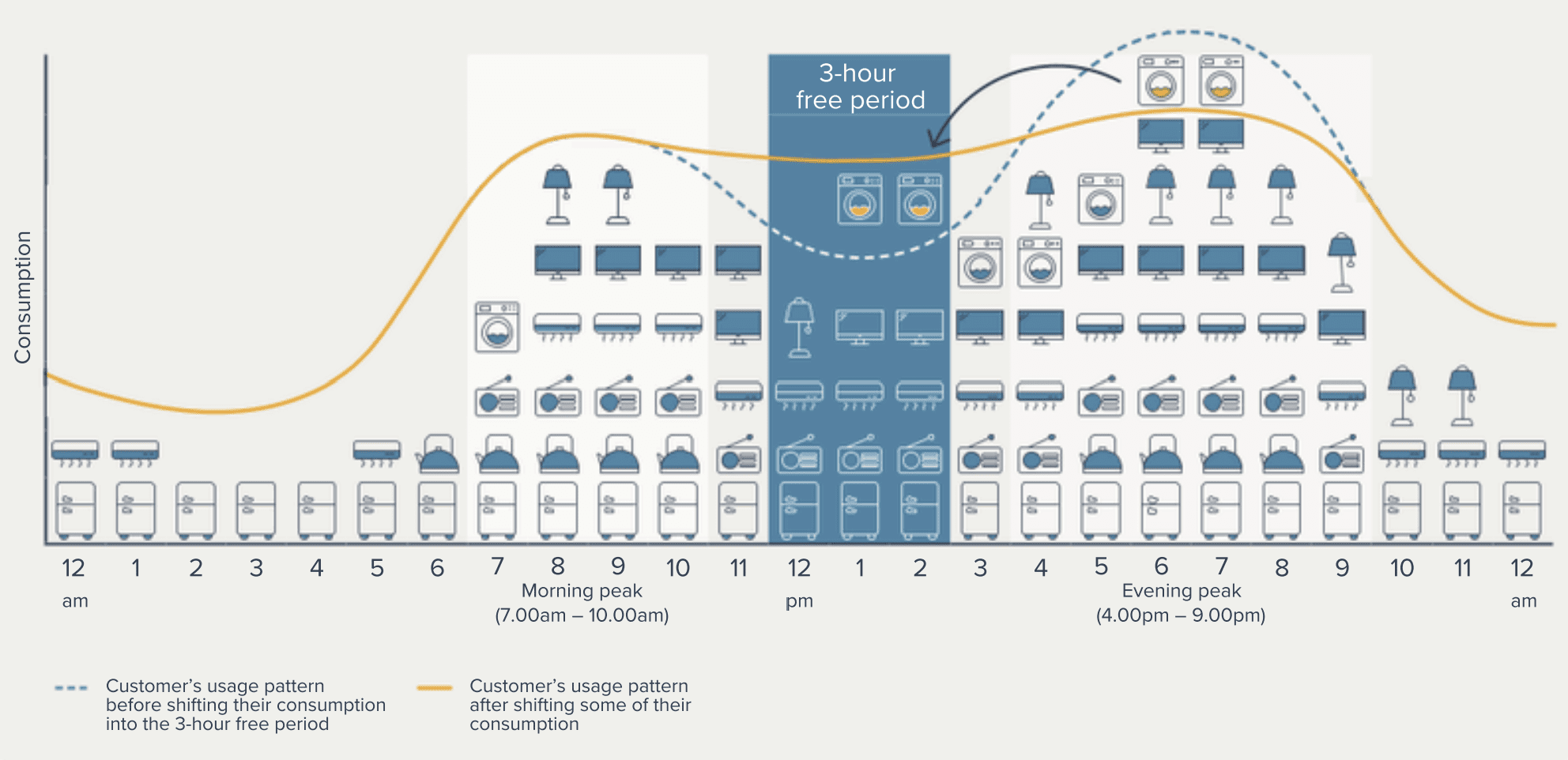
A graphic from the Australian Energy Regulator showing how the Solar Sharer Offer is expected to shift energy demand.
The plans with free electricity periods are supposed to be designed so households with typical electricity consumption patterns won’t pay any extra if they switch to a Solar Sharer Offer plan. While they may pay a little more outside of the free period, normal consumption in the free period will even it out.
But households with typical consumption patterns won’t save money unless they shift at least some electricity use to the free period. This will be easy with a battery or an EV that’s sometimes parked at home during the day. But there are plenty of other ways to do it. You can put a timer on your hot water system or other appliances, or heat or cool your home during the day using your air conditioner. The better your home’s insulation and weather sealing, the better this will work, so you may want to consider improving it now to beat any rush and be ready for winter.
If you want my opinion on whether it’s fair that you’ll only save money if you shift electricity consumption to the free period — yeah, it’s totally fair. Their whole point is to shift shock juice use to the middle of the day and not to effortlessly make people’s lives better.
Not The Best Option For Solar Only Households
Keep in mind that if you have a decent sized solar system and no battery, you’re likely to be better off without a Solar Sharer Offer plan. This is because you probably use hardly any grid electricity during the free period. But if you do have a battery, it can be very worthwhile because you can charge it with up to 24 free kilowatt-hours on cloudy winter days when your solar system’s output may be minimal.
There are also electricity plans with periods of free electricity available right now. So, provided you have a smart meter, you don’t have to wait until July 1 to get one. They’re even available in Victoria, the mainland state that generates the least amount of electricity from solar, with only 17% coming from the sun. While not as impressive as South Australia’s 28%, they’re not being slack, as it’s double what it was 5 years ago.
The plan is to eventually extend the Solar Sharer Offer to all eastern states and the ACT, which makes sense, as there’s going to be a lot more solar in the future.
For more on the Solar Sharer Offer, read our explainer on how to get around the planned cap on free electricity.
 About Ronald Brakels
 RSS - Posts





There must be a typo here:
“In SA the proposed free period is from 12am to 3pm.”
You probably meant 12pm not am.
Corrected,thanks
No such thing as 12am or 12pm — there’s only 12 noon and 12 midnight!
What will a retailer like Amber do, as they offer wholesale rates and don’t make any profit on usage to pay for the cost of this?
I asked Ergon if they’ll offer something similar and their answer made no sense to me.
Any idea if we’ll see something like this in markets with single power suppliers?
We could really benefit in Far North Queensland as it’s much cloudier than you’d expect meaning lots of days when we could use a battery topup.
Why is it that the retail suppliers can control your solar usage during solar productivity periods ? ie reduce the efficiency of solar inverters remotely.
Then sell day time usage as in the customers interest while charging at normat rates in stead of the house holder benifiting from full solar input.
Ergon is a Queensland State Energy asset held in Public Ownership. Regional power pricing is determined through a consultative process conducted by the Queensland Competition Authority [QCA], which sets prices for each financial year.
This was how ChatGPT summarised the answer to the question: Why they are not planning to introduce a three-hour no-cost per kWh in any 24-hour time interval.
This are some of the reported FNQ issues for that type of ToU Tariff:
The grid doesn’t have the same solar oversupply problem;
The network is weaker and more constrained;
Tariffs are regulated, limiting retailer flexibility;
The region already relies on government subsidy (UTP).
The UTP subsidy is essentially:
A government-funded price equalisation scheme so regional Queenslanders don’t pay the true (higher) cost of electricity.
I suspect the real answer is three letters – LNP, the current “directors” of Ergon for want of a better description…
Ownership, both public and private, including joint venturers, involving energy assets [corporate ownership and governance] located across Australia, including Queensland, is not well understood.
For many of Australia’s energy assets, the government still holds the freehold title, with those assets having simply been leased under various financial arrangements to be operated by private entities.
I think we can dismiss your assertion about LNP Directorships applied to Ergon, because it is quite common for individuals to imply wrongdoing without providing any evidence.
Thank you for the explainer, Ronald.
I can already tell that the issue for me with the Solar Sharer schemes, when they come in, will be how to easily and effectively maximise the benefit of them without sitting staring at my Solar app for three hours in the middle of every day.
As a newbie to the whole solar/battery/EV ecosystem I already spend too much time fiddling with the app to maximise the benefit of the power my system creates. The Solar Sharer system seems like a whole new level of manipulation that i know I will fail at.
It’s probably requires a follow up article or two from the Solar Quotes team but I’d really like to know if there is an app or component that can be added to my system to intelligently harvest the available free power and prioritise battery, EV or house consumption that best suits my circumstances without me interacting daily. Something like”household consumption first, Battery 2nd then EV 3rd” .. unless I over-ride for any reason.
Cheers
Tim, if you are a tinkerer, you could look at setting up Home Assistant: an Open Source system that runs on a small computer (I use a s/h Intel NUC). Inexpensive to set up, but does require some learning, but there is a community to help. Home Assistant is a total home management system that reads data from equipment like inverters & batteries & can control them as well. HA can even manage ones´ home entertainment system.
I have been using HA for about 5 years, & I am not a programmer, but I do fiddle! AI is entering the sphere, & will make customisation easier too.
Thanks for the suggestion, Doug. I’m not much of a tinkerer but I’ll look into Home Assistant.
Some systems have a good level of user programmability (e.g. Sigenergy) while others may be compatible with retailers who offer their own app for controlling how the battery operates (e.g. as with the Globird Zero Hero plan). In general these can be set and forget.
As Doug says, you can also look at the Home Assistant option. I use it and have it intelligently controlling the charging and discharging of the battery. Takes a bit more work initially but I don’t look at it much now, it just does what I want it to.
I’m already on a plan with 3 hours of free grid energy every day, this is not a new thing and it works very well with our solar PV and battery system.
These plans just add to the mayhem of pricing madness in electricity supply.
Unless you can crunch numbers very well, you will have little chance of getting around the certainty of higher supply charges and tariffs outside the 3 free period that will be present.
I can see 3 possible winners here . . .
Those with EVs that can soak up a good amount of the free limit, but they’ll need a level 2 charger on single phase (or adjust 3 phase to the limit), ok they’ll be hit with higher supply charge and tariffs for other times, but then I expect many EV owners also have solar and battery too, which leads to . . .
Those with solar and battery, hit that free period and get most of the 24kwh into their battery, and ensure they can get through the rest of the tariff times on that to avoid high charges.
8kw up to 10kw inverter is needed.
A more minor win for those with no solar or battery, but can shift most of their usage to the 3 hours, stay at home users like work from home, or retirees.
I agree, let us see what the daily rate will be for those who change to solar sharer? I am 99.9% certain it will be a large increase from what everyone is currently on.
Are there any details in the notice about whether this will apply to EV charging stations too?
If you charge from a station and get the first 24kwh from that station within the free period will it be free?
The Solar Sharer Plans are only for residences, so with a home EV charger you could charge your EV with up to 24kWh of free grid electricity & potentially more from your rooftop solar. But note with a 7.4kW single-phase home charger it will only provide around 22kWh over a 3 hour free period.
Public EV chargers won’t be affected, but some vary their price depending on time of day. For example, they may have a peak and off-peak rate.
The issue with privately owned public chargers is who pays the operating costs when transaction volumes are below the levels required to support the cost of operations and the ROC-based business model.
So the question: Does the service provider take the windfall by maintaining a retail-to-charge price for the three free hours per kWh?
If you opt in to the free electricity option, does that mean they do not pay you the feed-in-tarrif for those three hours?
To import for free you cant export at the same time. This implies you have a battery. It appears you can import. 24kwh then sell that later. That said if solar is already free would you? May suit wet days.
There’s no mention of changes to feed-in tariffs, so I expect they will remain the same. Variable feed-in tariffs exist, which offer little in the middle of the day but more late in the day (and at night) exist, but where they do, they are very rarely offered. Maybe we’ll see them offered more often.
The Solar Sharer Offer will, partially, offset the fall in feed-in tariffs, so it’s a good thing for them overall.
The current business model, in which costs other than Generation are recovered in the import cost per kWh and, depending on the tariff, may not apply to exports, is not sustainable.
In simple terms, $6 billion/year in lost non-generation revenue from Distributed PV [Domestic and Small Business] systems is likely to be a core driver of tariff reform across Australia.
We could discuss what they might look like in the future.
no mention in the document as to whether it will be available for otherwise flat rate plans. Not holding my breathe, but it would be good.
Generally, there’s no reason a retailer can’t offer a two rate plan which consists of 3 hours of free electricity plus a single rate the rest of the time. But we’ll have to see what is actually offered.
Not available to those without a smart digital meter.
Typical, regional QLD gets shafted again
I disagree, perhaps you should research how QLD Regional Power Pricing is established by the Queensland Competition Authority [QCA] for each financial year. Given QLD’s reliance on CFPS, it is important to note that consumers are protected against negative pricing events under the PPA they have entered into.
For those with off peak hot water (old school heater element) will they reduce the run times in the early hours of the morning by 3 hours and then replace the time with the 3 free hours in the middle of the day.
If not, does Solar Quotes want to suggest it?
If your hot water system is on a controlled load, I would say it is definitely worth considering getting a Solar Sharer plan and getting rid of your controlled load and putting your hot water system on a timer so it switches on during the free period.
Worth considering, but cost of electrician could be a year or more savings.
I was thinking the powerful Solar Quotes could put pressure on the likes of Endeavour Energy to adjust the timing of the pulses that start and stop the hot water heaters
The retailers already switch the hot water on during periods of low or negative pricing so they make a motza while you pay the normal hot water charge.
It is up to us to fit a timer to suit the 3 hour window of free power, or if we have solar then we should do this anyway as the 2c FIT is not much compared to the 20c we are charged to heat the water.
8kwh used daily to heat hot water tank with a 20c saving per kwh is $584 saved per year, so get your electrician to fit your timer!
It is a common recommendation to connect non-solar hot water systems to an off-peak fixed tariff.
Didn’t know there will be a daily 24 kWh limit. Can imagine the per kWh rate above the 24 kWh will be high as retailers will want to recoup the costs of the free power.
What costs? Households are providing the energy free and the rate after the 24kWh limit will be the rate for the applicable plan.
ToU Tariffs are defined by three time intervals in a 24-hour cycle: In my case, for the Solar Soaker Ergon Tariff Shoulder 9:00 pm to 11:00 am, Peak 4:00 pm to 9:00 pm and Day 11:00 am to 4:00 pm.
Would it not follow that the day rate would apply to any import over the 24 kWh limit or outside of the time interval? In my case, the day rate would be $0.07724 per kWh.
What remains yet to be published are the default Shoulder, Peak and day kWh rates for this DMO class of tariff.
With a 13.6 kWh battery a kWh at no cost time interval would produce absolutely no reduction in my cost of power, simply because during the daytime interval, my import is 0.00 kWh. So the only financial opportunity is to charge the battery from the grid and export the excess solar for value.
For an expression of interest, I would be more than happy to conduct the financial analysis based on the free-time interval, charging the battery, and estimate the cash flow from exports during that time.
The larger question will be how the retailers offering these 3 free hours plan to change their daily usage fees on these new plans. And to a lesser extent, time of use tariffs for those with smaller storage.
I wonder if Globird and OVO who already offer 3 hours free will introduce the 25kwh limit? They are currently unlimited.
. . . and AGL who own Ovo, they also have had the 3 for free for some time.
you could see these uncapped fee time plans change to whatever limits are put in place, so this could hurt some that have already taken up these plans.
They are very popular wih the Amber crowd, who are with Amber for summer and shoulder (6 months), and switch o glowbird or other such for winter / shoulder (6 months).
You don’t need a timer or an electrician, just a decent sized battery. When installing your system, Instead of paying for a fancy schmancy timer switch, just add another module to your battery.
We have 38kWh of battery, hot water system just connected to the general supply.
Hot water cistern usually turns on twice a day for about 20 minutes each time, maybe 3 times if we hit the hot water hard. Uses about 2% of the battery each time it turns on if it is after dark.
We tend to shower in the morning, so generally it will kick in not long after we shower, so it running off straight solar, then it generally kicks in once more around 2 am, and takes about 2% from the battery.
Hi Ronald,
Do you know if this will be available to commercial businesses?
The Default market offer \cheat sheet isn’t clear. It says available to ‘all’.
But the Jan 2026 energy.gov.au release suggests it is just for households.
https://www.energy.gov.au/news/solar-sharer-offer-cut-electricity-bills
I guess a lot of small businesses use residential energy plans, so could switch to benefit, but might run into the 24kWh limit.
The AER says it’s a “time-of-use standing offer tariff for residential customers with a smart meter”. So it looks like businesses can’t use it. But daytime rates on business plans should generally tend to trend down.
I would be interested in the three hours of free power to either top up the house battery on cloudy / wet days and/or charge our EV. Not sure though how expensive it would be to have mains power connected as an input to our battery. At the moment our small house battery (8.9kw/h) gets charged only from our solar panels and only at a maximum rate of 2.5kw. Can I get quotes through Solarquotes for connecting grid power to charge the house battery? Or should I just ask my local electrician?
Most batteries are able to charge from the grid. If you tell me what you have I’ll see if I can tell you what your options are.
Thanks Ronald. Our system is a few years old. The installer – OffGrid Energy in Adelaide – tells me it’s an option only if we get a new inverter. Our system has a SunnyBoy inverter, and we would need to upgrade to SMA Sunny Home Manager 2.0 at a cost of over $1,700. The gains would be marginal, so probably not worth it for us.
With the combination of the large drop in the battery subsidy, and the introduction of the free 24kWh of power in 3 hours occurring within a couple of month period, it changes the dynamics considerably.
Has anyone crunched the numbers to see how a battery only install compares to the cost of a minimum sized solar system and battery install (to qualify for the battery subsidy) post July 1 ?
The existing subsidies for large batteries far outweigh the cost of adding a few kW in panels to the roof. Even 2.5kW on the roof will help fill the gap between the 24 kW on offer and what you would want to have in reserve in order to be able to sell power at dinner time, in order to pay off the cost of the system faster or, for larger energy consumers, run their domestic appliances entirely from the battery. Just go big – as close to 50kWh as you can while the subsidies are on offer.