
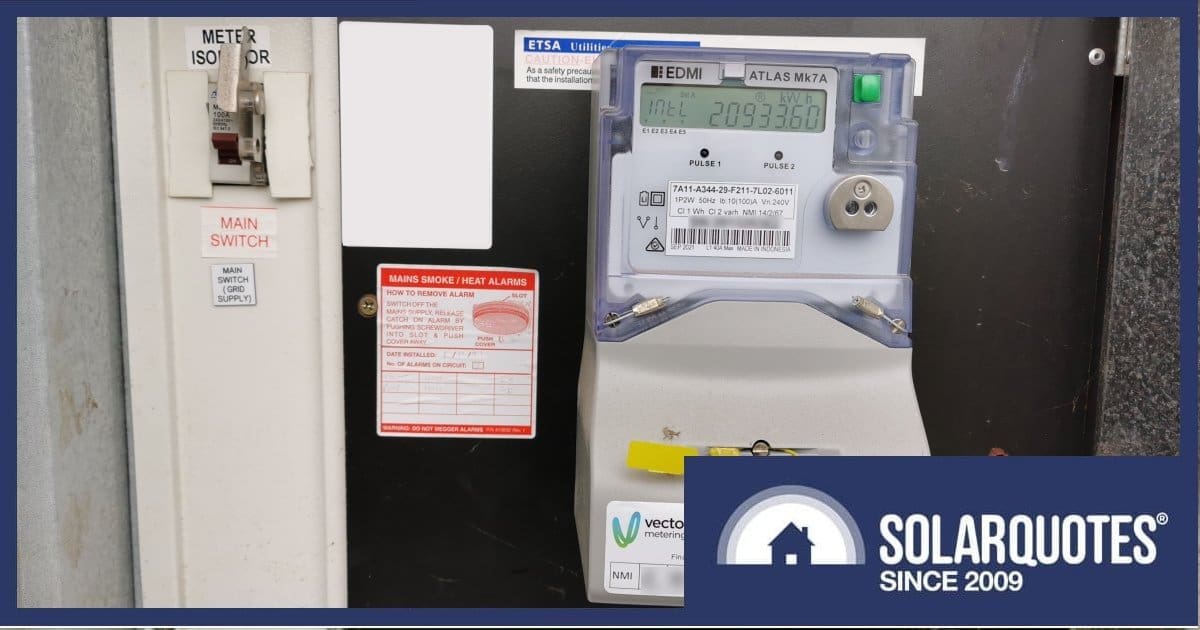
If you wish to upgrade to a smart meter, or if your electricity retailer wants to upgrade your current meter to a smart device, here’s what you need to know.
A smart (advanced) meter records electricity consumption – and exports where the home has solar panels – in 5- to 30-minute intervals. It wirelessly transmits this information to a customer’s electricity retailer for billing purposes. A smart meter can also provide electricity customers with more information on their energy consumption and generation.
All new and replacement meters in the National Electricity Market (NEM)1 are smart meters these days, and non-smart meters are replaced when solar panels are installed. But electricity retailers will increasingly be upgrading non-smart devices generally, even if the existing meter is still doing its job.
NEM Smart Meter Consumer Rights (Currently)
As things currently stand, if you haven’t requested a smart meter but your retailer has proposed to install one, you can opt out (for now – further information below). The retailer must tell you how and give you enough time to do so.
The retailer must provide you with two written notices preceding the upgrade; the first being between 60 and 25 business days before the proposed replacement date. The second must be at least 10 days after the first, and no less than 15 business days before the proposed replacement date.
The notices must also contain detail of any upfront charges you will incur; if any. And if you don’t want your meter to have remote communication capabilities, you can ask for these capabilities to be turned off; but note there may be ongoing costs associated with this.
If you are the initiator of the upgrade request, it’s likely your electricity retailer will accommodate it2. The retailer must arrange for the meter to be installed either by a date agreed with you, or if no timing is agreed, no later than 15 business days after they receive your request. Be sure to get clarification on any costs and …
Beware Tariff Changes
Once your smart meter has been installed, be aware your Distributed Network Service Provider (DNSP) may assign you the default network tariff for smart meters in your area. As a result, the rates under the plan with your retailer could change; for better or for worse depending on your situation.
For example, instead of being charged a flat rate for all electricity usage, you may be switched to Time-of-Use (ToU), where rates vary depending on when mains electricity is consumed. Whether you’ll be able to switch back to a flat tariff depends on the DNSP and your electricity retailer. The DNSP may not allow it; or the retailer may not offer a flat rate option for smart meter customers.
So, that’s something definitely worth looking into – you can compare electricity retailer plans here to get an idea of the impact of a change.
If you run into problems with an upgrade/proposed upgrade that cannot be resolved through negotiation with your retailer/DNSP, contact your state’s energy ombudsman.
The Smart Meter Times, They Are A Changin’
The Australian Energy Market Commission (AEMC) requires universal smart meter deployment across the NEM by 20303. The AEMC sees the devices as essential for transitioning Australia to a renewable energy system and achieving net zero emissions targets. But it was also aware of numerous consumer complaints about forced switching to time-of-use, demand or other unexpected tariff changes after smart meter installation along with other concerns.
In November last year, it issued its final rule requiring accelerated deployment. The final rule contains reforms it says will help protect customers by:
- Prohibiting any upfront costs ahead of a smart meter installation.
- Requiring explicit informed consent and notification requirements ahead of any retail tariff changes.
- Make flat tariffs available to customers with a smart meter (subject to implementation by jurisdictions).
- Ensuring customers can access all the benefits that smart meters provide.
- Introducing new customer-friendly information requirements.
- Enabling customers to request a smart meter from their retailer for any reason.
However, prohibiting upfront charges or exit fees on small customers does not apply under certain deployment scenarios, such as:
- New connections.
- Customer-initiated deployments.
- Deployments resulting from the customer installing new equipment (such as solar PV or a battery).
The AEMC’s smart meter reforms began rolling out in December last year and will be progressively implemented out to July 2026. The new consumer protections kick in on November 1 2025, and accelerated rollout commences in December. There’s some devil in the detail of the final rule in relation to customer protection that I’m not fully across – but more information can be found here, starting on page 25.
Footnotes
- The NEM consists of Queensland, New South Wales including the ACT, Victoria, South Australia and Tasmania. For smart meter upgrade information in WA, see here for Synergy. ↩
- If they can’t; it’s time to shop around for another retailer. ↩
- Smart meter deployment in Victoria for new and existing premises is pretty much done and dusted, but other states have some way to go. ↩
 About Michael Bloch
 RSS - Posts





And remember, there’s a difference between Time Of Use and Demand Tariffs.
Time of use is pretty obvious, you pay more for electricity in peak hours, typically between 3pm and 9pm and less outside of those hours.
Demand tariffs are much more complex and IMO should be banned for retail customers. Say you have the ducted heating on, the dryer running and hot water is doing its thing, which results in your load being 6kW. The demand tariff means you’ll get charged an additional fee for every day of that bill, so in this example 6 * 0.25 * 90 = $135. This is even if your electricity consumption stays below 1kW for every other hour of the 90 days. It’s basically doubling the daily supply charge.
Am glad that in Vic you can’t be opted into one of these plans..
The bigger issue may be demand tariffs rather than getting shunted from flat rates to time of use – some companies charge them, some don’t. And of those that do, at least some put the blame on the customer – your meter was designated as demand tariff. No mention of who made that decision or why. It’s also not very clear what you’ll be charged. At least peak versus off-peak rates are clear.
I think another thing to bear in mind is that a new smart meter gets a new NMI , well mine did.
This means you can’t use any of the compare plan services until you get 12 months of data again. Otherwise you have to type all your bills in every time but the government website gives the following error if you try that (Application error: a client-side exception has occurred (see the browser console for more information).)
On another note, we’re on our 3rd smart meter in 2 years. One died from ants, one from a power surge and the third from a nearby lightning strike. It’s also had the coms replaced twice. Far less reliable than the old meters.
I’ll have to check but I think each time they replace the meter I get a new NMI.
My question concerns off-grid solar power. I was informed that a smart meter would be installed at my property. I opted out because I was making plans on going off-grid, and a smart meter would have been a waste of time and money. However, this option was ignored, and I came home to find a smart meter had been installed. Will I be able to get this smart meter permanently disconnected when I get off-grid solar? We seem to have lost our power to choose how we want our power delivered or to disconnect from it. From what I can find out, customers get permission to disconnect if they’re demolishing a home or redeveloping. Nothing is mentioned about going off-grid. I choose not to go solar and stay on the grid.
Hi Julie,
Going off grid sounds romantic until the lights go out, your freezer is thawing & the generator won’t start.
After 17 years building remote area power, I assure you the generator is the least reliable part of the system, but if you don’t have one there’s likely no warranty on the battery.
And your neighbours aren’t likely to appreciate the noise through a long winter night when the genny is trying to protect the battery & keep the system running.
A decent genny costs $15k + $500pa to service which makes the grid a helluva lot quieter, more reliable & cheaper.
Lightweight grid hybrid solar IS NOT suitable for off grid service.
You can abolish the supply, or simply fail to pay your bill and they’ll disconnect you, but I wouldn’t.
Hi Anthony. Thanks for the follow-up in spite of the fact that I mucked up the last sentence I know what you’re saying, but the public is currently in a no-win situation with electricity supply, off-grid or on. I’ve been in my present abode for over 13 years, and have suffered regular freezer thawing, lights out for days sometimes, stove resetting etc, on the grid. My small township is one of the sacrificial areas when SA Power Networks goes into emergency power management mode. I ended up buying a Nectre wood combustion heater/oven (non electricity model) to cope with the times when I can’t use electricity to cook or boil water for a cuppa or hot water bottle to stay warm in Winter. The only nuisance is cutting up the logs from fallen tree limbs of trees from a vacant lot we own, but at least it’s free. We also keep an emergency portable butane gas cooker in the shed. That’s how constantly the power has turned off and on. So I may not notice the difference off grid. Julie
Hi Julie,
I know first hand that when SAPN have an outage, planned or not, they’ll send you a text message as an alert when it happens and when it’s over.
By law they have to be 99.998% reliable, so if the power is off for any more than 10½ minutes per year, you’re legitimately able to complain.
I have been owed compensation for an extended outage and they automatically forward a cheque. Only difficulty is if your bank and electricity account names don’t match.
I appreciate things arent perfect, I’ve installed systems west of Ceduna to reinforce dodgey SWER lines (and wholly recommend them) but “going off grid” isn’t cheap.
Though it might be desirable if you need to run a large 3 phase dairy for instance.
In any case, using a cheap lightweight hybrid system off grid is a fools errand.
Does that apply to all providers? Endeavour Energy. We have had an outage on average every month for 4 months, 8hours at a time. Two of those instances have been trees taking out powerlines, the others are “maintenance “
Hi Greg,
The Reliability Panel oversees the National Electricity Market’s reliability standard, including the 99.998% rule, under the Australian Energy Market Commission’s governance. It monitors and reports on reliability and determines the standards used, with its recommendations then considered by the AEMC for rule changes.
In practice:
Reliability Panel: sets/reviews the reliability standard.
AEMC: the rule-maker and governance body that implements changes.
AEMO: operates the system day to day.
AER: enforces compliance with the rules