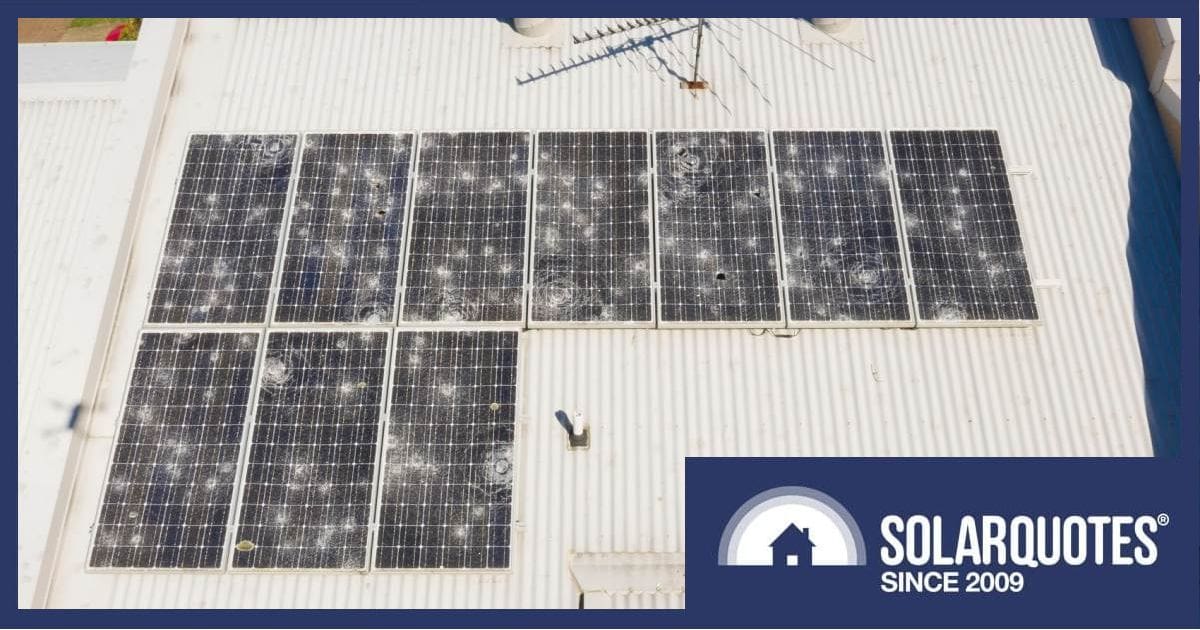
Image: @RACQOfficial
While all solar panels installed on homes in Australia have basic hailstone resistance attributes, some manufacturers take it a step further to provide a bit of extra peace of mind and a competitive edge. But we see some hail storms here that no panel could be expected to survive.
What Standard Level Of Hail Resistance Do Solar Panels Have?
Hail impact testing is mandatory under both Australian and international photovoltaic (PV) standards. For crystalline and thin-film modules, IEC 61215 requires modules to withstand impacts from ice balls measuring 25 mm in diameter at a velocity of 23 m/s (82.8 km/h) at 11 locations across the module under a moderate test (Class MH); or 75 mm in diameter for the severe test (Class SH).
More rigorous, enhanced tests include the Swiss Hail VKF HW4 Standard used by organisations such as Germany’s TÜV Rheinland.
The Glass Factor
A solar panel’s main hail protection is the front cover glass. This is “tempered” glass created by heating normal glass and then rapidly cooling it, making it 4-5 times stronger than regular glass.
The glass also contributes significantly to a panel’s weight. Older solar panels tend to have 3.2 mm cover glass. But over the years, some manufacturers have been reducing front glass thickness. It could be as little as 1.6 mm; but that is usually in double-glass (front and back) and bifacial modules; with the back glass providing extra strength.
Which Panel Manufacturers Offer Enhanced Hailstone Resistance?
The following isn’t an exhaustive list, but shows some residential rooftop example models with enhanced hailstone resistance available in Australia from several manufacturers currently included on the SolarQuotes recommended solar panel brand chart.
| Manufacturer | Example Model | Hailstone Size | Speed | Standard |
|---|---|---|---|---|
| Aiko | All current | 40 mm | 100 km/h | Swiss VKF HW4 |
| Canadian Solar | CS6.2-48TD | 35 mm | 83 km/h | IEC 61215 |
| Maxeon (Sunpower) | All current | 45 mm | 108 km/h | Swiss VKF HW4 |
| Phono Solar | Diamond Dual Glass | 45 mm | 110km/h | IEC 61215 |
| Suntech | All current | 45 mm | 110 km/h | VDE – inspired by Swiss standard |
| REC | Alpha Pure RX | 45 mm | 110 km/h | IEC 61215:2021 |
| Trina Solar | Vertex S+ | 45 mm | 110 km/h | IEC 61215 |
| TW Solar | TWMNH 48HE470 | 45 mm | 110 km/h | IEC 61215 |
| Winaico | All current | 35 mm | 100 km/h | Swiss VKF HW4 |
As for the difference in kinetic energy per impact, according to REC the ability to withstand 45 mm at 110 km/h represents ten times more per impact than the industry standard baseline of 25mm at 82.8 km/h.
If hailstone resistance is important to you, make sure you check a solar panel’s datasheet carefully as there can be differences between models from the same brand.
Hidden Damage – Microcracks
Something to be aware of is testing doesn’t assess the potential for cell damage below the glass, even when the glass isn’t broken — such as microcracks.
Microcracks are tiny, sometimes invisible fractures to the cells caused by stress. Microcracks can grow over time, causing power loss, creating hotspots, degrading panel performance and potentially leading to safety issues including moisture ingress.
Microcracks in solar panels are best detected using Electroluminescence (EL) imaging, where these and other defects are marked as dark areas.
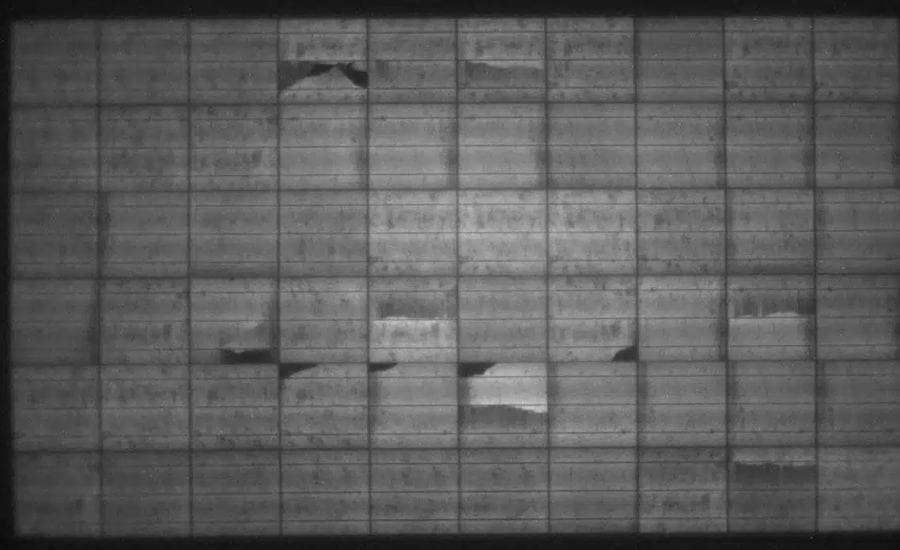
EL imaging showing microcrack damage (dark areas). Source: Winaico.
When Are The Hailstorm “Seasons” In Australia?
Severe hailstorms can happen at any time of the year under the appropriate atmospheric conditions. But general seasonal trends in each Australian state and territory are:
- New South Wales & ACT: September to February. Peak activity generally occurs in November and December.
- Victoria: Spring and summer (September to March).
- Queensland: Spring and summer months. South-east Queensland is regarded as a supercell hail “hotspot”.
- South Australia: Mainly occur between October and February.
- Western Australia: Differs depending on the region. Perth: more frequent from May to October. In the north-west, from November to April.
- Tasmania: Not as frequent as on the mainland, but more aligned with storms associated with cooler months.
- Northern Territory: During the wet season, which runs roughly from November to April.
A wild card in all this is climate change. According to a study from UNSW published in July this year, climate change may cause hailstorms to become more frequent and more damaging in some Australian cities; including Sydney, Canberra, Melbourne and Perth.
There’s Hail, And Then There’s Hail
A 25mm hailstone can pack a bit of a punch, 45mm is pretty big (around the diameter of a golf ball) and 75mm huge. But the hailstones seen in Queensland during a severe weather event back in 2020 were monstrous — up to *140 mm*. Forget about the panels, imagine having one of those hit your head.
The Insurance Council of Australia (ICA) declared a catastrophe for damage caused by the 2020 severe weather event that resulted in thousands of motor vehicle and property damage claims.
Check Home And Contents Insurance For Hail Coverage
Regardless of what a solar panel’s hailstone protection rating is, we’ve seen some storms in Australia produce stones that no panel could be expected to pull through unscathed except by luck.
That being the case, make sure you’ve informed your home and contents insurance provider that you have a solar power system, and confirm that hailstorm damage is covered. That call could save you a bundle of bucks if the worst should happen.
 About Michael Bloch
 RSS - Posts




Hey Joseph ….. what the **** happened to our solar panels?
Hail Mary
( sorry! )
I like your “sorry”. You’re full of grace.
Most people say I’m full of something quite different:)
Isn’t it great to be normal.
Michael,
Thank you for looking into a question which comes to mind every time there is a report of massive hail.
Some years ago, I dived for my porch in The Dandenongs, after the first two ear-splitting gunshot-like explosive hailstone impacts on the wooden deck. Ice shrapnel sprayed up from the impacts, but not dangerously, I figure. Any impact that dents a steel decking roof isn’t going to do glass a lot of good, though.
With every +1°C allowing the atmosphere to carry +7% moisture, +4°C in 75 years is +28% moisture. There’s already more frequent and heavier precipitation, then add bigger hailstones, more often. Just so long as the Atmospheric Rivers which bring megafloods are too warm for big hailstones?
Wet as QLD is now, with yet more flooding rain, these are the Good Old Days, when it was dryer and more livable. At least three times more rain to come is the average, but it comes in lumps – it’s the extremes which will do the damage – several times a year by then? Not good.
living in a shed-house in NSW, insurance is unavailable or waaay too costly UNESS someone knows a workaround?
So I’ve had to devise a modular and universal system of light mesh to reduce the impact at a cost of around a 2-3% efficiency loss
Imagined workarounds: Springloaded bubble wrap to zip into place? Or an electric motor to pull a padded pool blanket over? Now, do you wait for the first impact, or act on cold and deep overcast, just in case?
But if your mesh can remain in place with only 3% loss, then you’ve solved it, and deserve to be featured on SolarQuotes so we all can learn. (Insurance always has a cost – if yours is $0.00 ongoing, just 3% of free photons, then there’s only the capital cost?.)
Rod & Michael, what’s the chances of a photo on this page?
Can you deploy when a storm is approaching?
It’s essentially permanent so I don’t have to pfaff around.
0ne downside is that it could void a pedantic panel manufacturer’s panel warranty
Would’ve been good to have trina and jinko, popular brands on the chart !!
It does make you wonder if a roller blind could be created that is deployed ahead of a storm.