

The Cheaper Home Batteries Program is still booming, but long waits for installation are persisting — and it’s not because of battery stock shortages. Installers tell SolarQuotes the main bottleneck is having enough accredited workers to fit them. Inspections and approvals play a smaller role; the real limiter is installer capacity.
How Long Is The Wait For Home Batteries?
There’s been a surge of customers seeking to get a battery ahead of May changes to the federal battery rebate. According to the latest Sunwiz data, a record 1.2 gigawatt-hours of home batteries were registered through the Cheaper Home Batteries Program in February. Most reputable installers are now booked out until well into May, with new customers set to wait two months or more.
Installers Are Reporting Long Waits
Graeme Galletly, General Manager at Goliath Solar & Electrical, says his team is booked well into May 2026:
“We have 8–10 weeks lead time — we’re currently booking installations into May. Installation capacity is the main constraint. We’re comfortable with our own team, but inspections and service work also factor into timing.”
In Queensland, Caleb Davey from Expert Electrical reports a similar story:
“We’re fully booked through to mid/late May. Our main constraint is installer capacity — we’d love to hire another qualified electrician, but finding the right person is tough.”
Another installer told SolarQuotes that stock isn’t an issue, and customers seem more patient than before Christmas, highlighting that workforce capacity is the central constraint rather than product supply.
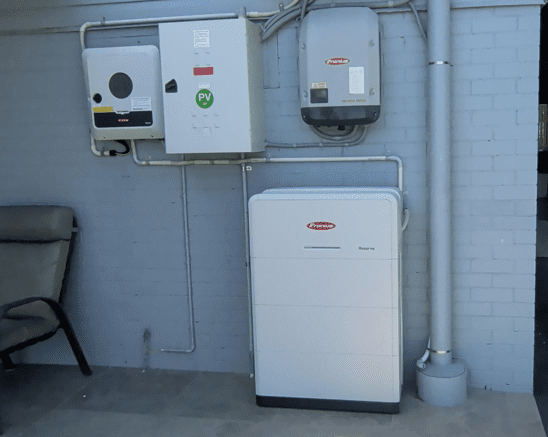
A Fronius Reserva battery installed by Expert Electrical.
Stock and Brand Availability Are OK
According to installers, battery supply is not a limiting factor and popular brands are generally available.
“We haven’t seen supply issues with Tesla, Sigenergy, Fronius or BYD,” says Galletly.
A recent development — Supply Partners Group securing a new distribution deal for Tesla Powerwalls in Australia — should help keep stock flowing for one of the most sought-after batteries, with Powerwall 3 soon to be compatible with Powerwall 2.
Why Installer Capacity Is the Bottleneck
Installer capacity is constrained by accreditation requirements and practical limits:
- Accreditation: Only installers formally accredited under Solar Accreditation Australia (SAA) for battery systems can perform rebate-eligible installs. Many are accredited for solar, but fewer hold battery-specific accreditation.
- Practical install limits: Each battery installation takes several hours to design, install, test, and commission. Even well-staffed teams can complete only a limited number of installs per week.
- Additional work: Installers also manage service and warranty work, further limiting daily capacity.
Growing the Installer Workforce
While the bottleneck is accredited installers, there’s no clear solution yet for increasing their numbers quickly. To install a home battery under the rebate, electricians must hold SAA Grid-Connected Battery Systems accreditation, which requires completing nationally recognised battery units through a Registered Training Organisation (RTO) and applying to SAA.
Some RTOs may now offer the required units, but there’s no evidence of a coordinated push by government or industry to rapidly grow the accredited installer workforce. For now, it seems the pool of qualified installers will expand only gradually.
It begs the question: how can a program this big be rolled out without a clear plan to get enough installers on the ground?
Another Curveball in the Mix
Media reports suggest the government is quietly modelling further tweaks to the Cheaper Home Batteries program. Installers who have been around a while are used to riding the “solar coaster” — with subsidies arriving one minute and disappearing the next — so the reputable ones tend to approach new rebate announcements cautiously, focusing on what they can actually deliver rather than the promises on paper.
Plan Ahead if You Want a Battery Soon
Lead times aren’t going away overnight. With accreditation and licensing taking time, installer slots remain tight — so you could be waiting months. While you wait, do your homework on what battery is right for you with our battery comparison table.
 About Kim Wainwright
 RSS - Posts






It wouldn’t make sense to train more staff, even without the drastic drop in the rebate coming on May 1, most installers would have figured the bulk of any rush would have been in the first 4 to 6 months, when those with existing solar would be looking to get batteries before the first rebate drop.
With 250k installs already completed you would have to think that pent up demand would have to be just about done as well, particularly with the big drop in rebate for decent sized batteries only what, 50 days away?.
Nothing wrong with slowing things down a little when it’s so easy to make mistakes by rushing. The industry has now had more than enough time to pause, learn from the early chaos, and build processes that actually scale without compromising safety or quality.
If we suddenly ramped up staffing just to chase a short‑term rebate spike, we’d only be setting ourselves up for another boom‑and‑bust cycle — and the bust always lands hardest on both customers and installers.
With the situation in Iran and the usual months‑long recovery time for global fuel supply pricing, the smart operators will be thinking longer‑term anyway.
Families are under real pressure, and the most helpful thing the industry can do right now is offer clear guidance and genuinely affordable financing options so people can make decisions that hold up over the next decade, not just the next rebate window.
I guess one of the reasons that the government may not be interested in pushing a big program to increase installer rates is that the demand for batteries is current high and will tail off as incentives reduce. It has already led to a huge increase in installations which is doing exactly what it is intended to do.
As the program tails off it would also be likely that the price of the systems themselves will come down as both competition and improved batteries lower costs per kWh.
The government may see it as operating like a bit of a handbrake on demand over time hence smoothing the demand curve and reducing finacnial pressures on the scheme.
Kim,
I wouldn’t whip the industry too hard over its failure to rapidly adapt to a spike in customer demand. Yes, it is *entirely* installers responsibility to manage their capacity to meet variable demand in a free market.
Hiring for a peak is risky, unless you can find subbies. It is far more important that achieved installs are good installs. Pent up demand is the best problem to have, I figure. Late customers can’t really expect to finish early.
The energy transition is a long haul. So long as renewable infrastructure goes in at a high average rate, we’ll get there – too late to avoid shooting through +2°C to +3°C and dire costs, though.
We’ve just had 15 successive overcast or very cloudy days here – that will proliferate. More panels will be needed in hundreds of thousands of installations as average yield dwindles in the increasingly Venusian climate. When EV transport takes off, for food security, ample home batteries & panels will be vital.
I can attest to the long lead times. I ordered early October and after much pressure in late 2025 I got an install date in mid-January 2026. A 3 month wait that might have been longer if I didn’t make a bit of noise – and I did that because the promises on sign up were for a quick install by mid-November.
Seems most firms and teams work to a team basis to keep busy while stock is assigned and materials readied. They want to be ready but not oversaturated. Addition staff needs addition of skill mix, experience and as a team.
Adding too many staff for the drop after may could also be unwanted. A stable business v out of control.
I ordered in early november and as soon as they had a green light I was flexible to avoid delays. So glad we didnt delay. Early december it was done.
Prices have risen for sure. $3k up on what we paid $12k.
Like most things these days, patience is key. Many companies rush the sale and push you into larger rebate categories.
I installed solar with a 53.2 kWh battery. Living in the hills of Melbourne with an EV, my goal is to control winter energy costs—summers are mild here, but winters drive usage. My winter peak days can hit 40–50 kWh, so with 13.2 kW of panels and good afternoon sun, I’m hoping to store enough to keep my bills under $100 a month (fingers crossed 🤞).
It’s a good initiative, though some are abusing it. Joining a VPP and feeding power back during peak demand would help return value to the grid.
Now I’m just waiting on the inspector so the system can be switched on—currently about a 15-working-day delay.
It seems these battery rebates are only for Chinese lithium batteries.
More people would probably take up the offer if was extended to Australian made sodium ion batteries which are safer and would be a boost to Australian manufacturing rather than propping up china’s economy
Um i have a Tesla Powerwall 3 that was manufactured in the Gigafactory Texas USA. I went for a brand thats proven their cell longevity in their cars