Shade is the number one enemy of a high performance solar power system.
If your roof has substantial shading between 9am and 3pm then installing solar panels is probably going to be a really bad investment.
If you are confident that your roof roof has absolutely no shading, then solar can be a great investment thanks to the current handouts by the Federal and State governments in terms of Solar Rebates and Solar Feed In Tariffs.
But what do you do if you suspect that your roof may get only a little shading throughout the day? Most roofs will get some shade from trees, power poles and neighbouring multi storey buildings.
How do you definitively work out how much shade your roof gets throughout the whole year?
And how do you use this information to get an accurate figure for how much power you can expect from a solar power system on your roof?
Because that is the figure you need to make an informed derision as to whether solar panels on your particular roof are going to give you the financial payback that you are looking for.
Well, the obvious answer is to get an accredited solar installer round to your house to have a look at your shaded roof and advise you.
So how will a reputable solar installer/designer work out the shade on your roof and how this translates to electricity output?
Well, unless your roof is very obviously free of any shading issues whatsoever, if he simply looks at your roof and says
“Hmmmmmmm… I reckon you’ll lose about [insert random (but low-sounding) number here] percent. She’ll be right!”
…then thank him for his time and throw his business card in the recycling bin.
Hopefully he’ll get on your roof and use a specialist instrument to conduct a full “Solar Shade Analysis”.
This is usually a camera with a fish eye lens that can amazingly take just 1 picture of the panorama around your roof and then crunch the resulting image data and tell you very accurately when and how much your roof will be in shade at any time of year.
Pretty cool eh?
So how does it work? What is this magic device?
One of the best systems on the market is called the SunEye.
It looks like this:
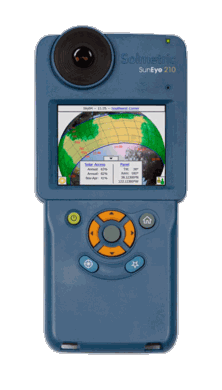
The fisheye lens is top left.
The installer places it on your roof and presses the button.
He will get a picture like this:
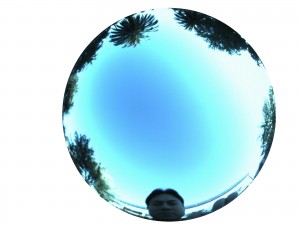
Which shows the obstructions to the sun around the circumference of the fish eye.
The software then superimposes a “sun path” onto the picture like this (the speech bubble annotations are mine):
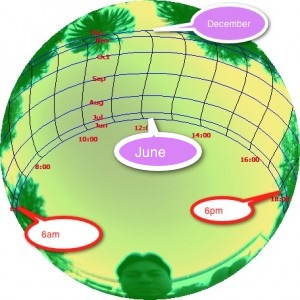
To read this picture you need to know that 6am starts at the LHS through to 6pm on the RHS.
The horizontal lines denote the month of the year, June at the bottom through to December at the top.
(The display can only show 6 months at a time – you can toggle the display with the device software to show toggle to the other 6 months of the year.)
If there is an obstruction inside the hatched area, you can see what time of day the shadow occurs and which month of the year.
So in this example, at 10am there will be shade, but only in Dec and November. At 6pm there is shade for the whole 6 months (June-Dec)
In a perfect world there will be absolutely no obstructions in the hatched area.
The installer will then download this image to his laptop and the software will crunch the data and provide a very accurate estimate of what your power production hit will be due to the shading issues for your roof.
You can then decide if you are happy with the reduction in power from the shading issues on your roof and make a fully informed decision on whether to install Solar Power on your home.
If you have any shading at all on your roof and you don’t use a similar method to measure the effect on solar power output, you are just making a “Wild Assed Guess” as to whether your multi thousand dollar investment will give you the returns you are looking for.
Finally if you do have minor shading issues, then consider a micro inverter based solar system. Whilst micro inverters are not a magic bullet for shade issues, they can stop minor shading issues from becoming major power killers.
 About Finn Peacock
 RSS - Posts




Finn, this is a really useful and interesting article – thankyou.
I wonder if the bottom line should be labelled “June” rather than January, as presumably the line the sun takes ‘peaks’ in December, then starts to track back ‘down’ the image.
Thanks for advising!
chrz
Mike
Hi Mike,
Good Spot! You are 100% correct – I have updated the label.
Also be aware that the diagram is for the Northern Hemisphere so their summer is June, hence a higher sun and less shading in June.
Finn
How about one for the southern hemisphere.?? That would be excellent.
Thanks for the info.
Hi Joy,
This instrument is 100% compatible here in the Southern Hemisphere, but the only screenshot I could find was from the US!
Hope that helps!
Finn
Hi finn, great article where does one buy this device, and what sort of dollars can one expect to pay for it.. l take it the software is included with the device…
Hi Glenn,
You can buy them from the Australian distributor here:
http://solarinverters.com.au/show_prod.php?prod_id=2mI7wc
I think they are about $3k
Fantastic info Finn! I am looking to go Solar and have started looking around for the best deals. My only concern is that my roof faces East/West with a pitch of 15%. Am I wasting my time?
Hi Patrice,
15 degrees pitch is fine for solar.
If you don’t have North facing roof space, be prepared to lose about 15% of your power (no big deal with current low panel prices).
Put your panels on the west facing roof and you’ll get more solar energy during the “peak electricity pricing hours”. You’ll be happy you did if you ever get put on a “Time of use” electricity tariff where electricity is much more expensive to use between 2pm and 5pm!
Hope that helps,
Finn
Hi Fin,
How did you find the 15% loss value? I did use the solar calculation tools and use for NSW, the result was that N, E, W have similar number while the E is the worse like -15%.
Would appreciate if you can elaborate more on this.
Thanks a lot.
Hi John, Ronald here.
The difference between facing panels North, East, or West will depend on your location and the local climate — some places have more clouds in the morning that the afternoon or vice versa. On this page there is a compass graphic and you can click on the different capitals to see how panel orientation affects solar generation:
https://www.solarquotes.com.au/panels/direction/
This is interesting as I realise that I have some shading from trees in the council parkland next door which impacts on the north facing roof where I thought it was completely sunny all day. In fact I have really been taking a good look at the roof just lately at different times of the day and half of it is shaded from 1- 2 pm onwards. Doesn’t look good!
I have had two quotes done recently through your site but no one used this device so I am unsure about going ahead with the solar now. I have been doing more reading on the impact of shade on the solar panels and the more I read the more I am unsure about going solar.
It might be a waste of money for me.
How do I find out who does use these devices when quoting?
Hi Toni,
It is a great question. To my great sadness, most installers do not use the Suneye even on roofs with obvious shading issues. To be fair – it is such a competitive market that the extra cost of sending round a qualified person to do a shade analysis on your roof, would wipe out a lot of their margin, so it is understandable I guess. Still makes me sad though 🙁
If you let me know your postcode, I can probably find someone
Finn
Hi Finn
Glad I stumbled across your blog. Great stuff!
I installed solar about a year ago. I live on acreage but have tall trees. I knew I was going to cop some shade due to some very tall trees on my property.
I can see some big holes in the output during the day and would now like to trim some of the trees causing this.
In order to instruct the tree-lopper properly I need to identify the offending trees and it sounds like a device like the Sun Eye is needed. Would that also serve to identify the trees that are causing the problem?
I live in the Sunshine Coast (QLD) hinterland and wondered if you knew of anyone over this way that could carry out such a survey.
Another suggestion I was given was to contact an architect for a shade pattern study.
Thanks for any advice you can offer
Hi Hugh, Ronald here.
I can have the Suneye sent to you, but I will mention it can only tell you about existing shade and won’t be able to tell you what should be trimmed to improve the situation.
If you’d still like it I’ll need your address. If you’d prefer not to post it here you can email me at [email protected]
I have two quotes thanks to you. However one company says I need panels to be tilted ,the other saying that they can be laid flat.My roof faces west and has 22 degree pitch. Witch one would you suggest if any Confused.
Hi Ken,
You would get slightly more power if you tilted your panels (especially if they were tilted to face north), but you do not need frames if you have a 22 degree west facing roof.
Whilst the perfect pitch for Victoria is 37 degrees – the extra power you would get by going to the expense of putting all your panels on tilt racks would be tiny compared to the cost of the racks. It would be much cheaper to make up for the “lost” power by adding a solar panel for $300 or so rather than spending $1000’s on a tilt frame.
Hope That Helps,
Finn
While I’m sure it is not as good as the Sun Eye there is a great app on the Google Store called Solar Shading by Comoving Magnetics. It is $16, but worked really well on my Samsung S4.
It worked out I would lose 17%. Without it – who would have known what my loss would be.
Okay, it seems that my post is late but anyway better late then never.
If you look for help in shading analysis you can just youse your Android phone and free non-commercial ScanTheSun app.
With ScanTheSun you can:
– calculate the solar energy reaching the collector
– find the energy loss due to shadow cast by objects in the vicinity (trees buildings)
– plan the collectors mounting (selection of the best part of the roof, proper panels orientation) even in a complicated urban areas
– calculate the hours of water warming or electric energy production during the day
– prepare a complex documentation of insolation and efficiency of solar installations
Here is a ScanTheSun screen recorded video:
https://www.youtube.com/watch?v=GHKAhpQv1Vs
and another video with additional explanations
https://www.youtube.com/watch?v=m6BIzAaE09s
Please refer to Google Play for more info on ScanTheSun
https://play.google.com/store/apps/details?id=com.scanthesun&hl=en
I have invented ScanTheSun as non-commercial scientific contribution and I hope it will be helpful to some of you.
Ernest Grodner, PhD,
University of Warsaw
I have a question regarding splitting panels.
If panels are placed on my North facing roof and the rest are place on my North/West facing roof what effect will this have on the current generated once the sun descends below the ridge of the North panels and is only feeding the North /west panels ?
Also is it possible to mix inverters.
Say for instance to have micro inverters on the North panel and a normal Inverter on the North/West panels or should all the panels have micro inverters ?
This will answer your question:
http://www.solarquotes.com.au/blog/solar-panels-on-roofs-facing-different-directions-then-you-need-to-do-this/
In theory, yes you can mix micros and DC on the same roof. You’d need separate cables down from the roof for the micros and the DC inverters.
Also consider DC optimisers:
http://www.solarquotes.com.au/blog/microinverters-vs-dc-optimisers-which-is-best-infographic/
Hi Finn,
Is it possible to lend the Suneye for a job on the sunshine coast qld that has some shade issue’s. I used to have The Solar path finder but found it lacking in accuracy. Regards Adrian Flux Electrical
Yes – I’ll post it to you as soon as I’m back from Easter camping trip!
Hi Finn,
I was wondering if I could have a lend of your Suneye – I’m involved with a project that will require solar power at 4 sites – all in Forestry Corporation NSW areas, so shade issues are significant.
yes – shoot an email to [email protected] with your postal address
Hi Finn
Is SunEye still the best/only decent way to assess the extent of shading and the degree to which it will impact output? I am struggling to find someone prepared to use one to confirm the viability of their recommended systems. [one company claimed they would use a SunEye in the installation process to determine the best location for panels, but did not offer to use it before we signed up. Another said they didn’t use one because “they didn’t need to – Near Map is a good enough reference” Both of these companies are on your “High Feedback Rating” list. We are located in Brisbane. Any advice would be much appreciated. Thanks
Hello Sharon, Ronald here.
To get a highly accurate picture of the effects of shade it is important to use a Suneye or similar device. But you probably already have a good idea whether or not your roof has serious shade issues. If there are no shadows on your roof past early morning or before late afternoon, then it’s not a large problem. But if there are shadows on your roof for a significant part of the day I would insist on a shade analysis so you can know if installing solar is worthwhile for you.
I believe Finn still has a SunEye that he can lend out, so if you want to borrow it I can let him know. You will need someone who can safely go on your roof to use it.
Hi, We have had companies tell us we are too shaded to bother with solar, but our neighbour has agreed to cut some trees to help us. Does anyone in Brisbane use the sun eye?
Hi Colin
There are a number of quality installers in Brisbane who use Suneye. MC Electrical is one:
https://www.solarquotes.com.au/installer-review/mc-electrical/
Note that until the trees are cut it will only be possible to estimate what effect that will have.
Hi Finn
Looking at installing solar but being surrounded by trees led me to focus on the shading issues and trying to quantify their impact. I did some manual work (taking sightings of the location and height of the trees and plotting the sun’s trajectory manually) but thought: “there must be a better way”.
I read about the SunEye system here on SolarQuotes but want to share with you what I ended up finding, It’s an app (of course) that allows you to use your smart phone as the measuring device. The app then produces some pretty impressive results, calculating your potential production, as well as the losses from shading and panel tilt angle. I’d include some examples of the graphs and reports here if I could, but you might find it worthy of a blog post that would show these.
I did search Solar Quotes for a reference to it but it doesn’t appear to be mentioned anywhere, so I thought I’d share my experience.
It’s called “Scan the Sun” and I’d recommend anyone with possible shading issues having a look at their site http://scanthesun.com/scanthesun.php.
And best of all – despite the very impressive features and reports generated by this app, it is – at least for now – free! 🙂
By the way, I contacted three installers (obtained through Solar Quotes). I told them that there were lots of trees and probable shading issues. One of them suggested a site visit, the second came only after my insistence and none of them made any attempt at shading analysis. Just as well I did my own!
Cheers
Geoff
PS re-reading my comments I realise it sounds a bit like an ad. I am in no way associated with this product; I am simply impressed by the functionality and wanted to share my experience.
Hi Finn,
Are you still lending the suneye device? We have just moved into a new house in Wollongong and have good sun in the morning but large trees shade most of my roof from early afternoon onwards (granted it is June). As per others’ comments, none of my solar quotes installers offered to do a shading analysis so I’m having to work it out for myself and also consider optimiser options.
Keep up the good work.
Hi Tim
Yes, we still lend out the suneye. Send an email to:
[email protected]
…requesting it and we will send it out to you.
Hi Finn
I’m wondering if near maps technology has changed at all and improved for shading analysis or if you still recommend a sun eye or other device for analysis?
I have been told that my roof if quite shaded at certain times of year and have had one installer say enphase microinverters are the way to go and the other stating that solar edge were definitely the way to go. I read your other blogpost on these matters too – but am not sure if one solution is more optimal for a similar price?
I’d appreciate your feedback!
Hi Andrew,
I had a similar quandary earlier this year before installing our own solar system. Finn was good enough to lend me his suneye device and I found it very easy to use and helpful in understanding year round shading issues. If you send him an email I’m sure he’d be happy to send to you too. Bear in mind you need to be able to safely access your roof to use the device.
I also weighed up enphase vs solar edge but concluded that Tigo optimisers with a Fronius inverter was the most cost effective and best fit for us (I must admit I was spooked by some of the poor reviews of solar edge online). Obviously I’ll never know how the other options would have turned out but all I can say is I’m delighted with the system I chose. Yesterday we generated 37kWh – new record. Not bad for a 6.3kW system.
Hi Tim, Finn,
I have to work out if solar will be worthwhile installing [due to shade issues in winter on north and east roof areas] so I am wondering what panels you went with and if just west facing panels are ok.
I have 3 quotes from the solar quotes site but the shade issue hasn’t been mentioned by any of them.
Also Tim do the Tigo optimisers add much cost to the system?
One of the quotes I received suggested I go for a 9.1kW system rather than the 6.6kW ones, but seeing that your 6.3kW system can produce up to 37kWh maybe I only need the smaller system. What do you think?
To receive the 2020 rebate I only have this week to finalise who I go with as the installer and what brands, size etc. I select.
I am in the Toowoomba Qld area.
Regards, Trevor.
Hello Tim, Ronald here.
Finn has Tindo panels on his roof. He’s never had any problems with the panels but they are not cheap so I can only recommend them if you are willing to pay a premium for Australian made panels.
You can get a detailed shade analysis done, but even if you lose two-thirds of your entire winter output due to shade that will only add roughly one year to the simple payback period in Toowoomba and you may not consider that to be a problem.
You can use our solar and battery calculator to see the effect of using all west facing panels:
https://www.solarquotes.com.au/solar-calculator/
It says if you pay $6,600 for a 6.6 kilowatt solar system with all west facing panels, for a typical household it will have a simple payback time of about 6 years. West facing panels can be helpful for powering summer air conditioning.
Using microinverters, optimisers, or Maxim optimised panels that have optimisation built in can modestly reduce the effects of shade but can’t eliminate it, so you’ll need to decide if the extra cost is worth it to you. You may be better off using the money to install a larger system instead. The amount optimisers cost can vary considerably and may be $80 or more per panel. (A 6.6 kilowatt solar system may have 20 panels.)
My general advice is to install as large a solar system as will easily fit on the roof, but what is best for you will depend on your needs and your budget. A larger system will be beneficial if you decide to get batteries in the future when they come down in price and/or buy an electric car.
STCs are created on the day the panels are installed and it’s very unlikely that will happen this year, so don’t feel pressured to rush into anything.
Thanks for getting back to me Ronald, also I was under the impression that the rebate was about to decrease for 2021, is that right? That was the reason I was trying to sign up for a deal before the end of the year. I also have sun on the north facing roof for maybe 8 or 9 months of the year so would it help with some panels placed there? Regards, Trev.
The number of STCs you will receive will decrease by 9% at the start of 2021. This will increase the price of a 6.6 kilowatt solar system by around $300. But the STCs are received when the installation is completed so unless you can get the installation done this month, which is very unlikely, it will make no difference. Of course, some installers may say they will give you the 2020 price even though they will install it in 2021 but you should probably take that with a grain of salt.
If the western roof is free of shade and there is room for the panels that would probably be a better location, but if they won’t all fit on the west roof then north sounds like the best choice despite the winter shade.
Hi Finn, would it be possible to borrow your Sun-Eye please? We have shade issues (particularly in winter). Just had a quote from someone your site suggested who said it wasn’t worth putting panels on the west side (possibly because of trees) and therefore cld only put up a 3kW system. I don’t know if this will be enough for us & worth the cost of installation. I have been on our roof many times & know there is a good lot of sun on the west during the summer day. We cld also consider trimming some trees on that side to help. Am feeling a bit despondent about this result. Thanks for your input.
Hi Kate
If you let us know who the installer is we will check with them if they want to do the Suneye analysis. If you’d prefer to email me, my address is:
[email protected]
Hi Solarquotes,
Just wondering in 2023 if it’s still worth getting a suneye analysis or if software such as pylon has reduced the need for the physical on site test?
Thanks Matt
The need for a suneye analysis has been reduced as software tools have improved, but if you want your shade analysis to be spot on, then suneye is best. But most installs won’t need that level of accuracy because most of the time if there is a little more shade or a little less than the software tools say, installing solar will still make sense.
Hi Ronald,
I’ve got widely varying opinions from the 3 potential installers I got from Solar Quotes regarding the impact of the shade on my roof.
The problem is I’ve only just cut down a massive spreading ash tree that dominated the area and is still in the available satellite imagery. I’m trying to estimate the location & extent of the remaining trees but there is just a big mass of green and it’s difficult.
I’ve been stuck for how to move forward for a couple of weeks now, because these 3 reputable companies all differ in their advice and I don’t know who to listen to. I’ve registered to use Pylon and Open Solar (using Nearmap) but I it’s hard to represent the remaining trees with any accuracy. Pylon is not bad but the remaining trees are quite close by so any tiny change I make to the modelling has a huge effect on the resulting outcome.
Could I please borrow the Suneye tool? Or is there some other thing you could suggest to help?
Kind regards,
Vija
Hi Vija,
I’ll see if the Suneye is available. Send us an email to [email protected]
Cheers
Hi Finn
Fantastic site, congratulations. Like others I am having trouble finding someone able to do a proper shade analysis – do you know of anyone in the 7277 vicinity?
Cheers – Steve
Hi Steve,
Sorry – I don’t – it drives me crazy that most installers don’t have a sun eye!
However! I do have a sun eye that I post out to people who want to do their own analysis. Let me know if you want to borrow it.
Hope That Helps,
Finn
That would be great!
Cheers – Steve
The sun-eye worked well for myself and a neighbour establishing that we both had around 96% solar access through the year and giving us the confidence to proceed with our plans. i agree that any serious installer should have one. Thanks again for all your help…
Cheers – Steve
Hi Finn,
We are having similar issues. No one You have referred have sun eye and in May and June at least we have noticed shading on our north facing roof to some extent between 10 and 2. Any chance we can borrow your suneye? 2081
Great news Steve – glad you didn’t fall off the roof 🙂
Hi Steve
That’s real positive, I’ve been reading this feed with interest, I work in the industry and want an edge, i think presenting this data in a professional way will win jobs.
Just got a question on how to take the shot when up on the roof, do you just put it on the north facing orientation in the middle of the roof and take the shot?
This is understandable if you only have a north facing aspect with panels.
What happens if you are thinking of using 2-3 orientations for panels.
Regards
Peter
Hi Finn,
I’ve just received about 6 quotes from various installers including some from solar quote. All of them picked up that there would be “some” shading but still wanted to put a PV system in and all gave me the standard PV production table (with the inevitable proviso that it was subject to any and all conditions for my roof and probably wouldn’t perform to the stated levels). The performance hit varied from negligible to 10%, but they were all WAGs using NearMap. Ok, I expected a hit of some sort for some of the day.
Then I got a guy who called and said, “I’ve had a look at your roof and there’s no point me coming out. I could put panels up, but you won’t see much power and it will be lucky to pay for itself in under 25 years!”. Apparently, he had some photos form NearMap that indicated that most of the roof was covered by shade for most of the day for most of the year! He estimated only 3-4 months of the year would panels not be under any shade at all and said that even a 3-5% coverage by shade could cost 25-30% of power output and if it got as high as 10-15% then the panel produced next to nothing.
So now I’m wondering who to believe. They all used NearMap, some say there’s a negligible problem and then there’s this one guy who says it would be a complete waste of money but this is all qualitative. None of them can provide any quantitative analysis on what will really happen and if it’s not worth the money. I’m in the 3172 postcode, do you know anyone who can come out and do this properly and give me firm numbers on what is really going on?
Regards,
Laci