
The Australian Energy Market Commission (AEMC) says its proposed network pricing reforms could cut electricity costs and deliver up to $6 billion in savings across 15 years — but modelling suggests those savings won’t be shared evenly, with some solar owners potentially worse off.
Will AEMC’s Network Pricing Reforms Save Money?
The modelling projects savings of $40 to $80 per household per year on electricity bills by 2040. It estimates some families would be much better off, saving up to $740 a year by 2040, with two-thirds of households that are unable to have solar or batteries benefiting.
The impact is slightly negative however for solar and battery owners. The payback period for solar extends from approximately 4.4 to 4.7 years, while solar and batteries go from 4.6 to 5.0 years, although home batteries could be better rewarded for easing network pressure during peak periods.
Quitting gas would become more financially enticing, with payback from going all-electric improving from 8.3 to 7.7 years.
This follows earlier SolarQuotes coverage of the draft proposals, which raised concerns about higher fixed charges and shifting costs onto low-usage and solar households. The latest release doesn’t change that direction — but it does add further modelling and proposed consumer protections.
Is This Really About Savings — Or Cost Shifting?
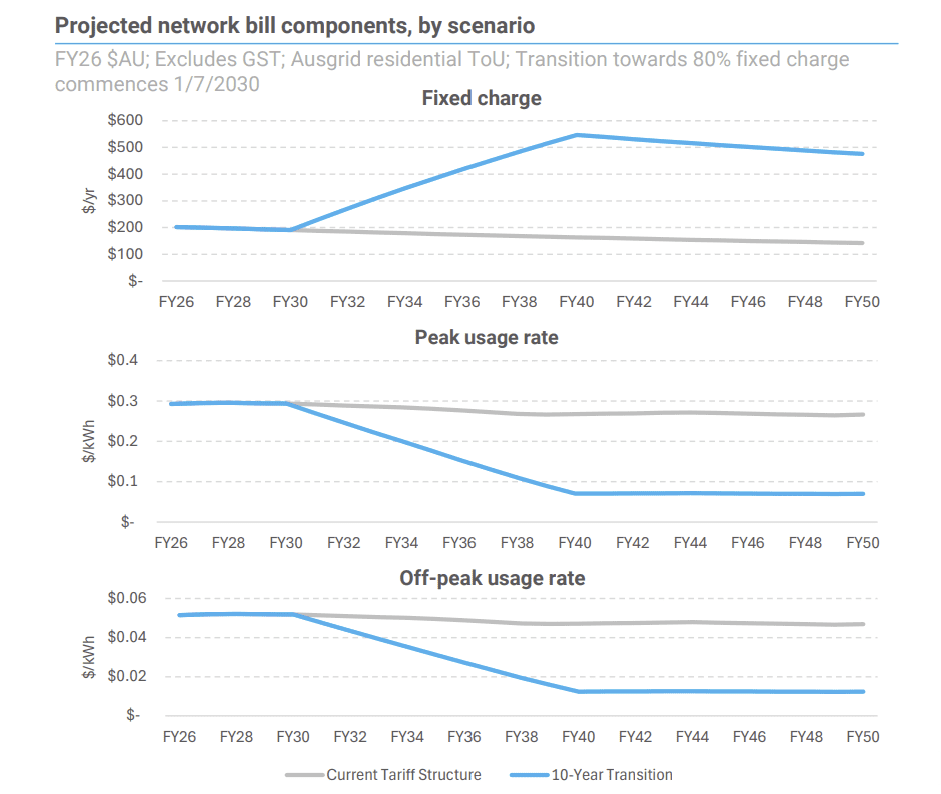
AEMC projections for potential changes that would see fixed charges go up and usage costs go down.
Dig into the detail of the report and the focus is less about cutting bills across the board, and more about reshaping who pays what under the AEMC’s so-called “cost-reflective” pricing approach.
The AEMC also links the reforms to broader benefits, including lower wholesale costs, improved energy security and reduced emissions, although these outcomes are not directly evidenced in the pricing modelling.
Electricity networks still need to pay for poles and wires regardless of how much energy flows through them. As households install solar and reduce grid consumption, recovering those costs through usage alone becomes more difficult.
The solution being proposed is not to reduce those costs, but to recover more of them in ways that are less dependent on how much electricity is used. That’s why fixed charges remain central to the discussion — even if they are not the headline focus.
What Role Does Peak Pricing Actually Play?
A big part of the AEMC’s case relies on higher prices when electricity is used during peak demand, and lower prices when the grid is underused. But that element is more prominent in the modelling than in the media release itself.
In practice, the reform depends on households responding to these price differences. Those who can shift usage, store energy, or avoid peak periods may benefit. Those who can’t are more exposed — particularly if a larger share of their bill is fixed.
What This Means For Solar And Electrification
This is where the tension becomes harder to ignore.
For years, households have been encouraged to install solar, electrify appliances, and reduce reliance on fossil fuels. Those decisions were supported by clear financial signals — use less grid power, and your bill goes down.
This reform starts to change that relationship.
As more costs move into fixed charges, reducing grid consumption delivers smaller savings. At the same time, more complex pricing makes outcomes depend more on behaviour, flexibility, and access to technology like batteries.
The AEMC argues this supports electrification overall — and at a system level, that may be true. But at a household level, the incentives become less straightforward.
Winners, Losers, And Acknowledged Risks
The modelling confirms that not everyone benefits.
Some households — particularly those with flexibility, storage, or the ability to shift usage — are better placed to respond to changing price structures.
Others, including low-usage households and some solar-only homes, may face higher costs depending on how tariffs are designed and implemented.
The Australian Energy Market Commission acknowledges these distributional impacts. A separate report by HoustonKemp examines the likely impacts in more detail and sets out options to manage them, rather than challenging the direction of change itself.
Those options include limiting how quickly fixed charges can rise, changing how network costs are shared between different types of customers, and requiring retailers to offer clearer choices and obtain customer consent before moving people onto different tariff structures.
These measures are aimed at managing the transition and reducing the risk of sudden bill increases as reforms are introduced.
Not Final, But The Direction Is Clear
The AEMC has not yet made final recommendations, with more than 2,700 submissions received ahead of a final report due in June 2026.
Even so, the direction of reform is becoming clearer. It points toward more complex pricing structures, a stronger reliance on fixed cost recovery, and a greater focus on how households use electricity — not just how much.
For solar households, savings are becoming more dependent on tariff structure and usage timing, along with how much energy is generated.
The impact of these changes will become clearer as the reforms are finalised and rolled out over the coming years.
To stay up to date on AEMC’s finalised changes once they are announced and other home electrification news, subscribe to SolarQuotes’ free weekly newsletter.
 About Kim Wainwright
 RSS - Posts






The AEMC’s role isn’t just to balance industry and consumer interests, it also has to consider long‑term environmental outcomes where they affect consumers. That’s why the shift toward higher fixed charges matters.
By reducing the financial reward for lowering grid consumption, these reforms weaken one of the clearest efficiency signals households have. The AEMC links the changes to lower emissions, but the modelling in this report doesn’t actually demonstrate that.
In a transition period where demand reduction and efficient use still play a major role, it feels early to dilute those signals. The risk is that overall consumption rises, which cuts against the environmental outcomes the AEMC is meant to consider.
Exactly! The AEMC claim dynamic network pricing will lead to substantial curtailment in peak demand during periods where network capacity is approaching its limits.
However, the charts in this article show a reduction in peak network charges from 30 c/kWh to about 8. Rather than reducing peak network demand, the AEMC’s proposals will probably increase it.
Dynamic network pricing requires batteries and VPP, which the proposed pricing structure will discourage.
This proposal therefore needs a lot more modelling to determine the impact or the proposed pricing structure on network capacity and resultant cost increases to meet additional peak demand.
The lazy governments could have buried poles and putting them underground when broadband was being put in but Turnball knocked it back keeping a third world grid alive
Exactly x 2 !!
If anything this looks like a classic oligopoly play supported by a captive regulator.
AND it totally ignores the big opportunity presented by greater localisation of energy production and storage FUNDED BY CUSTOMERS.
Or perhaps it’s NOT ignoring it. Perhaps its trying to head off customers investing in and profiting from their own CER as this means less for the networks and corporate generators. Which it does.
To them I say: “Suck it up sunshine!”
So from FY2030 there will be less incentive to go solar, solar / battery, EVs heading the same way with de-incentivisation.
Bad luck for those who invested, or planning to invest.
What is with this chart $200 per year fixed charge (daily supply charge) ?
That’s 54-55c per day ?
I take it this was from the suggested reform info ?
SA is fairly cheap for DSC at about $1.10 inc gst (unlike the highest tariffs in Oz at 54c peak).
So we now pay over $400 for the DSC a year.
I know some states are up around high $1 something, even $2 a day, they will feel it too, just a little less sting and lower tariffs helping now.
These are the proposed rate changes for the financial year 2026 for Regional Queensland [QCA Recommendation]. I have added GST where applicable to the pricing.
2025/26 24 Hr Demand [current]:
Tariff T11 $0.32970 FIT $0.08660 Daily Fee $1.68840
2026/27 24 Hr Demand:
Tariff T11 $0.28278 FIT $0.06153 Daily Fee $1.71709
My 10.03 kW system, coupled with a 13.6 kWh battery, does not support an excess over consumption of 28 kWh [to offset the daily fixed fee]. But the good news is that I have no measurable 5 kW in the mement throttling [export curtailment].
To produce 30 kWh per day, I would have to increase my system size by 8 kW. The only option is to move to 3-phase, but since I do not have 3-phase power available at the house, this is not an option.
My back-of-the-envelope calculation for the loss of revenue to cover Transmission and Distribution costs, and other costs attributable to behind-the-meter production, is about $476.19 per household with solar.
Anthony, I am pretty sure SA sees quite a bit of the poles and wores charges lumped within our tariffs.
But we do have 13 ours a day peak tou, 0600-1000, and the wrost 1500 to midnight, that hurts a lot.
Probably when it’s all balanced out we pay a little more than the states with high DSC and low tariffs.
Honestly, it looks like i was very naïve when i installed my solar and battery, believing the hype that it was going to let me avoid the exorbitant amount being charged by the power companies.
I should have realised it would just mean they would find new ways to bend us over.
If i had my time over, would i install solar now? With the current pricing signals probably not.
If the numbers added up, perhaps a battery only to suck up free power in the middle of the day, but I don’t think solar stacks up now with this new information.
Andrew,
Skipping domestic solar increasingly becomes an environmentally responsible strategy, with zero effect on net emissions, as coal goes extinct, and all grid energy is renewable. And solar and wind farms need customers. Prosumers and their batteries were a way to shift the cost of the transition, but won’t be needed in due course. So the goalposts shift.
But the pricing shift from consumption to an emphasis on grid maintenance is also simple physics. When the fuel is free, all costs are capex plus maintenance, as other opex is largely nonexistent. A pricing shift is rational, but still needs a consumption element to fund extra generation for increased demand over time.
What would be enlightening would be to compare total grid income from the higher connection fee, with actual grid maintenance expenditure. That would reveal how shifty the move is in reality.
It’s all still cheaper than full-capability off-grid, I figure, looking at my investment for that caper.
The flaw in this reasoning is that the ‘fixed’ transmission and distribution construction and maintenance costs actually boil down to a $ per kWh of capacity. A fixed charge does nothing to apportion the cost equitably by driving good grid-sharing behaviour. You can equally well recover the costs ENTIRELY from a variable charge on use of the resources .
I would suggest a better variable charge tiered on power draw, tou and locality would be fairer to all households:
1. You use more, you pay more
2. You smash the grid at the wrong time with your battery charging/discharging, you pay more
3. You consume locally produced energy when it’s available – you pay less
4. You use less, you pay less
5. You back your CER onto & off the grid when others need it.
But not a ‘gotcha’ demand charge that smashes you an entire month for a single blip – this is only appropriate for industrial connections sized for specific customers. The portfolio effect in the ‘burbs makes this highly inappropriate.
Andrew, no matter what happens with pricing, you will be better off with solar (in most situations, must be able to self consume as much as possible during solar soak).
Even better with solar / battery.
Not all DNSP in the various NEM states have good retail deals, but look for a retailer, small ones seem to be more into this, ones that offer a decent FIT for 3 hours evening peak feed in . . . energymade easy.gov.au doesn’t seem to include these, some searching is needed.
Some are 25c – 40c or so, if you have 5kw inverter (less your homes usage through that time) that nets $3.75 to $6, very handy to offset DSC or at least some of it in around 4 years time if this does come to be.
As long as you have the battery to avoid the inevitable hiegher DSC and higher TOU peak / shoulder charges.
If you have 10kw inverter double that, if you have 3P and can export that in your region, then 3 x more again.
The last word will rest with Minster Bowen who did pass some comments in the media when the AEMO proposal was publicised. He hasn’t rubber stamped the proposal and hopefully won’t.
I can see the logic in the proposed direction of a two component cost for electrical supply charges.
1. The variable cost of electricity which is the cost to produce the electrons.
2. The fixed cost of the transmission network to move the electrons from the generation source to the end user.
What is not included in the modelling is what makes up the fixed cost. This needs to be defined very clearly and as of yet is not being addressed.
The second component of the fixed cost is how to spread this fixed cost across the entire gambit of electricity users. The transmission system is designed to carry the highest peak load demand at any given point in time, namely Summer on a hot day and evening.
I would put forward that the fixed cost is charged to the end user based their peak demand in a day. A system for charging on daily peak demand can be seen a number of time of day metering tariffs. This will allocate fixed costs far more efficiently than that which AMEC is proposing.
Exactly. Network investment is driven by the need to cover the highest demand over the year, plus a margin for safety. Perhaps ideally people should be charged a fixed price based on their level of demand in these peak periods, not just monthly peaks but the peaks during the peak months. People with solar and batteries probably impose little of this peak demand, and certainly can respond better to any price signals during such peaks, so should not simply be hit with a higher fixed price. In addition, household solar and battery systems do not simply lower demand but also supply electricity to other households who may only be a few hundred metres away, reducing the need for increased network investment especially in peak prices. It is not clear the AEMCs recommendations remotely reflect this economic benefit.
Typical proportional split, Queensland Competition Authority, which recommends Regional Power Pricing (QCA-style pricing) discloses
what varies slightly year to year, a typical regional tariff might look like:
30–40% → Wholesale generation
40–50% → Network (non-generation)
10–20% → Retail + policy + metering + system costs
So more than half of the per-kWh price is not the generation cost.
If you were to put this question to https://chatgpt.com, you might get a similar answer as to how the Default Market Offer [DMO] is established in NSW as a case.
This is the question “what are the cost components expressed as a percentage in the default market offer [DMO] for NSW”.
We have people planning changes in lots of things. What seems to happen a lot of times is that often things are overlooked, and that has unintended consequences and the smarties make changes to their situation, so the planned thing crashes.
I am a business analyst, and, quite frankly, when you read the comments, too much weight is placed on some issues and not on others. One of the issues in analysing investment is changes to the business model and their impact on the ROC.
On any reasonable analysis, the cost of power is 50% generation and 50% the fixed and escalating cost of distribution. If power consumption decreases for whatever reason, it has a marginal impact on the escalating cost of distribution.
In summary, Rooftop Solar will reduce power costs, but it will not reduce the escalating cost of grid connection if the grid is to be the energy provider of last resort.
Look at the trend in two-way solar export tariffs, export-time scenarios, and FIT reduced to Zero Value. What you are left with is no credit attributed to exports to offset the daily fixed fees and escalating unavoidable costs.
All economics 101 with no social policy.
1) They are rewarding those landlords who refuse to do the right thing by their tenants
2) If large companies end up with stranded or underutilised assets surely that is the shareholders problem, not the consumers.
3) Do line providers pay fair value for the power lost in transmission and who to? Or us that bundled in fixed cost.
Finally I point out at present even at peak solar my power is brought and 3c and sold at 34c kwhr to my next door neighbour and goes nowhere near HV transmission lines. Unfair.
Its a question of fairness really. We are generally a country with a sense of collective focus.
I have solar installed over 6 years ago on a three phase system and additional solar and a battery coming in the second half of this year. I like others have done well out of my investment so far.
I also realise that there are plenty of people who can’t take advantage of this shift for financial or other reasons eg living in rented accommodation or they can’t afford it etc. If those reducing numbers of users were forced to pay the cost of maintenance and electricity on their own, their costs would dramatically increase over time through no fault of their own. So spreading the network cost over all customers through higher daily charges seems a fair approach. And it would allow the cost of electricity itself to come down too.
I am certainly willing to share that cost to make for a fairer system.
If this gets up I will have no meaningful incentive to reduce my electricity consumption post 2030.
In fact I will have every incentive to consume as much as possible, so hello EVs and goodbye ICE.
John,
The ABC today reported that the 300,000 EVs already on the road give Australia “three days of petrol” in fossil fuel savings. Given the stated high cost of “storing petrol instead of selling it”, the time it would take to build massive storage, and the increasing risk of not finding enough dinosaur juice to fill it, a BEV is a safer, cheaper, bet.
If you and 99,999 others *do* switch to on-shore-powered locomotion in the next few months, increased mobility security accompanies the flow of savings into your bank accounts, as we add another day of mobility reserve for the slow learners. And twice that next year?
“Post 2030” there will be no need to “reduce electricity consumption”, as this little heads-up either snaps extra generation into place on a war footing, or we have deliberately chosen acute misery. Grid upgrades are less needed with DERs – they have top national priority now, I submit.
Transition fast, despite govt obstruction – it is vital now.
Erik, we are, or were, supposed to be losing 27% of coal capacity by 2030, and 45% within a few more years. I’m not sure if that’s still the case with the LNP pushing back QLD’s decommissioning dates. I have an inkling NSW may have done likewise, but don’t quote me on that.
Given coal provides the vast majority of power in Australia, green energy is not supplanting it, and we’re talking less than 4 years away, reducing electricity consumption to avoid blackouts will likely be critical, depending on the state and region you live in.
My prediction is no extra generation or war footing, Australia opts for acute misery. The Left are insisting on nothing but wind, solar, and batteries – gas for a short while longer, the Right are committed to coal, maybe nuclear, with wind, solar, and batteries getting no special preferences or privileges.
Australia needs reliable low cost energy, and policy supporting this. Instead we’ve conflicting policy, limited investment, and aging infrastructure.
Hi John,
See if you can spot a trend here.
https://explore.openelectricity.org.au/energy/sa1/?range=all&interval=half-year&view=discrete-time&group=Detailed
Do you mean SA importing up to about 25% of their power, or the fact that $/MWh has tripled over the last decade?
I consider https://explore.openelectricity.org.au/energy/nem/?range=all&interval=1M&view=discrete-time&group=Detailed more relevant.
Very crudely speaking, over the last quarter century GWh/month has increased by maybe 40%, coal’s share of generation dropped from about 99% to 50%, total coal generation dropping by maybe a third, and the wind and solar component only really become noteworthy in the last 5 or so years.
Of course the scale hides the variation. Looking at the 1D view and coal generates over 60% at times, and uses up to ~80% of coal capacity. Solar gets up to around 60% at noon, but is non-existent 6pm to 7am. Wind adds a bit, but it’s not replacing coal.
Bathurst NSW here. I notice in the graph that the fixed charges starting at $200/year and raising to $550 by 2040 (175% increase)
My fixed charges already about to $450 per year. What will my fixed charges be then (175% above $450 is $1238)
What about evening out country and city fixed charges to be all the same or a rate based on ability to consume or export power?
Without being certain, I suspect the $200 is based on what Ausgrid actually receives for network access which appears to be 55.3432c/day in 2025/26. This equates to $202/year.
It excludes metering fees, GST, maybe a few other small charges, and the pint of blood your retailer feels entitled to.The DNSP has no control over these.
Exactly as per my comment above . . . not sure now the fixed charge is the DSC (daily supply charge) or the bit that makes up part of the daily tariffs.
I was assuming DSC and $200 or so a year is way less than what’s appled now for every consumer for sure.
If those figures are fixed charges in the tariffs, we are really screwed with the way that is proposed.
South coast NSW. South of Batemans Bay. Looking on the Origin web site the cheapest daily supply charge of the three plans that came up for my address is $1.7888 per day. That’s much more than all the fixed charges mentioned here. Bigger distances, less population I understand why.
Looking around others during last supplier change charges were $1.76 per day up to $2.30. (from memory and rounded)
Previous country area I lived in it was the same.
Is there a case that domestic net producers of electricity in less populated areas are of more or less burden or benefit to the grid when compared to metropolitan areas?
As I read this the AEMC’s indicated direction is higher costs at a time when plenty of folk are already screaming about the cost of living. Now I get the final recommendations have not been released, but this is what, the 4th SQ article suggesting costs will soar?
Bear in mind I’m a high solar export, low usage household. Historically I’ve made a nice return off high FITs, but those days are now over. My current base offer is ~free connection + 1 free kWh/day in exchange for exports, & a $1K bill for other usage, which is crap. What’s the trigger point for going off-grid though?
If the AEMC raise fixed charges ~50%, and keep FITs as they are, then high exports won’t cover costs, & usage savings won’t cover the increase. If FiTs fall, as is more likely, a further $1K increase is likely. NB – this is without ongoing inflationary increases.
At $2K/year due to FiTs zeroing out, & fixed costs spiking, off-grid becomes the only option. Is this where AEMC is aiming? If so, stuff the grid!
The major underlying problems in OZ are the sheer size of our island continent, along with the vast distances between capital cities, location of other rural centres of some size, smaller local rural centres etc.
Those factors alone make it almost impossible to ‘standardise’ throughout the entire continent. As well, we still have existing fossil fuel generators which haven’t reached the end of their useful life, huge network transmission costs if you want to move the output from a ‘renewable’ source to (say) another major demand centre that’s a thousand kilometres away.
Almost identical problems arise if you want to use nuclear power stations or natural gas as major sources for electricity generation. or
It’s the classic ‘tyranny of Distance’ problem that has always bedevilled Australia..
OZ has around 3.7 people per square kilometre, Other smaller countries such as France has around 124.3 people per square km which is about 33.5 times greater density than OZ
Des,
You make a good point. How marvelous it is that solar, wind, and batteries solve the problem, while reducing energy generation costs to boot! Long skinny grids are too expensive to build and maintain – but there is no need when the sun distributes the energy for us. Arrays are cheap, batteries following with time – certainly cheaper than coal and its clapped out foully polluting incinerators.
Really remote consumers are best served by an island local solar grid. The entire nation needs DERs to locally firm the grid, without wasting funds on fatter wires to handle peak loads. A bit of battery top up is all that is required for bad weather filling.
When more than 1 MWh of battery goes into a vehicle now, we just sprinkle the grid with ever more GWh, bringing the price down as we go.
That’s the genius of renewables – enormously reduced need to grid-transport energy. Overnight non-local top-up’s trickle charging only needs the existing thin grid.
Yes. We need better energy management over thin wires but how are the energy companies going to make profits off us. This is the crux we are faced with. Big companies needing to continue to make lots of $ in an easier way then managing the merge into distributed energy and control systems that manage this. Biggest issue when this was privatised. No incentive to reduce (network) consumption as this reduces the demand on the expensing wires in place that then don’t get utilised sufficiently.
>It’s the classic ‘tyranny of Distance’ problem that has always bedevilled Australia..
>OZ has around 3.7 people per square kilometre, Other smaller countries such as France has around 124.3 people per square km which is about 33.5 times greater density than OZ
This is misleading.
Yes regional power lines are sparse compared to other countries, but the average person lives in a highly urbanised area.
Australia is one of the most urbanised countries in the world.
According to Wikipedia – Urbanisation in Australia:
90 percent of the population living in just 0.22 per cent of the country’s land area and 87 percent living within 50 kilometres of the coast.
As at the 2016 Census, more than two-thirds of Australians lived in a capital city, with 40 percent of the population being in the two largest cities of Sydney and Melbourne.
Yes True but no understanding of where their produce comes from and how it gets to their plate. The country subsides the city yet the city needs the country to live and the country pays more for everything.
Same with tourism and energy (traditional).
Would a higher demand charge component be an option.
I think in a place like Italy the default connection doesn’t give you enough amps to be able to run an air conditioner. If you want that you need to get effectively a second connection.
Larger commercial customers have a demand component to their bill, but they also have mechanisms manage their demand.
Looking at the Victorian smart meter spec I think their is the facility for the meter to be programmed cut off power if more than a certain kwh is consumed in a certain 30 minute period. It is brutal, but would allow (at a big inconvenience) people to manage a demand charge without blowing out their bills and not realising it.
Maybe the solution would be a base model of say 5kw import/7.5 export. You can choose to use your meter to keep you in that limit by cutting you off if you consume more, ie 2.5kwh over a 30 mins in peak hour. Above that everybody is on demand charges, but with mechanisms to control the charge if they like.
I took the jump from grid connect to totally off grid in Aug 2024 due to seeing this in the wind and poor FITs, It has been the best move I have ever made, it also gave me more power to use because I wasn’t sending it back to the grid and getting bugger all for it but stored it with extra battery storage