
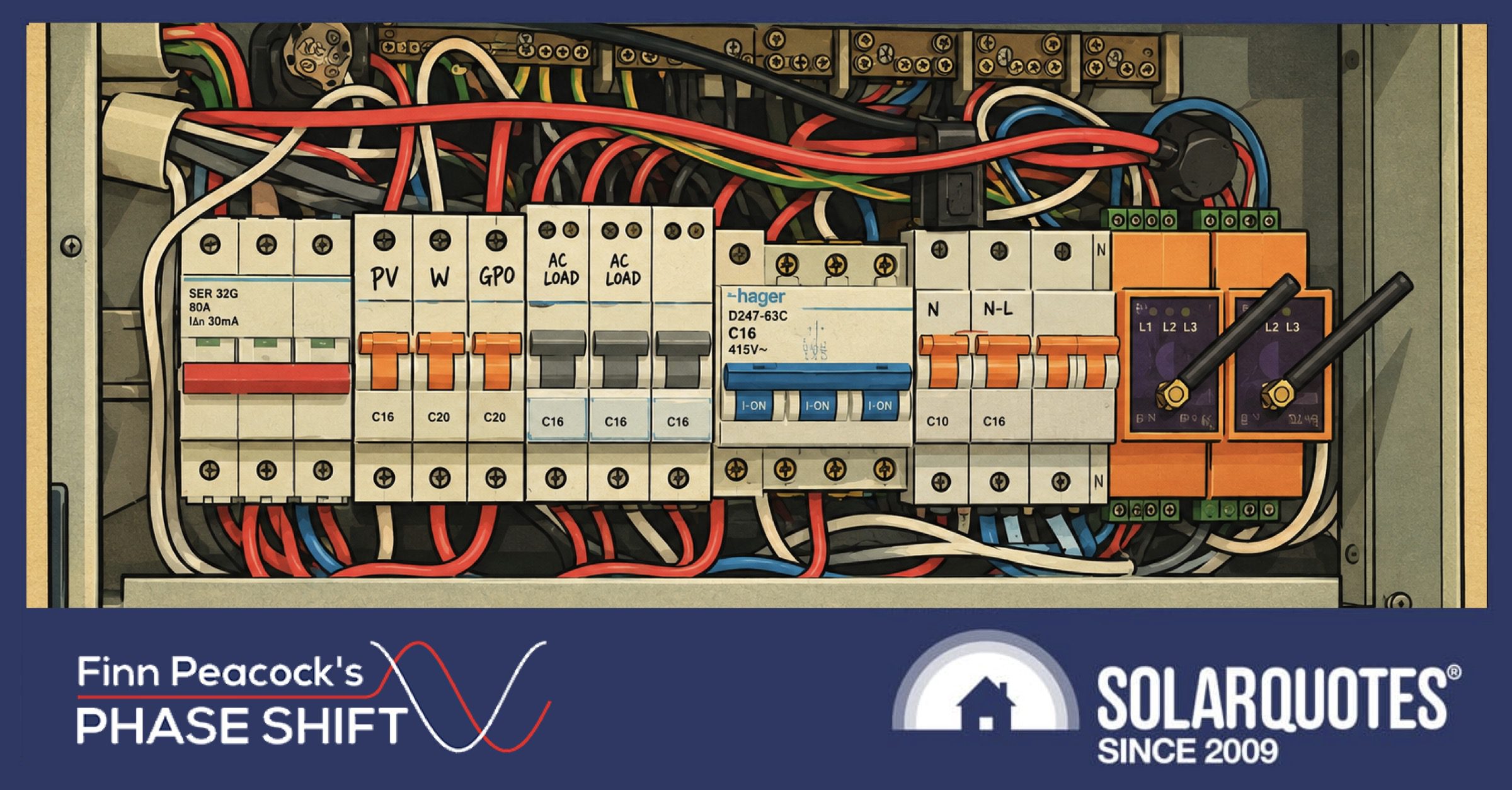
Look at what’s been bolted onto the typical Aussie home in the last decade. A solar inverter reporting panel output to your phone. A battery that trades with the grid while you sleep. A heat pump hot water system that heats from surplus solar, an EV charger with its own app.
Then open the switchboard. It’s the same thing your parents had, with better breakers and less asbestos.
- It can’t tell you how much power any individual circuit is using, so when you get a big bill, you are clueless as to why.
- It can’t switch circuits remotely to ensure you don’t overload your main breaker when on-grid
- It can’t switch circuits remotely to ensure you don’t overload your battery when in backup mode.
- It can’t tell you if a breaker’s life-saving protection has failed – depending on you to test them every 6 months with manual test buttons – which nobody does.
- And if one of those breakers trips at 2am it gives you no idea why.
Everything in the house runs through that box, and the box knows nothing. Of all the bits of home electrification, it’s the one still stuck in the last century.
SPAN went first
The first serious attempt came from California. SPAN was founded by a guy who worked on Tesla’s Powerwall 2, and it shows. The SPAN panel replaces the whole breaker box, puts a controllable relay and an energy monitor on each of up to 32 circuits
It looks brilliantly executed. But it’s built for American 120/240V split-phase power and American electrical codes. You can’t buy one here, and that won’t change without a redesign.
Basis gave it a red hot go
Closer to home, Auckland startup Basis has built the first smart switchboard designed to our shared Aussie/Kiwi wiring rules. I read the Gen-1 technical datasheet and the full installation guide, and met the founder this week at the Everything Electric Show (video soon). There’s plenty to admire.
Every circuit gets digital protection you set in software: the breaker rating, the RCD sensitivity (10 or 30 mA), Type A or Type B, and AC arc fault detection. Each circuit is metered, and each can be switched remotely. There’s a surge protector built in. The chunky spring-clamp terminals are a nice touch.
Then I tried to think about how it would work with a typical Australian solar and battery home, and realised it’s not the solution we need.
It’s indoor only. It must be flush-mounted inside a stud wall. In a lot of Australian homes, especially older ones, the switchboard lives in the meter box on an outside wall. The rated operating range tops out at 40°C, which an Adelaide garage passes before lunch in January.
It’s single-phase only, with a 63 A main switch. Three-phase homes are out. For a single-phase house with a heat pump, induction and an EV charger, 63 A works, and the board will switch circuits off dynamically to keep the load under 63A, but it’s tight.
There’s nowhere to put solar and battery gear. The Basis enclosure has no DIN rail. None. No space for the inverter’s main switch, the battery isolator, the backup changeover switch, the inverter’s DIN-mounted power meter, or the CTs the battery needs to see what the house is doing. The install guide’s only guidance on solar and batteries is to connect them to the bottom circuit module so the busbar doesn’t overload. On a modern Aussie job, you’d end up hanging a second enclosure next to the shiny smart one to hold everything that makes the solar and battery work.
There’s no plan for battery backup. The install guide doesn’t mention backup circuits at all. Ironically, per-circuit relays are exactly what you’d need to fix the “wrong circuits on backup” problem that plagues Aussie battery installs.
The digital switchboard Australia needs
We’re electrifying our homes faster than almost anywhere. The board of the future should be designed for the modern electricity-hungry Aussie home with solar, batteries, EV and backup.
Here’s my dream spec, just in case anyone wants to make one:
Rated for outdoors. If it can’t live in an Australian meter box on a west-facing wall, in the sun, at 45°C, it doesn’t work for most of the country. That means a proper IP rating and a temperature range that suits Birdsville as well as Hobart.
Single and three-phase with main switches sized for an all-electric home with an EV charger.
Surge protection as standard.
Digital protection on every circuit. Per-circuit, programmable RCBOs with metering, configurable sensitivity, Type B where the circuit needs it, rated for reverse feed from inverters, and AC arc fault detection1.
Self-testing that replaces the six-monthly test. Each circuit should test itself on a schedule, log the result and tell you if it fails. No one tests their RCDs every six months – and that’s a problem.
A proper DIN zone for solar and battery gear. Enough rail for a backup changeover and bypass switch, DIN-mounted power meters and whatever the next battery brand needs. Standard 35 mm rail, so any compliant device fits.
Somewhere to mount the CTs. Right now, current transformers get clipped onto whatever cable the installer can reach, and often end up dangling off a cable, hard to identify and too often backward. Give them a fixed, labelled mounting point on the main conductors, and make the current direction obvious.
Backup built into the design. Either a grid-side section and a backup section, or a whole-home design where the battery feeds the board and software sheds non-essential circuits when the grid drops. The owner should choose what stays on during a blackout, and be able to change their mind without calling a sparky.
It works without the internet. The relays, the protection and the monitoring should all work locally. The cloud should be a convenience. Open APIs so you don’t need proprietary monitoring or control software.
Non-proprietary modules, or a guarantee. Standard form factors that other makers can supply.
A pocket for the SLD, with a sign. Every solar and battery install should come with a single-line diagram showing how the system is wired. In my experience, they’re missing from almost all switchboards. The board of the future should have a dedicated pocket inside the door with “SLD GOES HERE – DON’T BLOODY SKIP IT!” printed on it in large letters.
Over to you, Basis
Basis has already done the hard part: digital, per-circuit protection certified to AS/NZS standards, in a product people can buy. What’s missing for Australia is mostly the box around it. An outdoor enclosure, a three-phase version and a DIN zone for solar and battery gear.
If you’re a sparky, tell me in the comments what I’ve missed. You open a helluva lot more switchboards than I do.
Footnotes
- with published data on nuisance trip rates because if it nusiance trips, it will be disabled ↩
 About Finn Peacock
 RSS - Posts






It’d be ideal if products like Schneider’s PowerTag were lower cost, as individual circuit, even wireless room temperature monitoring is available. The interface is a bit clunky in the gateway, and geared more towards gathering data that a full SCADA system can display & log. Potential for home systems, but to expensive to attract residential inclusion.
IDK, not a sparky but really I think we just need RCBO’s which allow but don’t require Shelley style integration to be affordable. Needs a vendor to become a leader but set open standards.
A bit like smart lights but done better. It gets to a point where the integrated electronics is so cheap relatively that if you want a dumb one you just don’t talk to the smart one.
Then the software layer provide the integration and value in a more future proof way and this could be the real product?
However you do it there is a case for dumb. Dumb is better than smart done poorly. Anything with embedded software brings security and maintenance issues. How do these things get security patches? What happens when their 32 bit unsigned integer time rolls over the looses its anchor?
Will the company that built your integrated switchboard be around in 5yrs? Would you subscribe for security and maintenance patches for the lifetime, since it costs money to handle CVE.
love it, great idea, few other boxes to look at for good (to retain) & bad (to avoid) such as enphase system controller, [perhaps whoever does it can offer a matching empty box for the other bits, like ‘modular’]
Sounds like the sort of thing a Chartered Electrical Engineer who has just sold a successful business would want to be involved in.
Considering the number of likely interested people who get regular emails from said hypothetical and trusted person, crowdfunding wouldn’t be dificult.
Finn, my house build in Watervale will be looking for such a board by Christmas. Please get a move on . . . 😀
Same here, I would buy one.
I’m in the process of a 3 phase switchboard upgrade, plus new A/c, hot water, and large solar and battery. I’ve repeatedly been told not to bother with solar as too much shade.
However my solar meter says I average 100w per sq m all year round. 250 sqm of 22 degrees incline metal roof
Oooh, that SLD would be an absolute winner. I want one. 😉
Though I designed the DC side of my off-grid 4-inverter 3-battery multiple MPPT installation, on the AC side I’m only guessing that the Main Switch isolates the PV inverters, and “Inverter 1” & “Inverter 2” are the battery inverter AC isolators. (A simple flick test after dark elucidates, admittedly.)
And I should check that the Genset isolator connects to the correct Victron Multiplus port, not the AC bus where the PV inverters go.
The 63A main switch is not overloaded here, if only carrying the nominal 12 kW PV inverter power. But BEV, HWS, excavator charger, and microwave can draw 15 kW before adding welder or plasma cutter.
Add a another BEV charger, as folk will over the next decade, and 63A is no longer fit for purpose in the imminent electrical age. I suspect your standard household switchboard ought to be 100A or so, at least where there’s off-street parking, or feed to the kerb is permitted?
I had one on order, but my sparky brother went through it all with Basis and said that it’s clear they’re not designed as a retrofit. More intended for new builds only.
In theory, a Basis unit install can save time for the sparky on-site, but given retrofit is a big part of the potential market they’ve really not done their homework.
And yes should have been designed to be 3 phase capable from the get go. The fact they didn’t indicates how rushed the design was. Makes me wonder what else was “overlooked”.
I also wonder about the tech in these boards being usable, or even able to be replaced let alone upgraded in a few years time. A cloud connected system won’t be working the same in 10 years time as now, the technology changes will make the gear obsolete in 5 and Basis haven’t considered technology rot.
So like you I’m still looking for a better switchboard.
I’ve been weighing up a whole bunch of shelly gear or the basis kit, so this was a good read. Sounds like you are describing what I’m looking for. We do have circuits split across multiple distribution boards so we won’t be able to get away with a single physical unit and still get full coverage.
I think what you describe is a utopia no commercial company will ever make at a cost to suit every Australian home. A lot of R&D resources needed to get this done right and then wishing its essentially open source negates any commercial advantage to leverage to recover those costs and see a way to profitability. Schneider will possibly buy Shelly soon , so eventually that ecosystem will likely get polluted by corporate interference and shareholder prioritization over serving customer interests first.
Hi SJR,
When you say “polluted by corporate interference and shareholder prioritization over serving customer interests first.” there is s word for that.
Enshitification
And it’s happening all over the joint.
A grand idea Finn, but i still lean towards the keep it simple stupid theory at the moment.
Our boards might be archaic, but they work and mostly they will last the life of the house if never touched, The amount of old houses still with those fuse blocks that are still around speak to that.
i would find it hard to believe a “smart board” installed today would show the same longevity. I would suspect it would be redundant and have to be replaced if it had a fault after just a few years of service.
When someone comes up with a plug and play one that costs $100 to swap out – then i am in.
Australia is not the only country in the world where air temperature on a summer day gets to over 40⁰C. Perhaps it is time to move Australian switchboards indoors, and installing them indoors in new builds?
I am participating in the CSIRO’s “Living Lab” project that gathers info from people like me a fair way down the electrification journey.
They have indicated they may offer to provide individual circuit monitoring and an app for my phone.
I will pass this article on to them.
Sparkies are almost comically resistant to change. New stuff is scary except for the very small tail.
That’s probably a good thing for safety and the fact they have embedded ways after a few thousand hours of on the job training
We need the kit that is certified in Aus, and there is some, and then for people to adopt it
The Clipsal Max 9 series of boards is decent. Clipsal should then be offering it with smart RCBOs, and AFDD options. Lots of DIN rail space to put in whatever accessories are required, like solar isolators and smart meters.
Are DC isolators allowed in the AC switchboard?
My PV isolators are in a separate Dinrail enclosure.
AC and DC require segregation, either 50mm air space or a physical barrier like conduit
Finn, when the magic box arrives let us know. I am an enthusiast watching numbers and see where my money goes and like to make better decisions. Unfortunately, not an electrician. So, waiting for your news.