
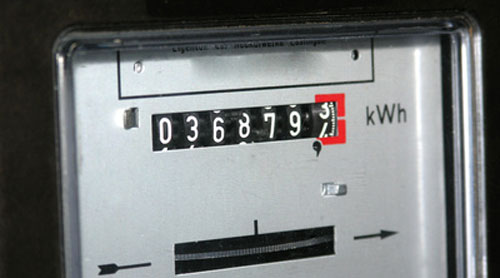
Don’t confuse kW and kWh. It matters!
One of the most common sources of confusion I encounter when talking to non-electrical people about solar power is related to the terms kW and kWh. What do they stand for? What do they mean? And what’s the difference between the two? Watch the video, or read below to find out…
Folks who are really confused also throw the term “kilowatt/hour” into the mix. I’ll deal with that doozy in this footnote1.
Starting with the absolute basics
Please excuse this post if you think I am explaining the bleeding obvious! But I think it is vital to write a post that describes these key units of electricity in a way that requires zero prior knowledge of anything electricity-related.
So here is my humble attempt to answer the question:
What is the difference between a kW and kWh?
Let’s start with what each letter stands for.
k stands for kilo. Which means “one thousand”.
W stands for Watt, which is a measure of power.
h stands for hour, which is obviously a measure of time.
kilowatts: kW
So kW means kilowatt, which is 1000 Watts. It is a measure of power. Notice that, if you like to keep anal electrical engineers like me happy, the correct way to write it is always with a small k and a capital W. Peak power defines a solar system’s size. e.g. a 3 kW system can produce 3 kW of power at solar noon (when the sun is at its strongest) on a perfect solar day:
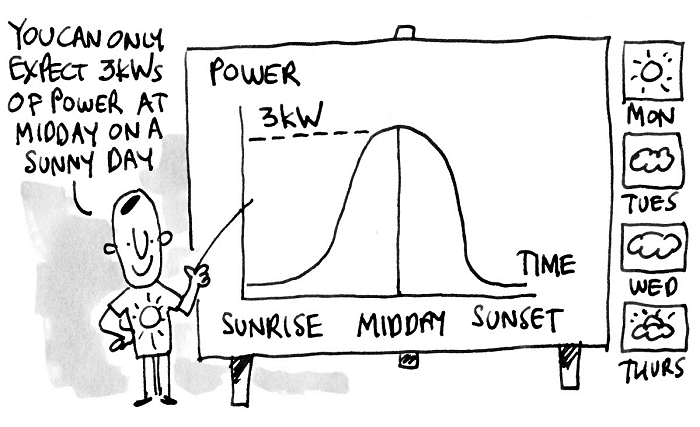
A 3 kW solar system can produce 3 kW of power at around midday on a perfectly sunny day.
kilowatt-hour: kWh
kWh stands for kilowatt-hour. A kWh is a measure of energy (not power). If your solar panels (for example) continuously output 1 kW of power for a whole 60 minutes, you will have produced 1 kWh of energy. The amount of electricity you use (or generate) is defined in kWhs. e.g. “My solar system produced 4 kWh of electricity today!”
So at the highest level: kW measures power, and kWh measures energy.
Why is the difference between Energy and Power important?
It is very common for people to mistakenly interchange the terms energy and power as if there is no difference. Most people do it all the time without noticing. It drives electrical geeks like me up the wall, especially when I read it in national newspapers and books!
For example: If someone is talking about their electricity usage and says:
“I used 8 kW yesterday”
They probably really mean that they used 8 units of electrical energy yesterday, In which case they should have said
“I used 8 kWh yesterday”
Yeah, yeah I know what you are thinking: Who cares?
Well, it is actually quite important if you are buying a solar system.
If a buyer has studied their energy consumption and carelessly says they need a solar power system to produce 12 kW, they might end up being quoted a 12 kW solar power system, which will cost about $10,000 at today’s prices and produce about 48 kWh per day.
If what they actually meant was that they need one to cover an energy usage of 12 kWh per day, they really need a 3 kW solar system that costs about $3,500 at the time of writing!
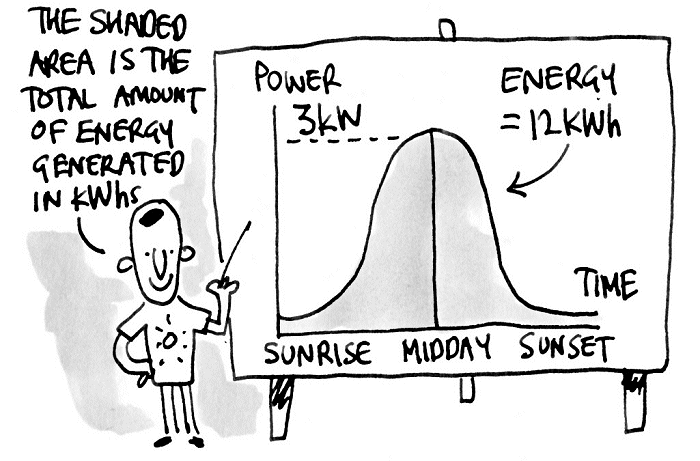
So please don’t confuse kW and kWh. If you do, you may end up with a solar system that is completely the wrong size!
How do kW and kWh relate to batteries?
When buying batteries, you need to think about both the power of the battery and the energy storage capacity of the battery you are looking at.
The battery’s energy storage capacity is measured in kWh—for example, the ‘Powerwall 2’ stores 13.5 kWh of energy.
Its power is 5 kW, so it can charge or discharge at that rate. At full power, then, it can fully discharge in under 3 hours.
The more energy (kWh) a battery has, the more you can store and the longer it will last, the more power it has the faster you can get that energy in or out of the battery,
In other words, the more power it has, the more appliances you can power with it and the more energy it has, the longer you can power those appliances.
For normal household use, you want enough energy to get you through the night and at least 5 kW of power for speedy charging.
Top tip for filtering out the worst solar and battery salesmen: Ask them to explain the difference between a kW and kWh. If they get this wrong how on earth are they gonna understand your requirements? A lot of cold calling door knockers will fail this test in my experience.
The technical bit for those that are interested:
Energy: Energy is measured in Joules. Energy is the capacity of something to do work.
Power: Power is the rate at which energy is used. Power is measured in Watts.
1 Watt is a rate of energy usage of 1 Joule every second, or 1 Joule per second (J/s).
Footnotes
- A kilowatt/hour is a nonsensical unit in most contexts. If you find yourself using this unit, double-check what you really mean, which is probably kilowatt-hour. Kilowatt/hour means kilowatts per hour. Kilowatt is a measure of power (units: Joules per second ), so you are really saying joules per second per second, or joules per second squared. Which would be a measure of how quickly power is increasing. An acceleration of power if you like. There are very few circumstances where that is a relevant measure. Especially when talking about solar or batteries. Lots of people get kilowatts/hour confused with kWh. Please don’t let it be you. 99% of the time, you’ll mean kWh. ↩
 About Finn Peacock
 RSS - Posts





I don’t care how simplistic it sounds, your article has been a revelation. AT LAST I understand what it is all about.
Thanks a heap, much appreciated.
Peter L
Any time Peter 🙂
Hi Finn
I am looking at a floor tile for using under ‘click floor’. The specification includes
an RT rating of 0.07 m2 K/W.
Does this mean it has some insulation properties ?? High / OK / Low ???
I see plenty of U Value and R Value and would like to know where RT sits with
the others.
Thanks
Ian ( Shropshire)
Hi Ian, Ronald here.
RT rating presumably stands for R Total and is similar to R except it is supposed to take into account its actual R value when installed normally. A rating of 0.07 for RT is very low. Pretty much anything should have a value higher than that so it’s probably worth checking if it’s correct. The manufacture should be able to help.
This page from the US has typical R values for flooring:
https://www.houseneeds.com/learning-center/pex-tubing-radiant-floor-heating/flooring-r-value-different-materials
And this page from Australia recommends polyester floor insulation:
https://www.architectureanddesign.com.au/suppliers/ecomaster/understanding-the-r-value-of-underfloor-insulation
I’m not an expert on floor insulation so I can’t really say what’s best.
Pete, “ if ya got this now. In being able to understanding it all, well done to ya ! Now, please ask or tell us about PF of it all, eh ? “
Power factor ?
Seriously thanks a 10kwh and 1000kw!!!
Hi Finn. Good site mate…I am ready to start a new job with Goforsolar in Port Melbourne. Haven’t seen any reviews on them on here yet…Do you know much about them and there quality please. Cheers Mick
you website is such a gem. thank you for sharing great info.
You are a star
It sounds like it would be better to have a system that is not connected to the grid,. After reading your info, very enlightening BTW, it sounds like the authorities and retailers are making it harder for people to reduce their reliance on fossil fuel produced electricity. Sounds like retailers are complaining to government authorities that they are not making enough profit.
In actual fact, I think that makes it even more necessary to increase PV generation and feed it to the grid. The retrogressive Australian government is busy supporting the fossil fuel industry, which means we reduce fossil fuel consumption in Australia despite the government.
Awesome website. Thank you so much for the lay persons explanations. Starting to get an understanding of this stuff.
Hey Finn
I also think your delivery was perfectly acceptable and in no way offensive but can see why Jock “mighta” been annoyed but the facts WERE provided in a humorous way and I thank you for that. After all it was my English teacher at school many years ago told me “English as she’s wrote ain’t as she’s spoke”
Im still confused Finn…..im off grid and my regulator, PL60, tells me how much solar energy I have harvested in Amp/Hours….so how do I convert this to kWH?
To convert Ah (Ampere-hours) to kW hours, simply multiply by the voltage (because Power = Voltage x Current) and divide by 1000 (because it is *kilo* Watt hours).
For example:
If a 12V battery has given you 100Ah, then:
12V x 100 = 1,200 Watt hours
1,200 divided by 1000 = 1.2kWh
Penny has dropped….many thanks!
I’ve seen some inverters here (Zambia) either rated using kVa or kW. Are these terms interchangeable?
For casually comparing inverters, yes, those terms are generally interchangeable.
Hi Finn,
I am buying a 3 bedroom house in the country and it has gas cooktop gas hws,electric oven and all the rest lights fridge etc.(2 people)
My question is Is it worth installing a solar power system to go help keep the power bill down? We will be on the pension very shortly.Your comments would be much appreciated.
regars Steve
Hi Steven,
Solar may be worth it, especially as you will be home in the day.
But… your priority should be to first invest in energy efficiency, and get your electricity usage down. The cheapest kWh is one you don’t use!
The priorities should be:
1) Heating/Cooling – Insulate, insulate, insulate. Shade north facing windows in summer. Draught proof any gaps. Then go for 7* efficient Heater/Aircon units.
2) Hot Water – if you have electric hot water, consider solar hot water or a heat pump
http://www.solarhotwaterquotes.com.au/solar-heat-pumps.html
3) If your fridges are old – consider upgrading, new ones use 5x less energy
4) LED lights throughout: https://www.solarquotes.com.au/energy-efficiency/led-lights/
5) Solar!
Hope That Helps,
Finn
My name is Tim Forcey. You can shorten that and call me Tim if you want, and you probably won’t get in any trouble whatsoever (unless there are other “Tims” around).
But never ever shorten kilowatt-hours to kilowatts!
Sadly, even most of those in the “electrical” world seem to do it.
Finn I am lost, I really am. Here is the deal I use 30kwh per day on a single phase house which is our current house. We are building a new house which will be 3 phase. ( Most of the house is single phase but i will be spreading circuit loads across all 3. there will be 50 some odd different circuits spread across 3. The only thing I have that is 3 phase is a 30 kw/cooling capacity not electrical capacity air con unit ) I am hooking up a daisy chained Tesla power wall system ( the 7kw versions. ). I wanna stay on the grid ( so hybrid ). I live in melbourne. I dont wont to pay a single bill. I refuse to be told from solar sales people as the ones i have dealt with honestly have no idea what they even sell let alone the tesla system. What on earth do I need? I.e How many watts or kilowatts must I produce from the panels? What size inverter do i need? ( the biggest I can find tesla ready is the fronius Symo 5.0-3-S Hybrid 5kw. I would like to use this brand of inverter as they are tesla ready and have had over 60 years experience in battery charging ) Will i need more than 1 inverter? How many tesla batteries do I need, Can the tesla batteries be daisy chained? Any help dude would be great. Im just lost.
Hi Robert,
How many panels depends on when you use the energy:
http://www.solarquotes.com.au/do-i-get-paid-for-my-solar-energy.html
You can daisy chain the Teslas and use a single inverter, they’ll just throttle the power output so as not to exceed the inverter rating, but you’ll get double the energy storage.
I’d get one battery to start with and see how you go.
5kW of panels and a Powerwall are being installed for about $18k right now.
Im in Canada and we are years behind you in Austrailia in solar tecknowledgy, aiways a interesting read. Thx
G’day Finn and team,
12 years ago when we built our house I had it connected to 3 phase supply, I no longer have a need for the 3 phase, should I have it changed to single phase, is there any advantage o disadvantage?
I also have two separate solar systems. A 1.5 kW about 6 yeas old and a 5 kW about 3 yeas old, they are separately connected to two of the three phases.
On average my system exports twice the amount of power that I import, yet I still get a power bill although most of it is the ridiculous supply charge, or connection fee as some call it.
I also have a 6kW petrol generator that is connected to my power board via a mains/ emergency switch. because of the high number of blackouts we get.
I’d like to go off grid. Am I right in thinking that with the generator as backup I don’t really need to calculate battery storage for the occasional 3 o 4 day low solar period, and could allow for say only two days battery supply.
Thanks for the great work,
Bob
Hi Bob,
I don’t see any advantage in taking 2 phases off your house. I’d leave all three.
And yes – a generator lets you have much fewer batteries – if you find you are using your generator too much – then you can add more batteries later.
Hope That Helps,
Finn
The use of kWh as energy unit is as clumsy as saying the length of a trip is 100 km/h day. The proper energy unit in the international system is the Joule (J) and 1 kWh is 3.6 MJ. Alas energy companies are unable to speak properly of energy.
I agree kWh is so premetric But whats in a name? Actually quite a lot of history.
Joules in Australian lingo should not be confused with other words like jewels or Jules’ diamond engagement ring.
joule (J) The amount of work or energy exerted when a force of one newton causes a displacement of one meter.
or
joules) = force (newtons) x distance (meters), where a joule is the unit of work.
And isnt it also amazing that a Joule is also equal to a watt second
so that 1 kWh is 3.6 MJ.
Why the CAPITALS?
W is capitalized in recognition of the 18th Century inventer James Watt who produced a much improved steam engine that helped British industry lead the world during the industrial revolution.
J also capitalized as it also honours an English physicist named James Prescott Joule who pioneered the understanding of the relationship between work and heat. The world owes a lot to Mr Watt and Mr Joule IMHO. Feel free to Google “Joule” and “Watt”.
Yes. Talking about “kWh” is much more intuitive to nearly everyone than multiples of “3.6MJ”, EXCEPT that it is buggered up more than 50% of the time, even by people in the industry (both with electric vehicles, and stationary PV systems in my experience).
Hi,
a usage of 8kWh per day as you say can be done with a 2kW solar system.
Do you multiply 2kW x 4 ( meaning 4hr of sun per day? )
please clarify this.
Thank you.
Regards
Lothar
yes – you get about 4 ‘sun hours’ per day averaged over the year in Australia – a bit more up north – a bit less in Melbourne and Tassie. So 4 kWh owe kW installed.
I am setting up of the grid as there is no mains where i am so what kva invertor would i need when i on two oanels one 12vokt battery to run a small house that only using piwer for a five start rated frigde a tv and led lights threw out and a water pump ? The system i have has a gen back up of 2800kva max and the solar can be added to as miney permits . So the wuestion is is my daily usage is up to 16kwh what kva do I need ?
Michael, the answer yo your question is a long one. It is not as simple as giving you a number.
I highly recommend this book which answers your question comprehensively:
http://caravanandmotorhomebooks.com/product/solar-success/
Hope That Helps,
Finn
Hi Mr:- Finn Peacock, My daily usage is 2kwh, i have 3 phase system, only air conditioner is in 3 phases, pool and others are in balanced 3 phase, i have an off peak meter with heat pump, cooking on gas converted, ready to install in 2 weeks, solar of 5kw with 7.5kw 3 phase inverter, best in market, how much i will save in quarterly payments, no one in home, from 9am to 4pm, pool in auto timer in morning, before 11am and after 4pm, that cause pump run out of water, burnt the seals of motor, happen when i am not there, so auto timer i cancelled and i start by myself, after come home at 4pm, no battery requested for solar system, so what is your advice to save money, washing done at the same time, when i am back, due, to unbalance load stoppage, and drain plug blocked,in sink, and wet my carpet, please advice me sir, dishwasher, i disconnected, drier none in home, fridge is 4 yrs old, with 5 star, no old tvs, 56inch, led, use 1hr/per day, whole home is compact fluorescent lamps(CFL), how far i go sir, ready to retire, please advice, me thanks.
Hello Leslie, Ronald here. If you have gotten your electricity use down to 2 kilowatt-hours a day then you have already done very well. I can’t think of anything at the moment to further reduce your electricity use. But if you are going to retire soon then you are likely to be home during the day which should let use more solar electricity and even less grid electricity.
What happens when i don’t use, will you please explain, thank you sir.
I need air conditioner to run in nights, not in the morning, when i am along, please, advice me, sir.
You could install a battery system to store solar energy during the day to use at night, but at the moment they are too expensive to pay for themselves for normal households.
There are air conditioners that can use solar electricity during the day to make ice to cool a house at night, but they don’t make financial sense either.
I am afraid there is not anything I can really think of to help you, apart from suggesting you use solar power in the afternoon to cool the house down so you won’t have to use quite so much grid electricity to cool it at night.
If you mean what will happen to solar electricity you don’t use, it will be sent into the grid and you will receive a small feed-in tariff for it. In most states it is usually only about 6 cents a kilowatt-hour. While this isn’t a lot, it will still help to reduce your electricity bills.
Hi you don’t say what size your pool is. but most common pumps for domestic pools are around 0.75kw and generally are recommended to run 4 to 6 hours a day. To make best use of solar power you should set timer to run in late morning and again in early afternoon.
It is unfortunate you damaged the pump by running out of water. but don’t explain how this could happen. I’ve never had this experience in 12 years. you could fit o loss of pressure switch that would stop the pump if it ever happened again
Well answered, thank you.
We find there is very little direct sunlight in our part of Tasmania. Does cloud cover still produce power in solar panels? Should more panels be purchased to compensate for lack of direct sunlight?
Hello John, I’m afraid cloud cover really reduces the output of solar panels and so Tasmania is the worst place in Australia for solar power. Light cloud may result in panels producing about 30% as much as under clear skies while heavy cloud can reduce it to 10% or less.
Installing extra panels can make up for the lack of sunshine. You can have panels that total to 133% of your inverter capacity and still receive Small-scale Technology Certificates (STCs) for them that reduce the cost of rooftop solar. I wrote about this here:
https://www.solarquotes.com.au/blog/oversizing-solar-arrays/
Getting a larger inverter and installing a much larger solar system overall is an option, but note that the larger your rooftop solar system, the less electricity you will use yourself and the more will be sent into the grid for a low feed-in tariff and this will increase its payback time. So from a purely dollars and cents perspective it doesn’t make sense to make your rooftop solar system too large. But if you are doing it for environmental reasons, then go for it. But note that, unlike in South Australia, if you want a solar inverter larger than 5 kilowatts in Tasmania, it unfortunately complicates matters.
Hi Finn – just perusing your great website and beginners guide to solar – full of excellent & pertinent information. Has got me thinking – is it feasible to install a small 3kW system and not connect it through your fusebox/metering system? For example, install a hybrid system, but run new wiring from the inverter to say new power points in the laundry and bathroom and use the washing machine/dryer etc during the day. Lights might be the only thing needed in these areas overnight and could run off the grid. Perhaps different coloured power points could indicate solar.
Similarly, new individual wiring could be run to free-standing wall heating units to warm the house during the day via solar to limit heating expenses.
Is something like this legal and feasible? I own an old turn-of-the-century house that is hard to heat in winter, especially the upstairs bedrooms – maybe this is all I need?
Cheers
Daryl
Hello Daryl, Ronald here. What you suggest is possible, and provided it is never connected to the grid it is legal. But economically speaking it doesn’t make a lot of sense, as you would have to pay extra to get a hybrid inverter installed and you wouldn’t be able to send surplus solar electricity into the grid for a feed-in tariff. In addition, because the output of solar panels varies a lot during the due to the position of the sun and because of clouds, you would need batteries to have a reliable off-grid supply of electricity and they are still too expensive to pay for themselves.
So if you are able, it makes much more economic sense to install a grid connected solar system.
wow. thanks you so much. thanks you. i was about to make a mistake. you save me.
Hi Finn
I have a tesla 14k system and would not have purchased it if I had known about the evergen 17 k unit in time.
I was wondering though if I could still purchase the evergen unit and create extra storage from my 5.2 k solar? I also have solar hot water which I started with but there doesn’t seem to be a need anymore with the battery being fully charged up each day by noon?
Hello Ray.
Extra storage capacity will only be of use if you regularly use more than the 13+ kilowatt-hours you can get out of the Powerwall 2 at night.
But if you did want the extra storage, the Evergen Equinox is DC coupled, so while you could technically get it, this would involve scrapping your current inverter. Assuming your Powerwall 2 is AC coupled, it should continue to work, although I don’t know if you would have problems balancing their use. One might end up doing most of the work.
Economically it won’t pay for itself for an on-grid installation.
BTW, what do you mean by “anal electrical engineer”? “Anal”???
Jack, I’ll give you two definitions and you can decide which one is most likely to be correct:
(1) An anal engineer specializes in building artificial sphincters.
(2) It is a term from Freudian Psychology that is short for “anal retentive” and, “is used to describe a person who pays such attention to detail that it becomes an obsession and may be an annoyance to others.”
…..er…. Can you give us some more detailed information about that?….
I thought an “anal electrical engineer” was a strangely wired electrician….?
No. No I can’t.
But Sigmund Freud can. I highly recommend you don’t check him out.
Thanks a ton buddy…helped me a lot to understand basics.
Hi,
My latest electricity bill suggests I am using around 60 kWh per day.
Can you please give me an idea of what size system would be the best?
Thanks
Hello Emma
This is a difficult question to answer. I generally recommend people install as much as they reasonably can:
https://www.solarquotes.com.au/blog/fill-your-roof-with-solar/
I recommend this because for most people the largest system they can easily fit on their roof will pay for itself. But it will depend on your personal preferences and budget.
If your home has single phase power then the largest system you can easily install is a 5 kilowatt inverter with around 6.5 kilowatts of panels. In most Australian cities this will generate an average of around 25 kilowatt-hours a day. Or, if you have the roof space, you can pay extra for a system that export limits and this will enable you to install more panels and with your large electricity consumption you may find this worthwhile.
If you have 3 phase power then the limit is more likely to be the size of your roof, so you could either follow my suggestion of installing as much solar as will easily fit or an easy option would be to just install a 5 kilowatt inverter with around 6.5 kilowatts of panels which will help lower your electricity bills but will produce around half or less of your daily electricity consumption.
Hi! How can this be solved to come up its consumption per day in Peso for example.
0.90kWh/24h given that 4.8218 pesos/kWh
How much is the consumption in a day?
That would be 0.9 multiplied by 24 which gives a total of 21.6 kilowatt-hours. You then multiply that by 4.8218 pesos to get 104.15 pesos.
This is so really really helpful, thank you so much. I was getting all confused on trying to figure out what exactly I need.
You the man big fella, you the man…….. Excuse me I have a phone call to make
My electric bill says I used 1000 kwh for this month.
1000kwh / 30 equals 33kwh per day (presume 30day month)
33kwh per day / 24 = 1.389 kw used in an hour
so, the basic question is, if 1.389 kw is average, with peaks and valleys, what size system would I need???
For most people I suggest they get as large a solar system as they can conveniently fit on their roof. This is because rooftop solar can provide an excellent return even if households only use a small portion of the electricity it generates. The largest system most homes can install without complications is around 6.5 kilowatts. How much that will generate depends on where you are but generally speaking it will produce an average of about 25 kilowatt-hours a day.
If your home has 3 phase power then it is easier to install a larger system and the limiting factor may be how many panels you can easily fit on your roof.
If your budget is tight you can install a smaller system. Small systems can potentially pay for themselves very rapidly, especially if there are usually people at home during the day using the solar electricity generated, but it is possible you will end up regretting not having the additional savings a larger system could have resulted in.
Here is an article I wrote on why larger systems usually make sense:
https://www.solarquotes.com.au/blog/fill-your-roof-with-solar/
33kwh per day / 24 = 1.389 kw used in an hour. No, not correct.
33kWh per day / 24 = 1.389 kWh used in an hour. You cannot ‘use’ x amount of kW. You drive the load by kW to ‘use’ kWh….
Thank you so much for this info, though you are now communicating with a well intentioned technophobe.
So we wacked on 16 panels and two inverters a couple of years ago. (Both inverters have had to be replaced? Bad bunch they said…side topic).
Do we invest in solar hot water then onto a battery system or will the battery system make solar hot water sort of retrograde?
Hello Andrew, Ronald here.
At the moment a battery system won’t save you money but hopefully they’ll continue to fall in price. A solar hot water system can same you money but it may be more cost effective to increase your solar PV capacity and use the extra generation to heat water instead. If you choose that route, rather than expand your current system it may be easier to add an new system on a free section of your roof or possibly replace your old system with a larger new one.
Thanks for that.
The reason I am responding now is that the situation has changed (and to give some previously not disclosed info).
I have a teenage daughter who, 90% of the time, doesn’t suffer from autism cause she thoroughly enjoys it!
We had a 16 hour blackout this week and I can assure you that became part of the 10% and none of us wish to suffer breakdowns like that again.
So my wife insists we get a battery soon.
Call it a lifestyle choice rather than economic.
So say 12 grand for an installed Tesla Powerwall 2 (just to chuck a figure out there).
Over 10 years it doesn’t seem too bad an insurance policy.
But it will be cheaper than 1200 bucks a year won’t it? We will decrease that cost with use of the battery every night and not using mains power right?
We are big power users, so will a battery simply use itself up each night, then turn off and we use mains power and so on every 24 hour cycle?
We understand that if, no make that when, the next blackout occurs we will have to conserve to make a battery last.
Hello Andrew
I’m afraid Tesla has raised the price of their Powerwall 2 and the middle of their estimated installed price is now $15,275.
https://www.solarquotes.com.au/blog/tesla-powerwall-2-price-rise/
I don’t know where you are, but if you are paying 27 cents for grid electricity while receiving a 10 cent solar feed-in tariff and have a high overnight electricity consumption and a large solar system and use an average of 0.8 cycles per day then over 10 years you would save around $6,650 on your electricity bills over 10 years, depending on how efficient it turns out to be and how rapidly its capacity deteriorates. This would leave you $8,625 in the hole after 10 years. But since backup is very important to you, if you used only have its usable capacity and left the rest for backup you’d only save around $3,325 over 10 years leaving you about $11,950 behind.
In your situation a generator may be a much lower cost option. You could invest in one that’s wired into your home or you could follow the cheaper route of getting a portable generator and making do with extension cords to power loads.
I live in Hawaii, my landlord has a Toshiba 20000 btu,204 watts how much will it cost him using on a 5hr day?
BTUs? Are you still using them in America? Not even the B’s use BTUs any more. Well, as one BTU is 1055 joules that’s a 21 megajoule air conditioner. An air conditioner should cool at least 4.5 times the amount of electrical energy it uses so you are looking at an air conditioner that draws around 1.3 kilowatt-hours. If it ran continuously for 5 hours it would consume about 6.5 kilowatt-hours. But it’s unlikely to do run continuously unless it’s a heatwave, so you might need to ask someone who knows about air conditioning in Hawaii to get an accurate estimate.
Hi sir,
I’m trying to go solar for my home in the Philippines, I found an online calculator that says I need a 36.32 kWh battery to supply the 454 kWh/Month consumption I currently have.
I found a 150 AH battery for P7,500 (AUD 192.47), will that be enough?
I’m confused.
Hope you and your family got through the recent hurricane unharmed, Gilbert. The estimate of 36.32 kilowatt-hours is about right for an American or Australian household going off grid with lead-acid batteries. You may need a very different amount depending on your electricity consumption and budget. If a 150 AH battery is the usual 12 volts then it will only hold 1.8 kilowatt-hours. I think it would probably be best to talk to people in your area who are installing solar and batteries. I’m not in a good position to be able to help you.
Curious.. trying to learn and improve. Electric bill shows 8kwh on days not home… Is that average or do I need to make some changes? 1350 sq ft home gas water heater and furnace. Thank you !!
Hello Betsey
If your home is using 8 kilowatt-hours a day when you are not there that is way above normal. Unless you have a large pool filter or something operating it’s very unusual. A refrigerator might use one kilowatt-hour a day, although it can be higher in summer. You can install monitoring to see exactly where your power is going:
https://support.solarquotes.com.au/hc/en-us/articles/115001271874-What-third-party-energy-monitoring-solution-should-I-buy-
But just experimenting by turning things off may show you what is using the energy. If you find the electricity consumption is by something you can’t or don’t want to reduce then you would be very likely to benefit from solar. Note I am assuming you are in Australia.
I forgot to ask in my previous post this question…
If I install solar panels, and I can’t afford both these plus a solar hit e water system is there any reason why myself and others simply switch our electric hot water system from off-peak to only run during daylight and heat our water tanks using solar energy and thus save the 2 to 3 thousand dollars it costs to have a separate system?
Surely, there’s a simple method to change the heating hours without the energy companies gouging their clients with extra fees etc…
And I sure hope this wasn’t too dumb a question…
Hello I recently got solar panels installed I was supposed to get 12 panels installed but only got 6 . 335kw the contractor said that the 6 they installed produces the same as the 12 I was supposed to get . Because they are bigger panels . It’s a 2.0 solar system that I was gonna get but with the 6 I’m now at a 2.1kw LG panels with individual inverters and a electrical panel upgrade .. what’s the average cost for this system?
Hello Miguel
This seems very odd. No one has made 170 watt panels for a long time so 6 panels will not do the work of 12. I’d suggest checking your quote to make sure you have received what was agreed. If uncertain about what you should have received you can send a copy of the quote to may email:
[email protected]
It sound like you have LG panels with microinverters. This is high quality hardware so a 2.01 kilowatt system, which is what you’ll have with 6 panels of 335 watts, can be quite expensive. I would expect the maximum reasonable price to be perhaps $4,000.
I have a simple doubt. For example, if a solar panel produces energy of 4kwh per day does it means that it is producing the 4kw of power every hour. If it is so it will generate 94 kWh of energy for the whole day. Or else the second case is, it is producing 4kWh of energy in the whole day which means 0.166 kWh of energy every hour. What exactly is the case?. Please do answer.
Hi
The rule of thumb for north facing solar on Australian roofs is it will generate an average of 4 kilowatt-hours per day per kilowatt of panels. The amount of power produced per kilowatt of panels will vary through the day as the sun moves through the sky and due to clouds. Unless there are exceptionally good conditions the power output will never be more than 1 kilowatt. Even in the middle of a sunny day it will normally be less than this due to various factors.
Thanks for this information.
I have a 1.5kW system that has been producing about 10kW/h per quarter in south east QLD over the past 2 years. Working on 7 hours of sunlight per day this equates to 1.7kW/h per day (0.24 per operating hour). The system was installed when the Govt was offering the rebates a few years ago. Is this system working to capacity or should it be producing more that this?
Hi Uwe
A 1.5 kilowatt north facing solar system in Brisbane that isn’t shaded should produce an average of around 4.1 kilowatt-hours a day when new. Because it’s an older system it’s unlikely to produce as much, but if we assume it is operating at 90% of its original capacity it should still be producing a average of around 3.7 kilowatt-hours a day. If it is only producing around 1.7 kilowatt-hours a day it is definitely under performing.
UPDATE: I’ll jest check where you are getting your figures from, Uwe. If they are from your solar inverter you can be certain your system is under performing if it’s not heavily shaded. If the figures are from how much your electricity bill says you are exporting for a solar feed-in tariff, then your solar system could be fine and the low amount is because your home is directly consuming most of the solar energy produced.
Thank you!
Hello Steve
Helpful article, generally.
But a slight criticism.
You talk about salesmen and consistency etc.
However, after talking in your first couple of sections about firstly power, then secondly about energy.
NEXT HOWEVER, YOU REVERSE THE ORDER, and refer to energy then power. Most people would get a bit confused by this, and made me think twice.
Thus, your own criticisms of sales people etc, esp in this generally dodgy industry, can be applied to yourself and your company.
How can we trust you if you’re not Consistent.
PS I’m not in the industry.
Ken
“I used 8KW yesterday”
Actually both does and does not imply a time factor. “Yesterday” implies a day or a 24 hour period. So, they could have literally meant 8KW for the whole day or 333Wh/h
At the same time, it does not imply a known time component and that they did consume a total of 8KW between some unknown period of time less than 24h. Maybe it was all within an hour? Then your assumption is correct. Maybe it was 4 hours?
Although the accepted nomenclature does not accurately reflect it, KWh is a rate. It should be KWph,or KW/h like Mph or m/s
kWh is not a rate. kW (= kJ/s) is a rate.
A kWh is a more intuitive unit for electricity consumption or production use than multiples of 3,600,000J.
Now, for a bit of a brain-teaser, see if you can explain what you mean by “KW/h” (let’s ignore the capital “K”). :-O
I am consuming around 10kWh on average per day.
I have a 9kW shower used twice daily for a total of 30 minutes.
I am planning a 3kW array and to use cheaper overnight energy to charge my battery.
To get a free shower do I need a 9kW battery and hybrid inverter?
My cooker is rated at 2.1kW, would it be cost effective not aim for a free shower and go for a 3kW battery/inverter.
Meaning I could get free cooking.
Also is it worth getting a larger system and use it for heating?
Thank you for your help in advance.
Hi Steve, Ronald here.
If you have a 9 kilowatt electric instant hot water heater then a small solar system won’t do much to reduce its energy use. If you shower during the day a small solar system will help a little, but its still likely to draw a lot of power from the grid, especially in winter when hot water use is high and solar output is lower.
While I don’t know your exact situation, my general advice would be to install a larger solar system (perhaps 6.6 kilowatts) and instead of getting a battery get an electric hot water system with a small heating element and a storage tank and and have it on a timer so it switches on during the day. This will be entirely powered by solar on most days and will store energy as hot water at a much lower cost than a battery. Because home batteries are still quite expensive they won’t pay for themselves for a home with below average electricity consumption like yours, so they are only worth getting if you don’t mind them not paying for themselves.
While a larger solar system will produce more energy than your home uses, it will minimize the amount of grid electricity you use during the day and you’ll get a solar feed-in tariff for the surplus energy it sends into grid. Also, if you get a larger solar system you’ll be prepared if you decide to get a battery in the future or an electric car.
Cheers for explaining. Makes sense. Thank you.
Excellent explanation in layman’s terms Finn. It’s very rare in my experience to look up something on the net and the first article explains my query without all the rubbish to go with it. It’s now 2021 and your article is just as relevant as when you first posted it all those years ago. I’ve screen-dumped it and hopefully if I read it once a week (while at work, of course) some of it will permanently sink in!
Thank you for these excellent explanations. I am starting the journey of working out what I’m going to need for my off grid living and business activities and your examples are invaluable to me.
Name John
Question I have14.4 kwsystem Redback battery’s 38 panels should the system allow the batteries to get that low that the system will no long charge them and the only way to get them back is to charge them external. System is only 4 months old had a week of cloud cover system seem to be selling of power before charging.
Has this damaged the battery’s or will they re cover
The app says “Export Limit 5.0 kW”, what does that mean?!
A new system was installed (replaced with the old one), and panels have half angled for winter and the rest for summer, chose the tariff best suit and the monitoring app is working, thumb up!! Wait, the app says Export Limit 5.0 kW. I’ve been told that it is because our meter is a single phase, hah?! I rang the energy provider and they recommended I check if it is worth replacing the existing single-phase to three-phase. I am now asking the solar company who installed the system if it is worth it or not.
While waiting for the professional to reply, I wanted to understand the basics and this article gave me great tips about the difference between kW (power) and KWH (energy). Thank you so much!!
The current system exports 30 to 35 kWh (winter time) according to the app and my new system is 11kW. Do you think is it worth upgrading the meter to three-phase? what is the average cost? Your input is highly appreciated!
Hi Noriko,
These articles may help too. Cheers
https://support.solarquotes.com.au/hc/en-us/search?utf8=%E2%9C%93&query=Three+phase
Hi, Your website is very informative and helpful, thanks. We have probably an older style 5wK solar system (2011) and are looking at getting a battery installed. What size battery should we be aiming to purchase and is it a complete waste of time not getting blackout protection? The company my husband has been dealing with say you only need it, if you have a lot of blackouts. kind regards, Mandy.