
 Sometimes I write blog posts that are fact checks. But today’s is more a statement of fact. And that fact is:
If your electricity consumption is anywhere close to normal, it’s a bad idea to blow your only chance to use the battery rebate on a tiny 5 kilowatt-hour (kWh) battery, like the one promoted by Solar Battery Group’s letter mailout campaign.
Is A 5kWh Battery Big Enough?
I’m not saying there aren’t people out there who specifically only want a small 5kWh battery. They do exist, but they’re not normal.
I’m also not saying a normal household would get no benefit from a 5kWh battery. A puny itty bitty baby battery will provide infinitely more benefit than no battery at all. But the battery rebate can only be used once per property. So, unless you’re absolutely sure you only want 5kWh, it’s a dumb idea to get the smallest battery capacity the rebate covers.
There are several good reasons not to get a bantamweight battery:
- While a tiny battery can save you money, much more can be saved with one properly sized for your electricity consumption.
- Even when installed so it can provide backup, a 5 kWh battery has a high chance of already being drained, or close to it, when a blackout occurs. If a reserve of even just a couple of kWh is set so there will always be some energy in the battery when a blackout happens, it will greatly reduce the already low savings on bills it can provide.
- Even if fully charged when a blackout occurs, the amount of backup power it can provide is much less than for a larger battery. This means you can run fewer things at once, and turning on the kettle for a cuppa runs an excellent chance of tripping your battery.
- You only get to use the battery rebate once, so it makes sense to use it on a battery that provides significant savings while also providing the backup capability you want.
What prompted me to start wildly stating facts about puny battery systems was a letter mailout campaign by Solar Battery Group. For months now, they’ve been telling people they can get a low cost battery installed, but they only bother to mention it’s a 5kWh system in asterisk-anointed small print at the bottom of the page.
Solar Group’s Battery Mailout Offer
Here’s a letter Solar Battery Group mailed out last year in South Australia. A couple of details have been removed to protect the almost certainly innocent:
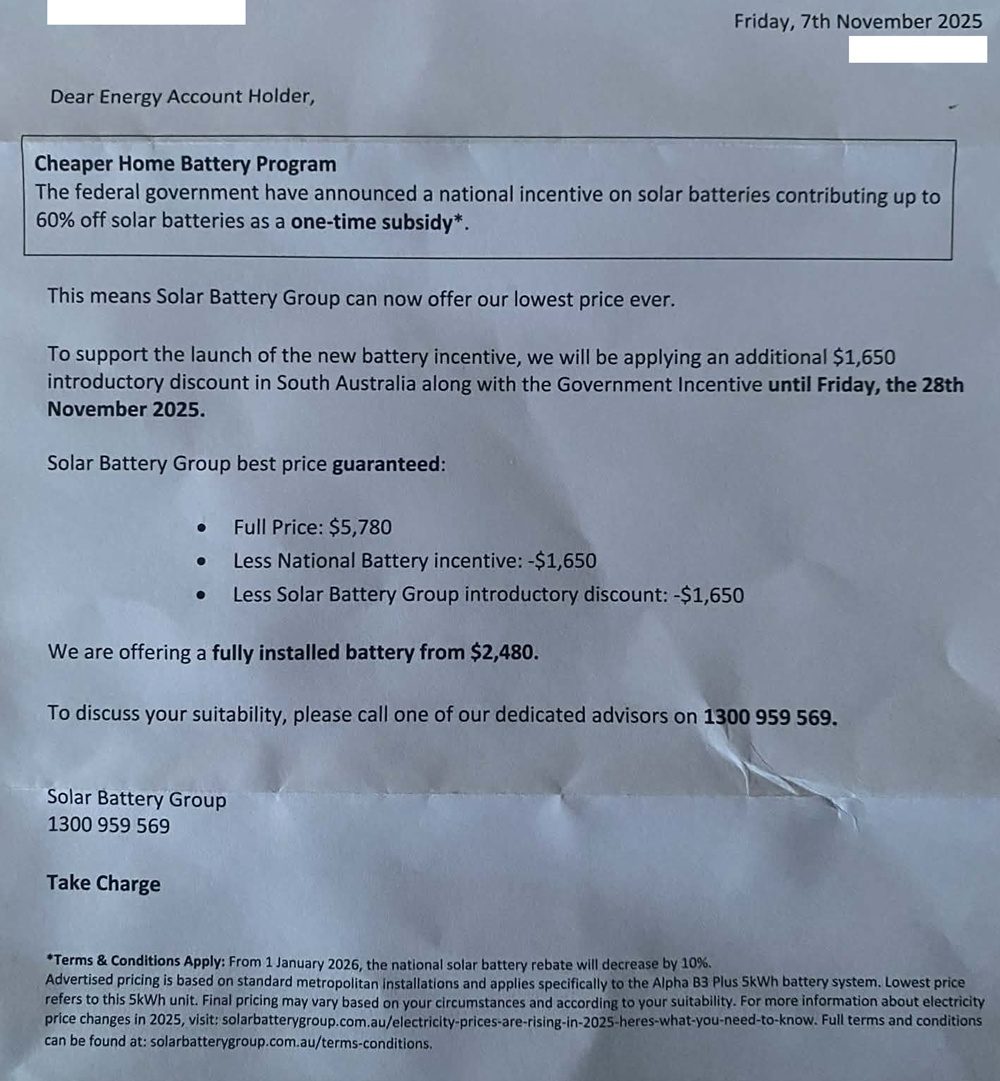
The way the letter says “one-time subsidy” gives a sense of urgency, but you don’t have to hurry because the battery rebate isn’t ending anytime soon. And it is a “one-time” subsidy in the sense it can only be received one time per property — so don’t blow it on baby’s first battery.
They give the “Solar Battery Group best price guaranteed“, which sounds good, but all it means is that it’s the best price that Solar Battery Group is going to give you, which means all they’re doing is promising not to offer a lower price. A promise that’s not all that useful. In fact, it’s a downright cut-block.
They break down the price they guarantee as follows:

Notice they don’t point out it’s only for a 5kWh battery here or anywhere in the body of the letter. To work that out, you either have to know that $1,650 is the rebate amount a 5kWh battery received last year — which isn’t bloody likely for the average person receiving the letter — or you can look at the smaller print at the bottom of the page.

So it’s only for 5kWh, which is the minimum size the rebate covers, it applies to standard metropolitan installations, and can vary according to circumstances.
Their NSW March Mailout
Here’s an image of a letter Solar Battery Group mailed out in NSW last month. Identifying bits have been blotted out. While I’d like to be able to say that Solar Battery Group had decided to shake things up by taking a Salvador Dali-esque style approach to formatting their letters, I’m 100% confident the wonkiness is due to the way it was scanned:
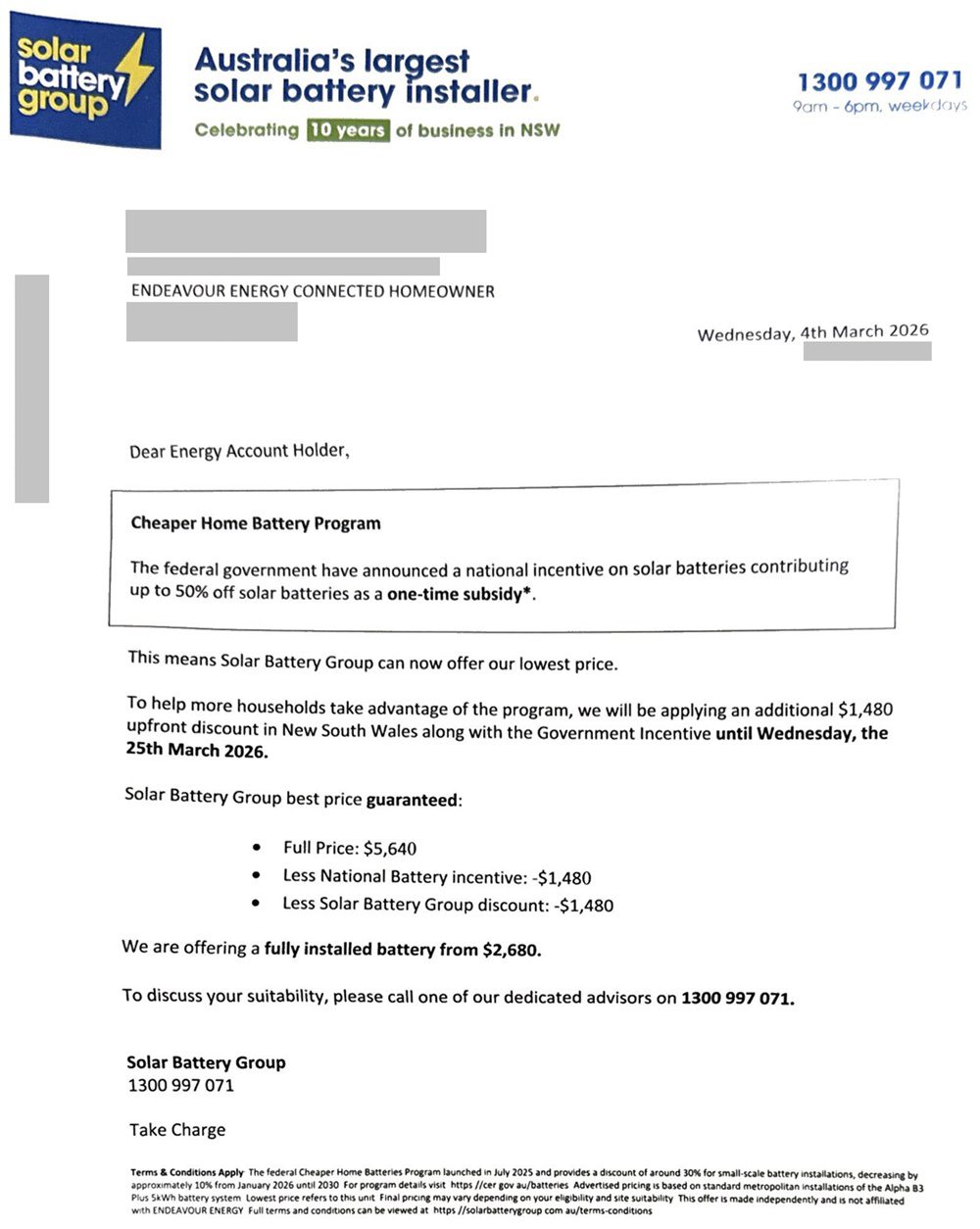
It follows the same basic format as the previous letter. Once again, the fact the price is for a 5kWh battery is only pointed out in the small print.
Real Tree Paper Was Used For This
The two advertisements above were printed out on paper, put in actual physical envelopes, and mailed out to owners of rooftop solar using a system known as “the real world”. (Yes, it’s still around.) This method gives an air of authority that advertising normally lacks. Despite having the Solar Battery Group logo at the top of the page, the NSW recipients assumed it was from their local council. Addressing the letter to:

Would have also added to its air of authority, even though in the small print they had to add…

They Didn’t Understand It Was For A Puny Battery
Not only did the NSW household not realise, at first, that the letter was advertising, they also didn’t understand that it was for a tiny 5kWh battery. They already had a battery quote from another installer for around $9,000 and assumed that he must be a rip-off artist, as that’s over three times as much money as this offer. But that quote could have been for a battery more than three times larger. A size far more suitable for typical households.
Sure, it does say in the small print that it is a 5kWh battery, but people who aren’t familiar with home batteries often won’t know that’s a tiny battery unlikely to meet their needs.
Solar Battery Group Says It Is An Entry-Level Offer
James Hetherington, CEO of Solar Battery Group, told SolarQuotes was just one of several offers the company pushes:
“Our intention with this campaign is to highlight a specific entry-level option that we believe is both accessible and valuable for a segment of the market. A key objective of this campaign is to challenge a common perception we encounter, that home battery systems cost well in excess of $3,000. We are proud to have been able to break this price barrier with an entry-level solution, and that is why this point is emphasised in our messaging.
The letters state that fully installed batteries are from the amounts specified in the letters, and the advertised pricing is based on batteries that are 5kWh. The battery size that is appropriate for the customer will depend on their personal needs and objectives in purchasing a battery. We would always assess what is fit for purpose for a customer.
We note that the Federal Government’s Cheaper Home Battery Program discount applies to batteries that are at least 5kWh and less than 100kWh. Given that a 5kWh battery is a sufficient size to enable access to the discount, we consider that it is appropriate to advertise prices based on a 5kWh battery.
The 5kWh system referenced is designed as an entry point for customers who are looking to begin their battery journey or upgrade an existing solar setup in a more affordable way.”
So What Size Battery Should I Get?
What size battery will be best for you depends on your individual circumstances, but in my view it’s not likely to be 5kWh. A simple rule of thumb is:
Buy battery capacity equal to your typical overnight electricity consumption, including the hour after sunrise and before sunset, plus extra kWh equal to the amount of secure backup capacity you want.
But another rule of thumb you may want to consider first is…
It’s hard to make a battery pay in Victoria and almost bloody impossible in Tasmania, so unless you value backup power, think carefully before getting one there.
But there’s also this rule of thumb that applies to 1.9 million Australians…
If you’re in South Australia, go larger than you otherwise would because electricity prices are high and time-of-use tariffs have a morning peak, making the return from batteries higher than anywhere else.
Then there’s this rule of thumb, which I feel I should mention since the world’s oil supply is in dire straits at the moment…
If you’re considering getting an EV — which you bloody well should be at this point if you drive — then get a larger battery than you would otherwise, especially if you know you’re unlikely to charge your EV during the day.
Finally, while it’s not a rule of thumb yet, you may want to consider…
Homes with smart meters in NSW, SE QLD, and SA will be able to get 3 hours of free electricity, capped at 24kWh, every day, from July, while Victorians will be able to get this from October. Plans with free electricity periods are already available in many areas. As this can improve the return from batteries, it can increase the amount of capacity it makes sense to get.
Now I’ve displayed my thumb collection, you may be wondering…
What the hell does all this mean in regard to what size battery I should get?
It means you should get more than 5kWh.
Unless your overnight electricity consumption is unusually low, a two person household that isn’t worried about having backup power they can rely on, should get a minimum of 10kWh. That’s twice as much as 5kWh.
But in general, my advice is most households should get around 16kWh or more. For many, this will be a kind of sweet spot between almost maxing out the amount of battery rebate per kWh, and getting hefty savings/credit on electricity bills. It’s also more than three times as much as 5kWh.
However, unless your overnight consumption is below average and likely to stay that way, I’d say everyone should at least consider whether they should get 20kWh or more, as in many situations it will provide enough savings to be worthwhile, while providing good backup capability.
Don’t Blow Your Battery Rebate On A Tiny System
What battery capacity is best for your needs is something that’s hard to pin down, but it’s not bloody likely to be 5kWh. While Solar Battery Group may try to upsell larger batteries to those who contact them, the type of advertising they’ve used is likely to result in people blowing their one and only use of the battery rebate on a system far too small for them.
To work out what battery you really need, check out our battery explainer page and try out our battery calculator.
 About Ronald Brakels
 RSS - Posts





Shonks everywhere!
Until May 1, you should have got the biggest battery you could afford – after May 1, you might need to pull out the calculator now, but you also need to work out what you want.
Most people advising on battery size are similar to Ronald’s point – cover your needs for the night, and maybe a little more to get you past any early morning high price period before the photons hit your panels.
But you need to actually work out what YOU want and what risk you are prepared to take.
If you want backup – how long do you want it for and what you want it to do. When you need backup, is it likely to be in poor weather? IE if you lose power on day 1 of a cyclone, it will be nice to have backup that night, but the next week or so might be pretty miserable nights when your panels are really only able to make enough juice through the rain and cloud cover to run the house and put a few percent back into the battery until the cyclone buggers off and nights are black.
Excellent advice, 10 years too late for me, but excellent all the same, I sadly was sucked in by solar groups battery sales pitch when I was just a mug punter, real world teachings and solar quotes blog, has since given me 20/20 hindsight and the knowledge, to be the family got to guy for all things solar, an expensive education for me though, Moral of the story, listen to what these guys are saying, your bank balance will thank you.
You forgot to allow for degradation over time, especially if your planning to stay in your current home for the next 10 years.
Also draining it to practically zero every night will make degradation much more accelerated as a larger battery, where you might regularly have say 20% min left in the tank each morning.
Will be bait and switch for sure in almost all cases.
Anyone that has allowed themselves even the basics of solar and battery 101 recognises the pitfalls here, of course these people are praying on folk with god knows how old a solar systems in place, likely going for the upsell on the solar too.
Got one from my brother today, a barter card offer, so full of holes, totally misrepresented photos of battery and inverter (that they called a charger ffs), supply only, installation not included, their wording “perfect for electricians, installers, & DIY buyers” ha ha :/
Says 20.48kwh of battery (2 dyness), with misrepresented photo, inverter model a too small 5kw goodwe, and again, a misrepresented photo.
God knows what pricing, they state the STCs will more than cover the $4000 cash outlay (on top off $12k bartercard).
SQ, drop an email here if you’d like to see it, happy to forward, contact name and mobile are on the “offer”.
Hi Les – sounds concerning. If you can flag that at [email protected] we’ll take a look.
Sent Max.
The Solar Battery Group mob, I regularly get their letter, been getting them for a very long time, I know the drill well. Of course I never bit on their offer. I’m🤗 happy with my Sigenstor and 32kWh worth of storage installed 5/12/25 and I haven’t drawn any power from the grid since then.
Solar Battery Groups lawyers were kind enough to send me a real letter as well threatening me with legal action for posting online almost verbatim what Ronald has said here.
Feel free to share the legal threats with us: [email protected] – we’d be fascinated to see what their legal argument was, and how they handle criticism from others
I continually get the scammy letters from Solar Battery Group personally addressed to me. Despite direct requests to this company to take me off their mailing list they keep sending me their spam.
Maybe I need to get my lawyer to send them a letter??
What has stopped me from playing the battery rebate game at all and getting a nice, big battery is that (so far) all installers are insisting on disconnecting my 3 year old powerwall2 (13.5kwh) to install whatever system they are offering.
All else aside, the nonchalant attitude of “just toss it”perfectly good (often very expensive) equipment is so wrong.
I know that a pw2 can work alongside other systems- Ive seen it work well in an “off grid” systems where multiple battery systems simply target zero import and do their own thing. I’m also certain there can be communication between different brands, it just wouldn’t be as simple as new installs
I had added last August an extra 40kw of another brand that is separate to my powerwall batteries. I have them both running and accomplishing what I was looking for.
Find someone who will map it out for you if you can’t. I had mine already map out before talking to the company.
Good luck.
Ps they are both connected to the grid 🙂
There’s nothing to map, it’s literally self contained and ac coupled. I’d accept just slapping in another battery(s) and saying inter-compatibility is not our problem.
I’ll try looking around again, but I’ve had zero luck with any “value” merchants
That and a 8,kw solar these days is just not going to be great value. They are chasing those fools who want cheap. Like buying a ebike instead of a car
I dont know who is the bigger fool. The buyer or seller?
Hi, I’ve been an avid reader of SolarQuotes for a number of years. I have now opened the latest email and am now unable to easily read the articles contained within the email.
Why, there are 2 ads that cover most of the screen – AI for ‘questions’ and the ‘get a quote icon’ at the bottom of the screen.
Is there any way these could be hidden to allow me to read the articles in the email.
Thanks Ross Kraft
Ross, you could always use an adblocker extension on your web browser and enjoy the articles free from overlaying ads.
such as Adblock Plus which reports:
This website:
http://www.solarquotes.com.au
This page:
/blog/beware-bargain-battery-offers-in-your-letterbox/?…
Block cookie consent pop-ups Hide most cookie banners on popular sites
Block more distractions Block common distractions like auto-play videos
Number of items blocked
on this page
4
in total
5,631
Ross, what device do you read on, and is it in portrait or landscape?
We are about to have a AlphaESS SMILE-B3-PLUS and SMILE-BAT-5P installed in our place by Solar Battery Group
The batterys system is over 15 KWh, the battery system is reasonably well regarded and affordable. We are hoping to have use of it for 8 to 10 years.
At this stage we have put down a $350 deposit with no fixed install date yet and a grace or change of mind period until 30 April.
Is there any valid and verifiable reason we should not have Solar Battery Group install this system?
Thank you
Peter
Hi Peter – you may want to check out their review page, which trends pretty negative.
Please! Enough fake outrage and emotive diminutive adjectives.
This article must be read through the lens of one-off access to substantial battery subsidies.
I live in NZ. I have solar, no battery yet. There is no battery subsidy here. I also have access to cheap off-peak (overnight) electricity. That changes the economics.
5kWh is enough to power our house overnight in summer, and over the evening peak in winter until the off-peak rate starts (9pm).
In terms of RoI, a 5kWh battery could be considered about ‘optimal’. Why pay for battery capacity when you aren’t using that capacity for large portions of the year, and at other times that capacity would only be substituting cheap off-peak grid power? Particular as battery prices continue to fall, so there is logic in deferring (over)investment.
That said I’d probably size 8kWh to allow for battery degradation and to limit frequent deep cycling & extend life. I’m fortunate enough to afford that. But there’s a good case for 5kWh
“5kWh is enough to power our house overnight in summer, and over the evening peak in winter until the off-peak rate starts (9pm).”
I don’t think its valid to do a direct comparison between Australia and NZ. Eg…In most parts of Australia off peak tariffs only run in the early hours of the morning. A battery is required to handle peak household consumption between sun down and around 1am next morning. If you’re running electric heating then during the winter a 5kw battery will definitely get you through the peak tariff period.
I live in Adelaide in a Passivhaus (2 people). Av daily consumption is 25Kwh in the winter and 12Kwh in the summer. Heating is 2 7Kw RC air conditioners. No artificial cooling during summer.
During the winter my 13Kwh Tesla Powerwall II just gets me through the peak tariff period (1500 – 0100) each day. By 6am next morning the battery is usually down to about 30% which is enough to get me through to 1000 when the solar sponge tariff kicks in.
Correction to my post above
” If you’re running electric heating then during the winter a 5kw battery will definitely NOT get you through the peak tariff period.”
NZ is a lovely benchmark if you’re powering a candle and a sheep. But 5kWh overnight in an Australian home? We’re talking electric cooking, ducted reverse-cycle, heat pump hot water, the sauna, the spa, the pool pump, and the bitcoin miner humming away in the garage. All perfectly normal mod cons for a developed nation.