
Choosing a reverse cycle air conditioner can feel overwhelming. There are dozens of brands available, all claiming to offer excellent performance, efficiency and reliability. Given we’re in winter, we’ll focus this article on the best brands for heating, to keep us toasty warm.
When we first started out at Powrhouse, I spoke to about a dozen different air conditioning companies. It seemed that everyone had a different (and strong) opinion on the best and worst air conditioning brands. I spoke to one company who swore that Daikin was the best brand, and then the next company said that the electronics on Daikin units was found wanting and customer service lacking. It was very difficult to know what to believe.
At Powrhouse, we like to base our opinions on facts and research, so we would cut through the noise and work out which air conditioning brands are the best, and which ones are possibly best avoided.
Remember: Your Air Conditioner Is Also a Heater
One of the biggest misconceptions we see is homeowners using their reverse cycle air conditioner only for cooling.
Modern reverse cycle systems are highly effective heaters and are typically the cheapest way to heat a home.
This is because reverse cycle air conditioners move heat rather than generate it directly. As a result, they can produce several units of heat for every unit of electricity consumed, making them significantly more efficient than electric resistance and gas heaters.
If you already have a reverse cycle air conditioner installed, I suggest trying it on heating mode and see how it feels. Hopefully you’ll feel comfortable – your bills certainly will be.
Our Research
A little while ago I started a large spreadsheet to compare the main air conditioning brands side-by-side. I looked at a variety of factors include Energy Ratings, Sound Levels, Costs, Online Reviews, Refrigerant, Warranty, Connectivity, Place of Manufacture and VEEC eligibility (for Victorian customers). It was a laborious but informative process.
Pleasingly, for the purposes of analysing air conditioners for winter, we also broke down the Energy Ratings by Heating and Cooling. The Australian Government Energy Rating Scheme is designed to make it easy to compare the energy efficiency of air conditioners.
There isn’t a huge variation in the heating efficiency of these units. Looking purely at efficiency, the Avanti Plus range from Mitsubishi Heavy Industries tops the table with 3.5 stars. The Lite range from Daikin doesn’t perform as strongly, only rated at 2 stars.
We should also mention that just because a unit is efficient from a heating perspective, it doesn’t necessarily mean it will be the most efficient cooling unit. Take Actron Air’s Serene range, it rates as 3 stars for heating but a huge 7 stars for cooling.
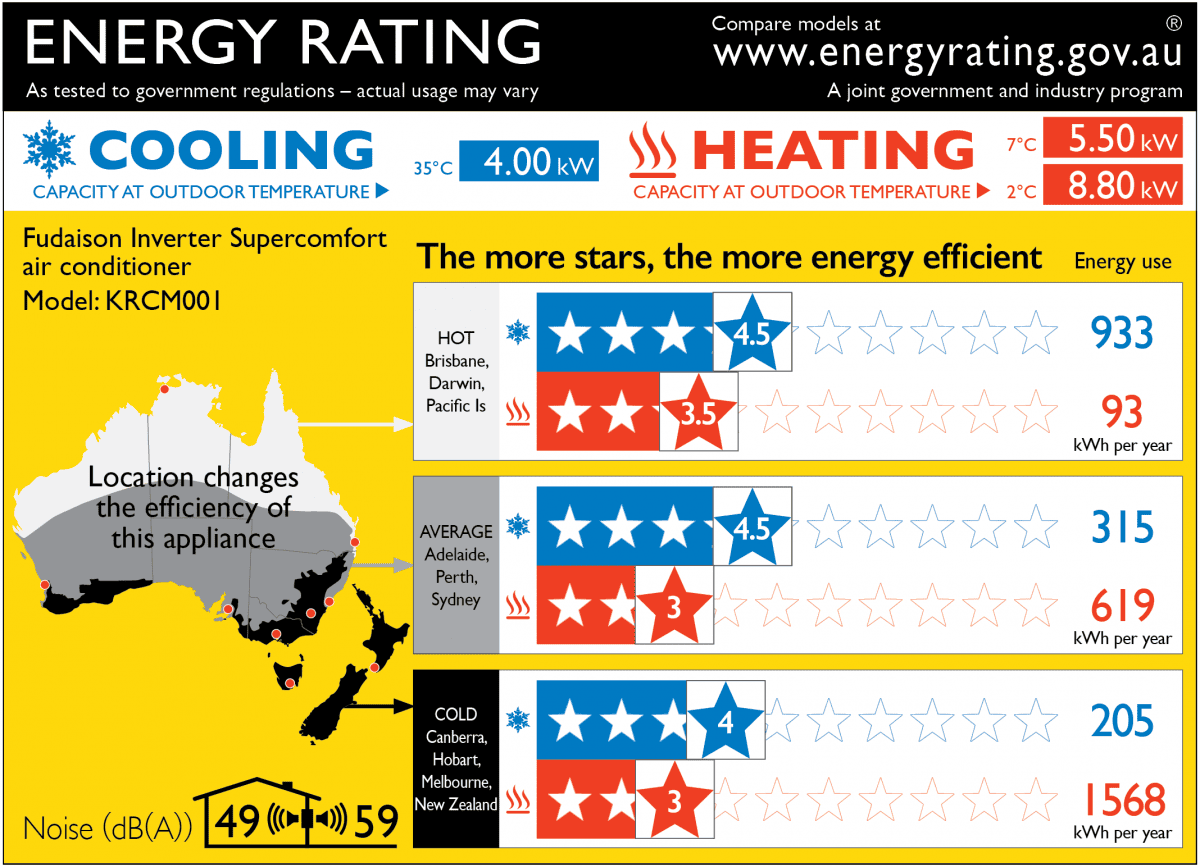
An example of the Zoned Energy Rating Label.
Our Recommended Brands
The reverse cycle air conditioning market is mature and well established. Most major manufacturers have been producing air conditioners for many years, and the technology is generally reliable.
That said, some brands have developed stronger reputations for performance, reliability and after-sales support.
Based on our research, the brands we most commonly recommend are:
The two “Mitsubishis” are different companies, even though they share the name “Mitsubishi.”
These manufacturers have long track records in the Australian market, generally receive strong feedback from both installers and homeowners and perform well at efficiently keeping our homes warm in winter.
Panasonic
Panasonic has been manufacturing appliances for decades and continues to produce high-quality air conditioning systems. Their units are generally well regarded for reliability, efficiency and claim to have market leading filters.
Daikin
Daikin is often regarded as the premium brand in the market. The company has an excellent reputation for reliability, efficiency and product quality.
Daikin units typically cost a little more than comparable models from other manufacturers, but many customers are comfortable paying the premium for a brand with such a strong track record.
Mitsubishi Heavy Industries
Mitsubishi Heavy Industries has built a reputation for producing robust and dependable air conditioning systems. Their units are known for strong heating and cooling performance and are widely respected within the industry.
Mitsubishi Electric
Despite the similar name, Mitsubishi Electric is a separate company from Mitsubishi Heavy Industries. Mitsubishi Electric has also established itself as a leading manufacturer and is known for producing efficient, reliable and user-friendly systems. And to confuse matters even further, Mitsubishi Electric is entirely independent from “Mitsubishi Motors”, the car company with exactly the same logo. Confused? You’re not the only one…
 Brands We’d Approach With Caution
 Brands We’d Approach With Caution
While there are many brands available, we generally suggest being cautious with some of the cheaper options on the market.
Brands such as Rinnai, Midea and TCL often compete heavily on price. While they may suit some situations, our preference is to invest in a higher-quality unit that is likely to provide better long-term performance and support.
Air conditioning and heating is a large expense. I’d prefer to pay more upfront, knowing that I have a greater chance of that unit lasting a long time. Customers in Victoria should be acutely aware of this, given rebates under the Victorian Energy Upgrades program reduce prices even further. But these rebates are only available once.
Our views are based on a combination of industry research, installer feedback and online customer reviews. As with any product category, individual experiences can vary, but we believe paying a little more upfront for a reputable brand is often money well spent.
Understanding Air Conditioner Warranties
Most reverse cycle air conditioners sold in Australia come with a five-year manufacturer’s warranty.
A five-year warranty is now very common across the industry, although we’d certainly hope to get significantly longer service life from a quality air conditioner.
It’s also important to remember that lifespan depends heavily on how the system is used. A unit that operates for many hours every day will naturally experience more wear and tear than one that is only used occasionally.
When comparing products, don’t place too much emphasis on warranty length alone.
Some companies advertise particularly attractive warranties as a marketing tool. However, a longer warranty doesn’t necessarily mean the product will last longer, or that you’ll get any support under a warranty claim.
In our view, a manufacturer’s reputation, track record and service network are often more important than an extra year or two of warranty coverage.
Conclusion
If you’re looking for a reverse cycle air conditioner that offers strong heating performance to keep your house warm in winter, we’d suggest starting your research with the Big 4: Daikin, Mitsubishi Heavy Industries, Mitsubishi Electric and Panasonic.
While there are cheaper alternatives available, we generally believe that investing in a reputable brand provides greater peace of mind and a better ownership experience over the life of the system.
If you’d like to share your experience with your own air conditioner, leave a review.
 About Tim Johnston
 RSS - Posts





We had whole house ducted gas heating and replaced it last year with four standalone MHI units in different rooms. We regularly use three of them: Office, Living Room and Bedroom. In winter our gas bill has dropped from an average $400 a month to $100 a month and our winter electricity bill has risen by about $20 a month (solar still covering most of it) So it’s been well worth it for us (though MHI are a bit pricey). And even using them for cooling has been cheaper than running the whole house ducted evaporative air cond. Especially overnight. To keep that one bedroom cool we had to run the evaporative all night and the motor uses about 500w. Now we just run that one MHI aircon and it uses less than that overall.
Good observation Kingston,
Unless you get a Breezair with proper drum fan & DC hub motor, most evaporative units use a simple AC motor.
Speed control means they’re basically choked on frequency, so they’re slower but still use most of the electrical energy.
Mine used to run 550W on high and 450W on low.
We replaced ducted gas heating and ducted evaporative cooling a few years ago. The advice from the installer was to oversize the unit for winter heating in Canberra, because the outside unit will ice up in winter and reduce heating capacity.
We note that:
We upgraded to 3 phase to accommodate an oversized unit.
The outside unit does ice up overnight and struggles to de-ice and will not heat the house for up to 2 hours on the coldest mornings.
It is a huge consumer of energy over winter adding 60 to 80 kWh per day on the coldest days.
Average RCAC winter consumption of 40kWh per day is greater than the 27kWh per day I expected. (I had converted the gas heating Mj/day consumption to kWh/day consumption).
It was worthwhile doubling the solar on the roof to 12kWp.
Our energy cost to cool in summer is zero.
Is it still a ducted system? I live in one of the coldest parts of Australia and while the units do sometimes have to de-ice, 2 hours sounds ridiculous.
Split systems I think are more efficient, far fewer losses. I can have 6 splits running at home and can be drawing only 2kW for the whole house at a given time, even with other things on at the same time.
Yes it is ducted. And the 2 hours was worst case. Typically about 30 minutes to get 50% of outside heat exchanger free of ice. The unit performs much better in cold, low humidity conditions.
On reflection, several split systems would be cheaper to install and run, inherent zoning, and lower startup current requirement. Having one big unit that is either on or off gives a sawtooth consumption load profile that solar and/or battery could not cover.
Ian,
My mother’s old split did ice up in deep winter, but mine don’t. The most used compressors are under a 1m wide N-facing porch, sun-heated in winter, but shaded in summer, by celestial mechanics. That’s seasonally optimised as much as zero effort allows, no fussing with a moveable sunshade.
Even with a small 3.5 kW RCAC adequate for the living area, given 6-stars insulation, including double glazing, the roof here holds 27 kW of PV. That yields only 1 kW in deep overcast, but even then ends the day with battery SoC = 100%. In Canberra, that’d pay dividends? (We’ve heard about your winters. Not game to try one.) Here at 38°S, the 40° tilted N roof often yields x8 as much in winter as the 17° tilted S roof, same array size, other MPPT string input, for comparison purposes. More equal in summer, when less needed.
Here it’s the BEV which draws most, but its 51 kWh allows that to fit to sunnier days. (Have gone for: “Fill the roof” + adequate batteries + ample inverters.)
Your setup invokes jealousy.
Bachelor here, still at 72. No wife or kids to spend the sweat of brow. That allows a few toys to fill the hours, and occupy the mind with house & system designs, before committing to build. And the leisure to design & owner-build gets you closer to optimum, nutting out as much as possible first. (Takes a peculiar disposition, but works for me, keeping busy till the wheels fall off.)
The aim of running the flag up the pole is to give a less common data point, hopefully showing that a good bit more PV, to generate useful amounts even in gloom, trumps oversized battery, as that bridges only so long. And ample inverter capacity is needed for 7.2 kW into the BEV while the HWS and other loads are drawing for hours as well. If kids, then 2 BEVs one of these days?
The world is going electric at disruptive speed. Providing more capacity in one whack, enough for some expansion, is cheaper than system upgrades. Most households will end up with bigger system eventually, even if bit by bit.
We have the same “defrosting issue” here in Bathurst NSW. Not as bad as yours however. Our way of solving it was to leave the system on overnight at the lowest possible temperature when a sub zero temperature was expected. Seemed to use about the same amount of electricity as waiting for it to defrost having it set to come on at say 7am. I called Daikin to encourage them to get their scientists to develop something like “antifreeze” that you use in ICE cars (pun deliberate).
Thank you, these articles are very useful. Word of mouth people get from tradies and friends is usually a horrible mixture of absolute rubbish people get from social media.
For example I have both Panasonic and Daikin units in my house, having done similar research myself before installing, and talking to reputable installers.
I had a tradie in the other day who said ‘don’t use Daikin, they’re cheap Chinese shit’. I smiled, and as testament to the guy obviously being an idiot, I had to get another tradie in 2 months later to correct the work he’d done.
Interesting that you don’t mention Fujitsu- I have no axe to grind but have had a Fujitsu split system used for heating for about ten years-still going strong-only fault was that the vane motor karked it once but a cheap repair.
Yes the ‘industry’ seems to be trying to ghost Fujitsu. IMHO a respected brand with a long track record.
Was ‘Fujitsu General’ in Australia, now rebranded to just General?
Yes. Tubby was spitting too much saying fewwwwwjiitsew
I had/have always used Fujitsu (used to work for the computer side – “Brand Loyalty”?). I have one in my loungeroom (over 12 years old) I had one in the family room, I have one in another house and I arranged to install one in my mum’s house when her “weatherwall” gas unit died. All were great, until the family room one died (at 7 years old). The Fujitsu installer said it would be cheaper to replace it than replace the compressor. The new unit is a ASTH18KMTD. It’s nothing like the earlier units. Very poor cost-cut version without some of the useful features of the earlier unit as mentioned in the spareadsheet. I could go on, but what’s the poimt?
I am stuck with it.
So DO YOUR HOMEWORK! It’s no good once the system is installed. You don’t have a choice.
The unit in the spreadsheet is an older model, the ASTG09KMTC and, it and its bigger brothers are no longer available.
The company is now GENERAL. The Fujitsu we used to know and trust, is gone.
Hi Tim, what options would you suggest for home owners who want to replace roof space mounted gas ducted heating units (like a Brivis Wombat) with an electric replacement but don’t have room around the outside of the house for an external unit.
Hi James,
It’s not unusual to roof mount, or wall mount a compressor unit.
Craning it into position can be an expense though.
And your solar installer may curse you, so consult with them as to where it goes, like the southern edge of the building in a spot that can’t accommodate panels.
(South facing solar is still worthwhile)
Or high on a wall? Maybe a wall that has some space above head height?
And away from windows etc?
High on a wall? Might need a structural engineer to validate the mount, with ties further into the roof space.
I saw the results of a high mounted aircon at my in-laws house – a brick wall moved out of plumb, with nasty cracking at the corner of a return wall.
Completely agree. I’ve only had Panasonic and Mitsubishi, and never had a problem with any of them, some of them around 20 years old. I prefer to use my wood-burning fireplace to heat, so I can preserve the aircon to cool in summer.
Suggested correction: “produce” changed to “relocate up to”
Note that refrigerative air conditioners (i.e. reverse cycle, ducted, not-ducted split systems, minisplits, etc. etc. various names) have a max. operating temperature.
Many standard residential air conditioners have a rated maximum outdoor operating ambient temperature around 43–47 °C, above which these units may run non-stop during heatwaves, increasing electricity use & component wear, while becoming progressively less effective at cooling.
If one is in a location that is likely to experience 45+ °C, select systems rated up to 50–52 °C.
Geoff,
Would you accept “yield” in lieu of “produce”? Precisely correct language communicates best if its complexity is audience-matched, I figure.
That tip on aircon ambient operating range is a great “heads-up” for all Aussies, I reckon. I’d have done it, even down here in Gippsland, if I’d known. We’ve only had 43°C once or twice, but that was on the old planet, not the one we’re swaddling in an ever thicker blanket of heat-trapping CO₂.
Hi Tim,
It is not just the quality of the unit/brand, it is the quality of the installer. And to be honest even the best and biggest companies can employ the worst blokes to do the job.
We bought a Daikin to replace an older model that was not performing and to back up another one we had installed in an open plan room. After two years we used it once to cool (we live just south of Hobart). It leaked water into the roof space and ruined the wall. The company sent a team to fix it and a painter to fix up the wall (they sent a bill for that but we refuted it). It never worked properly after that and eventually stopped altogether (still in warranty). Fed up and cold we called in a small business operator to fix it. He said it had leaked out all the gas due to a bad solder. We paid him $700 to re-gas and fix the pipe. We could have had it fixed under warranty but had zero faith in the company. Not sure if we should report it to Daikin.
Yes, you should. Especially if Daikin referred you to that installer.
And leave a review here on SQ.
These are the only ways to eliminate the cowboys from the industry.
Hi everyone,
Here goes –
I have stayed in England for 5 years, usa for 2 years. New Zealand for 8 years. I haven’t seen daikin much there but I went with a daikin fdya16, premium inverter model at melbourne. Worst decision of my life. DAIKIN’s are made for tropical climate and to provide good cooling but never made for cold climates and the place where u stay, the temperature goes below 10, don’t ever buy a daikin. I suspect due to a good difference of price for what is sold to an installer and then price it is sold to a consumer is more than others , it is sold a preferred choice. The stories with daikin are all over the place , once you start looking. My suggestion will be avoid daikin if winter temperature goes under 10. Ta
Hi Tim, I am not sure why Actron Air is not on the list. What are your thoughts on Actron Air Advanced, which is manufactured in Australia? Don’t they have a good warranty and after-sales support?
I have an Actron ducted system in Brisbane since 2011 and it has served me quite well. No breakdowns, and it is serviced annually.
Not having had a split system/s in the same location I cannot compare efficiency, but I do hear that ducted, while very convenient, tends to be more of an energy consumer than split. But it is also quieter.
I would however say that the installation quality is key, I was not too impressed with the guys who installed mine and since have had to get some things corrected.
As ducted normally goes through the roof space, I have wondered if it would have been worth spending the extra $ on a really high R-rated ducting. I think it would be but would be interested to hear from anyone experienced in this.
Of course the biggest issue with reverse cycle air cons is the wind chill factor that makes you feel cooler, so the airconditioner needs to warm the house to a higher temperature so the occupants feel warm. While they are more efficient the higher temperature differential looses more heat too.
I recently bought a new split system and concentrated on the best heating efficiency, as in wintertime the pv is not so available,…. but in summer with long days it matters little if the aircon is not so efficient, so in summer we run it all day if needed and switch off as the sun drops,.. as the house being overcooled during free sunshine means less or no extra cooling is needed after dark..
Here in the L-shaped living area, I had the (Mitsubishi Electric) split head mounted at the far end of the little leg of the L. It’s a galley kitchen, and microwave or induction cooking or a kettle boil are not only quick, but mostly under the airflow from the unit mounted almost touching the ceiling.
Lounge seating is around the corner, halfway down the longer leg, where not even eddies seem to reach. That means the temperature there can be 2°C lower than the aircon setting, but that’s easily fixed.
WInd chill can make your bones hurt, if you’re sensitive to draughts – then it’s important to get the siting right. (If not now, then one day, perhaps.)
Similar situation here, except the AC is mounted on the long wall oppsite the kitchen (in the small leg of the “L” ).
The old Fujitsu unit I had used to heat all of it easily and the temperature around the whole area was reasonably the same where ever we sat. Our new unit (Fujitsu ASTH18KMTD) just isn’t the same. It “wafts” air out the front that barely makes it to the wall opposite. (Most of the air just goes back into the top on the unit so it “thinks” it is warmer than it is). AND if we use the air fryer or stove (5 meters away) the heat from them causes the AC fan to slow down so the rest of the room is cold. Changing fan speed doesn’t matter. The fan speed is only a maximum, not the actual speed.
If it helps, there is a setting in the hidden menus that adjusts the temperature offset. So if you (say) set it to 20 dgrees (heating) it will add, or subtract sensor values to compensate.
I have a couple of Daikins. My only complaint is with the miniscule icons on the remote control – a tiny circular pattern for cooling and a tiny circular pattern for heating. I need to find my reading glasses to see that one is a sun and one is a snowflake. The installer told me a lot of people are confused about whether the sun is for heating, or for when it is hot outside.
Why not just say “HEAT” and “COOL”?
I had a largish Daikin inverter ducted system in Perth, and the wall-mounted control panel had exactly the same issue. I wrote H and C with a black Sharpie pen above the icons.
The system was reliable and worked well but that control panel sucked with its over-use of icons, irrespective of their size. IIRC Daikin offered an English language panel as an upgrade but I never investigated further.
FYI this Daikin system was 20 years old when I left Perth a few years back. It was still working fine and never had any service calls. I cleaned the return air grills myself and kept an eye on the outside unit for leaf build-up.
Yes, I use my Daikin AC onley occasionally and 1 need my glasses , 2 still get confused by the sun and snowflake, do I want it to be colder and use the chill of snow or do I want it warmer so turn up the sun ? No doubt symbols save the cost of multiple languages but red and blue/green like water taps would be easier to see especially after stepping out of the shower.
Wondering if any SQ commenters are willing/can give an opinion.
We’re looking to replace 2.4kW of resistive heating with a 3.5kW split. (2.4kW is adequate, greater peak output to hasten warming up from a cold start a plus). Located in Canberra. On specs the MHI Avanti Plus 3.5kW looks the way to go, delivering greater peak heating compared to similar sized units. Does anyone have experience with this unit, especially in terms of indoor noise? Being a fairly recent, well insulated and glazed build the house is pretty quiet, so internal noise is more perceptible.
Our preferred installer usually does Daikin and Mitsubishi Electric and have quoted on a few of their models, but it seems they’ll install the MHI unit if we want.
RCAC splits with a single head unit all install the same. Some come with more or less gas charge for a longer pipe run etc.. pupe inst cheap but gas is very costly.
Location of the outside unit may be important. Not a lazy tradie seeking to install and run who may leave it ground mounted and in the way. Thinks about drains etc. May cost a little extra but a better finished job.
I would strongly recommend a unit that caters to wifi control. Many charge extra for a add on module. MHI and Actron two i know. . The installer we used quoted us then i called and asked…oh we just include it since it should really come with it from factory but they dont. He hates annoyed customers who then feel disappointed. He doesnt want to come back.
We don’t have the 3.5 but we have a 2kW in the home office and a 5kW in the main bedroom on the wall directly above the bed above our heads. It’s all subjective but that 2kW doesn’t interfere with Teams meetings or phone calls and the 5kW doesn’t keep us awake at night. If you wake up at night, you can definitely hear it’s on for sure when it’s actively pumping air out, but it’s easy enough to fall back to sleep. That unit is probably less than 2 metres away from our heads. I actually think I have a decibel meter somewhere in my office. If you like, I could take a reading and let you know.
Thanks for the offer. Your description is help enough, though I guess if you want an excuse to procrastinate while facing some unloved office task, sure, take a reading 🙂
I see other people in the comments discussing head unit placement in an L shaped area. The space we want to heat is L shaped, split level and a raked ceiling. One arm and the elbow make up the lower level, the other arm the upper. As you would expect the ceiling rakes from the lower level to the upper. Practicality won out and the head unit will go on almost the point of the elbow. The most aesthetic location would be at the end of the upper arm, pretty much at the high point of the ceiling, but pushing hot air down and around a corner against a raked ceiling seems a dubious proposition.
Hi Ljsjl,
Have you considered a floor console? They blow hot air out literally at floor level.
Hi Anthony,
Thanks for the suggestion. I did look at floor consoles and on the elbow they would be a great fit in terms of air movement, except that the corner where it would be located is also the bean bag sun nook/occasional yoga/stretching/physio exercise spot. So a bit of a conflict there with bean bags blocking the inlets/outlets and the console rendering the wall a bit lumpy 🙂 The end of the uphill arm is also chock full of cabinetry so a wall mount is the only option.
REALLY try to find one in a similar situation to your’s. Then talk to the owners. Nothing like playing with a unit to discover good and bads before you buy it.
Because, once it’s installed, and you find some subtle feature that makes it impossible to live with, you’re stuck with it.
You can get MHI a/cs at Hammerbarn. One of the few decent brands that they carry!
It can also be relative to other factors. We have the Actron serene and knew of the 3/7 star issue. But we have a full ducted system which uses far more of our (battery) power so 3 stars on a split uses far far less power than the ducted.
We installed the split deliberately to reduce (not stop) reliance on excessive energy which affects our battery use. The ducted uses approx 6x the energy of the split system. It works best in high heat and then its commonly sunny for solid solar generation. Cold tends to be night or poor weather.
I was adamant about getting a big brand split system, Mitsubishi industrial being at the top of my list. My electrician and the installer (neither are brand affiliated) told me they have more warranty issues with the big boys. They’re argumentative about who’s at fault, slow to respond and slow to replace. They’ve both got TCL at home after installing heaps of them and have had substantially less faulty units and zero pushback when submitting a claim. I decided to take a gamble and I can’t fault them. I installed a 3.5kw and an 8kw unit for all of my heating and cooling. The house is toasty and across these current winter months I’m spending about $20-25 a week (350kwh a month) with one of the two running 24hrs 3-4 days a week. (I work away several days a week)
I had two 8-kW Fujitsu split systems that I recently replaced after 18 years, and they were still going strong. (Age) Had no problems throughout the time I had them.
Hi Peter.
Just out of interest, what is the model number of the new Fujitsu unit you got?
Thanks.
Jeff
Mitsubishi (三菱) translates to “three diamonds” so the logo being the same isn’t surprising.
Thanks for the reviews. Bit surprised that Actron didn’t figure more highly? Our unit is over 23 years old and runs as well as it did from day one.
Advice for all of them to keep them pumping out hit or cold: clean the filters.
I have a Mitsubishi electric and a Daikin Sahara (top of the line), and the Mitsubishi is way better to clean. The Sahara is meant to self clean, but it does a poor job at it, and needs manual, finicky cleaning often.
Mmm. ‘Self clean.’ I haven’t come across that in ACs before. Is that achieved by it reversing the indoor fan and blowing the dust out of the filter into the room? 😉
I have, however, come across plenty of ‘no clean’ old fashioned through-the-wall units in country motels I’ve stayed in over the years. In EVERY case I check the filter when I move in. In EVERY case the filter is so clogged the dust is banked up back out through the louvres of the decorative grill. Into the shower it goes. The power bills at these venues must be horrendous.
Hi Clive,
I’m glad you’re not the only one that leaves the motel AC filters out for cleaning. Just have to make sure the cleaners don’t bin them!
As I said, I take the filter into the shower with me. Proactive. However I’m only addressing the issue in one of perhaps 30 or 40 rooms? One motel in thousands?
Maybe the Govco enthusiasts looking to reduce Australia’s power consumption should look at subsidising the cost of travelling cleaning contractors to work their way through EVERY motel in the country? There has to be Megawatts being wasted here!
Sam,
My Mitsubishi Electirc aircons each came with a little 10 cm width roll of textured semi-perforated white (probably synthetic) textile stuff. They were stuffed into the wall-mount holder for the remote. The manual makes no mention of them. They’re a mystery, as opening the front of the aircon head reveals a great big curved screen, a bit finer than flywire. After 18 months, they’re like new, no visible dust yet.
The smoke from the stumps I’m burning is blowing the other way, so no clogging from that. After 9 mm of rain overnight, I’m piling on sticks, bark, and small branches to also clear the fuel load, while making the forest edge more traversable. (Yeah, for firetrucks too, if the El Niño lives up to predictions.) Incidentally, the smoke is keeping the mosquitoes at bay. None today, but yesterday, without fire, they’d lift you off the ground.
We’ve had a large 8KW Daikin ducted system for some years. But gas leaks and expensive repairs have made us question whether there are better units for coastal australia. Keen to know if anyone has any advice there?
I have a ducted Fujitsu system. I set the heating temp on the control panel at 20 degrees, however, a temp gauge/barometer shows that the open space living area, over a couple of hours at night time, reaches 25 degrees.
I have been told the thermostat is actually in the roof.
So, what is the purpose the temp control on the control panel?
Can this temp be changed?
Thank you for your assistance.
As I mentioned above I had a Fujitsu ducted system back in Perth. When installed I had a similar issue. The installation company advised the system has several temperature probes but only uses one of them. By default it’s the probe in the fan coil’s inlet in the ceiling. I too found this was less than desirable. I had the installers come back and change the setting to use the probe built in to the control panel. Worked fine from then on.
While you’re waiting for the service guys to come and re-programme your system, try setting the target temperature to 17 or 18c, that might get you the temperature you actually want 🙂
Apparently the Poms have heat pumps that run a reticulated heated water system to radiator style head units in individual rooms, they dont use air conditioner style units much at all as they only want radiant heating. (They might change their mind after this summer though)
Do they use this type of unit down in the southern parts of Australia? Because i had never heard of them until i got in a discussion with a pommy YouTube bloke about heat pumps and it took a while for the penny to drop that we were each talking about an entirely different thing.
Hi Andrew, The heating system you refer to is a Hydronic system. I used to live in the UK. When we moved back to Melbourne, we got a hydronic system installed. They are great for the cold weather here in Melbourne as they are efficient and completely quiet with no drafts. But we are still using the gas boiler that heats the water. We will change to a heat-pump unit soon. Obviously it doesn’t do cooling. We have evaporative for that. Has been good, but not when it’s humid. Planning to install a few split-system AC units. (that’s why I’m reading all these comments 🙂
My neighbour has a gas-powered hot water radiant panel heating system in several rooms of his house here in Melbourne. He says it works really well however he’s not keen on the $6k he’s paying for gas each year.
I suggested he get the gas furnace heat exchanger swapped out for a heat pump unit, similar to HP swimming pool systems. He did get a few quotes – at around $20k. Sounds outrageous to me given HP HWS’ are a quarter of that figure.
I do like the ideal of radiant panels in my bedrooms. No noise 🙂 Maybe I need to import a Pommy system, complete with a Pommy tradie who knows how to commission it?
The best person to ask is a warranty repair person (refrigeration mechanic). Thats what I did. He said if all the aircons he installs and regularly gets warranty call ours on, TLC aircons far are by far the least called back for warranty. I asked what he has in his home and he had TLC machines. Great star rating with 7 stars as well for their eco modes. I love me TLC spilt systems and so glad I went with them.
Why isn’t Fujitsu include in your article? I have Fujitsu inverter reverse cycle split systems that are 30 years old, recently serviced and working perfectly. Not 1 or 2 try 12 units in various properties. The new ones I’ve recently installed are very energy efficient. I also have a number of Mitshubishi Electric large commercial reverse cycle split systems over 20 years all annually serviced.